Search

The Hypocritical Christian

Month

April 2020

What Can an Exorcism Teach Us About Prayer?

imPossible concept

read Mark 9:14-29

A lot has transpired since Jesus spoke truth about the heart of man. He has performed an another miraculous feeding, this time 4000 people, received the profession of faith of Peter that he was the messiah, and revealed himself upon a mountaintop to be the chosen one of God. More about that in a future post.

If you have been reading this blog all along you know that Jesus is repeatedly demonstrating proof of his role as Messiah. This is Mark’s goal for his hearers.  “The beginning of the Gospel of Jesus the Messiah, the Son of God.” is another way to read the opening statement in Mark 1.  Mark wants non-Jewish people to see that Jesus is the true Son of God, rather than Caesar.  Mark wants Jewish listeners to see that Jesus fits the definition of the Messiah (Christ in Greek) based on the actions he takes.  In Isaiah, the arrival of God amidst the people is linked to the blind, deaf, mute, and lame being restored.  Jesus has been doing these very things all along in this gospel not too mention walking on water, raising the dead, and feeding thousands with minimal resources.

Back to the current passage.  Jesus, Peter, James and John come down from the mountain where Jesus was revealed transfigured. They encounter a controversy broiling between the Jewish religious leaders and the other disciples.  It seems that the disciples have attempted to heal a young person who is tormented by an evil spirit to no avail.

A father brought his son to the disciples for exorcism (the disciples have been doing this since the Lord’s commission for some time c.f. Mark 6:13) but their efforts failed. Admittedly, the condition described by the father sounds to our modern ears a lot more like epilepsy than demonic possession. Regardless of the source of the torment, the young man has suffered since childhood with this affliction.

Jesus enters the conversation and asks some questions about the nature of the affliction. The father has reached a point of deep frustration. He feels desperate. He feels helpless.  He isn’t even sure that Jesus is willing or capable either saying: “If you can do anything, take pity on us and help us.”

It is useful to read Jesus response to the father with the right inflection.  Note that earlier he expressed frustration that the disciples had failed in their efforts.  He is irritated that they are demonstrating a lack of faithfulness again and demands that the boy be brought to him.  So when Jesus replies to the father’s jeer “If you can do anything” it behooves us to hear the correct tone.

“IF you can?!? all things are possible to him who believes.”

In effect, Jesus is saying that the fault lies not in the capabilities of God to achieve the outcome but rather the fault lies with the faith of the disciples or the father or both. The boy’s father clearly picks up on Jesus meaning because he replies, “I believe, help me in my unbelief.”

The boy is healed.

It can seem dangerous or crazy to us to hear that the limiting factor for healing the boy was the faith.  It seems to some unreasonable or frightening to think that anything is possible through prayer to the one who believes. The seminary I attended worked hard at not letting any of its students get too far down such non scientific thinking.  Who knows they may have thought that we would all end up handling snakes and doing televised faith healings if they didn’t pump the brakes on our belief in the power of prayer. And yet, it is in the New Testament time and time again clear as daylight.  Jesus taught that just a little seed of faith can result in commanding mountains to move. The letter of James says “the effectual, fervent prayer of the righteous accomplishes much.

There are 4 separate types of prayer on display in this little episode in the life of Jesus. I think that they can help us to understand why prayer sometimes works and sometimes doesn’t.  The first kind of prayer demonstrated I am going to call challenge prayer.  This is the sort of exasperated prayer that the boy’s father was offering up.  “If you can then prove it” is the nature of the challenge prayer. It is spoken by many a person on evenings feeling awful from drinking. “If you just get me through this then…”  It is also spoken by people seeking to bargain something from God “If you love me then let me win the lottery.” etc.

There are 2 problems with challenge prayers.  The first problem is that the person praying the challenge prayer is holding back on total belief.  At the core of all challenge prayers is either the desire for God to prove something (existence, power, love) or to reward the petitioner regardless of the depth of faith. The second problem is that they sometimes work!  God reserves the right to honor any prayer including the ones that are centered in negotiation.  If the petition requested lines up with God’s will then God may answer it.  Lottery ticket winnings are seldom gonna be on the divine agenda I suspect.  Sorry if that disappoints you.  If it helps, it is disappointing to me, too.

Lining up with God’s will is not enough though.  This is the second kind of prayer in our tale, the kind that the disciples must have been demonstrating in their own efforts to expel the demon from the boy.  This I am gonna call the champion prayers. A champion prayer is one where the assumption is that God will do whatever is asked because the request “must be” in God’s will.  This kind of prayer is often seen in religious leaders who feel so confident that God is on their side that whatever is asked God will champion.

There is a conversation that Jesus has with his disciples in a home after the boy is healed.  They ask why they failed to be able to expel the demon even though they had enjoyed previous success with exorcisms. Jesus tells them “that this kind cannot come out by anything but prayer.”

It is hard for me to fathom that they were not praying when they were setting about healing the sick, etc. ; but something was limiting them.  The disciples had been give the power to heal the sick and cast out demons and they began I suspect to forget that the power was not a static thing that they possessed and controlled but rather that they were capable of being a conduit through which God could act. I bet they began to become confident in their own capabilities they quit trusting in God to accomplish the work that surely He would endorse and champion. So when they encountered a truly pesky demon they failed. The fault was not the effort of the prayer but the wrong starting place in the heart.  We can see this more clearly by contrasting champion and challenge prayer with the 3rd kind of prayer.

The third kind is centered prayer.  The disciples no doubt had asked in God’s name for the demon to exit the boy.  When Jesus does the say the fight is engaged and naturally the demon loses.  What made Jesus better able to pray?  Of course you might say well he is God so its not really a fair comparison. Sure.  Keep in mind that one of the aims of Jesus is to model behavior for the future believer.  He teaches us how to pray, encourages times of rest and reflection, gets baptized as an example, etc.  So what made Jesus different in his effort than the disciples.  He was perfectly centered on God.

My good friend, Rev. Dr. Paul Burns has a program called soul-metrics.  People who wish to grow in their spiritual health can take an assessment and really see where they are at in their relationship with God, with self, and with others.  It is a wonderful tool and if Jesus were to answer the questions there can be no doubt that he would get excellent marks! When Paul is teaching about the processes and research behind the GPS survey he designed he invites his students to use the following image for what one aspect of spiritual health is: a spigot!

spigot1

Don’t laugh.  You may recall that Jesus said that he is living water and that any one who drinks from him will never thirst. Dr. Burns uses the spigot image to suggest that the spiritually mature person has connected their hose to the spigot of God’s living water. It is connected and the flow is open to water the landscape of their lives and the lives of others.  Because as Jesus said it isn’t just that we are supposed to go to the well of the living water we are to become fountains of living water ourselves.  In other words we are meant to share the blessing.

Because Jesus is centered on God he is in alignment with God’s will. As such his prayer is effective.  Whereas the disciples represent those that think that the power of God is something to control for the causes that they championed, Jesus understood that the power of God is something that flows through a believer and accomplishes great things.  That is what he modeled.  Just to belabor the point, the disciples treated it more like bottled water rather than a connected hose.

The fourth and final prayer is the one uttered by the boy’s father.  This prayer is a model prayer.  In fact, I will go so far as to say that after the Lord’s Prayer it may be the best example of prayer that we have in all of the scriptures. Why?  Because the wording of this prayer communicates in a true and faithful way to God where the heart of the every person, believer or not, always lies — trapped in the tension between what is known and what is yet to be revealed.

“I believe! Help my unbelief!”

Amen

 

The Most Important Thing Jesus Ever Said

craziestjesus-blank

Read Mark 7: 1-23

I have a confession to make.  In our increasingly enlightened, progressive era of church attendance ( you know come as you are in jeans and a t-shirt or only engage digitally) there is something that still bothers me. Coffee in the sanctuary. I know there has been coffee shops in churches for decades now.  Also, let me be clear, I do not mind the relaxing of expectations about the way we are dressed.  I am in favor of relaxed expectations about the way that children behave in the sanctuary.  All this is true and good; yet, when I see a coffee cups in the sanctuary it just bugs me.  Recently, I even tried to get over it.  While ushering I had a small Styrofoam Cup o’ Joe in the back with me. It didn’t take.  I felt horrible having it in there even with it out of sight.

If you regularly have your travel mug with you don’t worry I am not judging you. Even if I were judging you you shouldn’t worry because that would be a me-problem not a you-problem. I bet there are similar things for you though.  Stuff that happens in church that irritates you a little inside. Maybe it is drums in the chancel? People not bringing their Bible with them? Folks talking during the sermon or songs. Little ones standing on the pews?

Whatever it is that bothers us 9 out of 10 times it is about us and not about God.  The Lord does desire orderly worship, but let’s be real, most of our worship hang-ups are about us not wanting things to change or being presented the opportunity to feel morally superior to the perceived miscreant.

Mark 7 begins with the Pharisees challenging Jesus on their perceived slights of his Disciples.  Seems His followers were failing to wash their hands before they ate or to follow all the rules that the Pharisees had teased out of the Torah for washing pots and pans, etc.  As I write this we are in social isolation for Covid-19 so washing hands and disinfecting things is crucial.  But that is a health concern not a worship thing.  So while it may seem like a big deal in our context right now, it shouldn’t have been that big a deal back then. This didn’t stop the Pharisees from trying to make it a thing.

Jesus engages in the debate and points out to the Pharisees ways in which they had stretched the Torah to accommodate behaviors that were outside the intent. In this case he highlighted how they had made a way for a person to essentially disown his mother or father and not care for them in their dotage all the while supposedly not have to be concerned with the commandment “to honor your mother and father.” 

In this way, Jesus claps back at the shade the Pharisees were casting upon him and his disciples. Saying that they contradict the very law of God by the traditions that they have handed down.

mic drop

It isn’t just then and it isn’t just the Pharisees.  Every single Church and denomination throughout the history of Christianity has been guilty adding burdens on to people or explaining way things that should not be explained away about God from time to time.  Usually it is the former. 

For instance.  When I was a kid in a small East Texas town the Baptists were opposed to dancing and drinking.  Now I can see where they might have some concerns when these things were happening simultaneously, but there is a reason for the old joke: What is Grace?  That Baptists don’t recognize each other at the liquor store.  In that same small town, there were members of the Church of Christ and they did not have music in worship because they saw no proof of instruments in the New Testament.  Never mind the litany of instrumentation found in Psalm 150 all that is mentioned in the early church is singing. Even though the Old Testament couldn’t be trusted about guitars, organs, and drums, I would bet serious money they still pulled from Isaiah at Christmas time and from Daniel throughout the year to scare people about the end of the world. Many in the Assemblies of God are told that you cannot be a Christian and smoke.  I am sure that would come as quite a surprise to C.S. Lewis or Tolkien. I don’t know that they smoked pipes while they talked faith, but it was the mid-twentieth century and they were English. You do the math.

All this stuff is rules of man.  These are the ways that we separate ourselves and pass judgment on our fellow believers.  It is a variation of salvation by what we do (works righteousness) dressed up in the altar clothes to look more holy.  I suspect Jesus was thinking to himself, “Are you serious right now?  These guys have been going around doing the work of the Lord: exorcising demons, healing the sick, proclaiming the good news, and all you guys can think to complain about them is that they don’t wash before lunch?  Me, Give Me Strength!”

This may be why he gathers everyone around him saying “Listen to Me, all of you, and understand:  there is NOTHING OUTSIDE of a person going in that defiles them rather the things that PROCEED OUT FROM WITHIN a person are what defiles them.”

This means none of the food we eat, music we listen to, television that we watch, clothes we wear, or a thousand other things we say or do are causing our damnation.  That isn’t to say that there are not some choices that are better than others.  That isn’t to say that our choices cannot shape our character negatively. It also is not to say that none of things that we do work at odds with our salvation.  As the Apostle Paul writes “all things are permissible but not all things are beneficial.”

It is to say that when we get caught up in these arguments that we are missing the point.  We are misdiagnosing the problem.  We are failing to understand why we were in need of Jesus in the first place.

The disciples didn’t get it either and later asked him to clarify. By way of an answer, Jesus quoted Jeremiah to them and told them (and all of us) who we truly are:

“What comes out of people’s hearts are evil thoughts, sexual immorality, theft, murder, adulteries, deeds of coveting, wickedness, as well as deceit, sensuality, envy, slander, pride and foolishness.  These things from the heart are what defiles a person.”

Take a moment. You are on that list somewhere.  If you think are not, then you need to stop lying to yourself.  As Martin Luther cautioned, “You have yet to consider the depth of your own sinfulness.”  I know that you are on it.  Everyone is.  Even if you are sexually pure, are never slothful or gluttonous, and have refrained from killing someone, you are there.  You are there because you have had evil thoughts (i.e. hatred, judgment, prejudice, etc.) or you have had covetousness ( i.e. wanted something that belonged to your neighbor or a stranger).   Face it you have been red hot angry with someone before or you have watched MTV Cribs.  All have sinned and fallen short of the glory of God.   In case you are wondering foolishness is a technical term that describes the person who does not have God in their life (either though atheism or stubbornness) and does not want God in their life.  Everyone is on this list because this list describes the human condition. The tragedy of the human being is not just that we sin but that we want to sin.

This may be the most important thing that Jesus ever taught.  This is the great physician diagnosing the virus infecting us all.  There is no cure. There is no magic combination of steps and behaviors that can solve it. No manner of hand washing, no specific religious practices, no carefully constructed moral principles, nothing whatsoever can solve the problem.  The virus will always run its course, we never develop natural immunity, and the outcome is always death.

This is the diagnosis and spiritually healthy people understand it.  Spiritually healthy people recognize their utter helplessness to do anything about it.   Go ahead take a moment and let it sink in.  Take a moment and argue with me.  All I ask is that you look in the mirror and be honest with yourself.  Again, spiritually healthy people recognize the illness and the inability to heal themselves.  Everything else is various shades of self justification.  Nothing more; nothing less.

This is why there is a Good Friday.  Make no mistake, Good Friday had to happen before there could be an Easter morning.  No Crucifixion; no Resurrection.  Neither are metaphorical but actual events that occurred.  Jesus wasn’t crucified because he was saying impolitic things and upset the powers that be.  That is liberal Christian modernity claptrap.  Jesus wasn’t just some great moral teacher trying to help us live enlightened lives. That is a dismissive label that allows for people to treat Jesus words like a buffet line and only consume what suits their tender palate.  Christ died because our hearts needed it.  Christ died because we have sinful hearts and the outcome of sin is death.

Jesus of Nazareth, the Christ, the Son of God, died for every one of the ways you related to that litany of evil that springs forth from the human heart.  From your heart. Every lie, every lustful moment, every judging comment, every action taken in anger, every hurtful word or gesture, every single way you violated the expectation to love your neighbor as yourself. 

That is why Christ died.

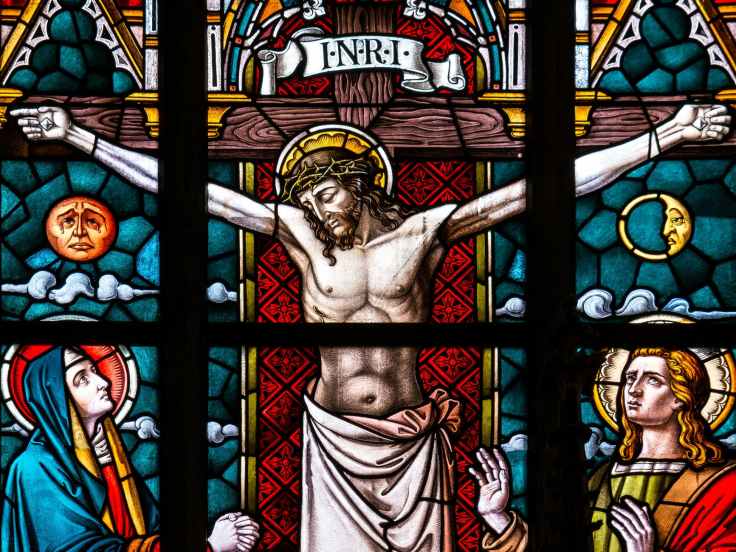
art cathedral christ christian
Photo by Pixabay on Pexels.com

“For God demonstrates his love for us that while we were yet sinners, Christ died for us.  Much more then, having now been justified by His Blood, we shall be saved from the wrath of God through him.” (Romans 5: 8-9)

And all you have to do is believe that it is true and, believing, trust that God is at work in you and your life through Jesus Christ.  

“For by grace you have been saved through faith; and this is not of yourselves but is the gift of God, not the result of works, that no one should boast.  And we are His workmanship created in Christ Jesus for good works that God prepared beforehand that we should do them.”  (Ephesians 2:8-9)

This the gospel.

And you may recall what Jesus had to say at the beginning of Mark:

The time is fulfilled and the kingdom of God is now; repent and believe in the gospel


Unexpected Provision

person offering orange fruit to a deer during day
Photo by Chris Czermak on Pexels.com

Read Mark 6:32-52

I think that most Christians experience the Bible in bits and pieces.  They listen to a sermon here they see a scripture verse on a t-shirt there. Its all very piecemeal.  Even if you go to Church every Sunday morning you wouldn’t experience the whole of scripture in a year.  Your church could be one that follows the Common Lectionary (a 3 year cycle) with every single reading done each week and you could read every single additional daily reading and after 3 years you still would not have seen every single verse in the Bible.

I mention this because getting our scripture as we do in bits and pieces we get our understanding in bits and pieces as well.  That’s partly why this blog is working through a single book systematically rather than jumping about.  My hope is to help all of us, myself included, read a book of the Bible straight through and get the feel for the whole rather than just a bit here and there.

Some things are richer in the sum of the parts. Some things are different.  Dark Side of The Moon, the Pink Floyd album, was released the year after I was born.  It was the #1 album in the United States for a bit but then simply remained on the charts for over 740 weeks (14 straight years!) after a brief drop it returned to the Billboard top 200 and for all intents and purposes has never left.   It has a couple of tunes that you probably know and some others that you would recognize if you heard them.  The most successful single is entitled Money.  My personal favorite is Time.  Both of those songs are great but listening to the entire album start to finish is a different experience.  When it was an actual vinyl album each side was one continuous piece of music drifting in and out of the songs until the needle reached the end.  The sum was different than the parts.

So it is with a book of the Bible, the sum is greater than the parts.  At the end of Chapter 6 we find two stories of Jesus that are usually encountered separately but have another meaning when brought together.  They are the feeding of the 5000 and Jesus walking on water.

Speaking of hearing stories one after another, just encountering the feeding of the 5000 after the tale of John the Baptist’s death conjures up all sorts of comparisons and contrasts.  The opulence of Herod’s party versus the simplicity of the gathering in the wilderness. The death that ends that gathering versus the life sustaining element of the loaves and fishes.  The ruler who kills versus the ruler who provides.

And it is Jesus that provides.  A crowd has gathered to see these disciples who have been going out teaching, performing exorcisms, and healing the sick.  They naturally also want to see the one who has sent them out in the first place, Jesus.  By the way the size of the crowd is sort of mind boggling.  It is recorded as around 5000 men.  Archeologists estimate that a typical village or town in the region like Bethsaida or Capernaum numbered no more than 3000 people. If CNN had existed this gathering would have made the news!  It did make the oral tradition of the early church that culminated in 2 different strands, the synoptic gospels and John.  With crowds like that you can begin to see why everyone knew who Jesus was by the time he went to Jerusalem for the last time.

Mark writes that when they encountered the crowd that Jesus took pity on them and started to teach them because they were “like sheep without a shepherd.” This is a huge hint for how Mark intends for the story to be heard by us.

Moses towards the end of his life prays that the people will be given a new shepherd in the wilderness to lead them into the promised land.  God calls Joshua for this purpose.  Incidentally, in the Greek translation of the Old Testament called the Septuagint, Joshua is rendered as Jesus.  The prophet Ezekiel delivers an oracle where God speaks judgment against the priests and leaders of the people of Israel for failing to be good shepherds.  Instead of relying on them the LORD promises to gather the people himself and place over them a shepherd who is from the line of  David to care for them.

This is the background of what is happening next and what Mark wants us to be aware of when we encounter this feeding in the wilderness.  Of course, there are other allusions like God providing sustenance through quail and manna during Exodus.  There is the feeding and providing for Elisha and Elijah in the wilderness as well.

So it gets late.  The disciples are mindful that the crowd needs to go home because who wants 5000 HANGRY people on your hands?  No one does, obviously.  Ask Marie Antoinette, bad things happen.  So they gently suggest to Jesus that he needs to wrap it up so that the multitude might go into the neighboring towns and overwhelm the local restaurants.

Jesus suggests that the disciples should feed them.  He gets some sarcasm in return.  What are we supposed to spend 200 denari on bread?  Basically, where are we gonna get that kind of money? If you are curious the amount quoted was roughly the annual wages of a day laborer.  The argument was escalating quickly.

As you probably know, Jesus asks them what they have and they come up with 5 loaves of bread and 2 fish.  Jesus blessed the meal looking up to heaven and had them distribute and everybody ate until they were satisfied.  There was even left over bread and pieces of fish.  We don’t know specifically how it happened but that isn’t the point.

Now taken by itself this story has a lot to teach / remind the believer about the nature of God.  “The Earth is the Lord’s and all that it contains” the Psalmist writes.  So naturally God can multiply any resource to match the need.  A later Psalmist shares that “YOU open your hand and satisfy the desire of every living thing.”  This is a story that urges us not to be afraid for our provision for our God provides.  It is a story that teaches believers that when they see a great need around them that encouraging the need to go away will only result in God saying “NO.  You feed them.” Whether individually or collectively it is a message that we all need to be reminded of from time to time.

Have you been afraid of how you might make ends meet lately?  How might it look if you gave that fear to God and trusted in gracious provision?

Has your Church been arguing about the financial wisdom of taking on a new mission or ministry? How might it look if they stepped out in faith with their 5 loaves and prayed for God to provide for the need they see?

This is not the only message that is present in this story though.  The unspoken question is who is this person in the middle who prays and bread and fish become inexhaustible?  Mark in alluding to the “sheep without a shepherd” begs us to ask ourselves this question.  Who is Jesus?

Very quickly after the baskets of left-overs are collected, Jesus sends the disciples off in the boat while he also departs to go pray.  The nature of this miracle is that the disciples dispersing the food would have realized what was going on long before the crowd figured it out.  Jesus wants everyone to get going before he has to deal with 5000 people who are now satiated and would expect more miracles from him.

Over night a storm whips up on the waters as the disciples are making their way to the other side.  Imagine how tired they had to have been.  Spent the day dealing with crowd control, arguing with Jesus, distributing and collecting the food, and now having to row against the wind and waves of a storm.  The storm and their exhaustion must have been awful because when they see Jesus walking toward them at 3AM they are convinced that they are seeing some sort of ghost.

Jesus tells them to not be afraid (the first thing that the messenger of God always says) and reveals himself to them.  He gets in the boat and the storm settled and they were amazed. That in itself is pretty amazing as they have already experienced Jesus waking up in the boat and commanding a storm to stop.

Psalm 107 reads “He caused the storm to be still so that the waves of the sea were hushed” and Job says to his friends regarding God, “who alone stretches out the heavens and tramples down the waves of the sea”.

Jesus is for the second time in Mark 6 disappointed in people.  In Nazareth he marvelled at the disbelief of the people there and now in the boat his own disciples “had not gained any insight from the incident of the loaves, but their hearts were hardened.”  That last turn of phrase is Bible speak for being spiritually blind.

When Jesus gets into the boat he says in Greek “Ego Emi” and this little phrase is so perplexing.  On the one hand it means simply “I am” or in this case “it is I”; just what anyone might say about themselves at any time.  On the other hand it is also the Greek translation of the name of God that Moses received at his encounter with a bush that burned but was not consumed.  The name of God, YHWH, or  “I AM”.  Is it possible that when Jesus was getting into the boat (having been tramping down the waves as Job describes) what he actually said to the disciples was “Fear Not for I AM”?

The two stories together certainly lead to a conclusion that it had been the intention of Jesus to reveal to his disciples through the loaves incident and the calming of the water that he was the One that had been promised long ago.  For Mark, who intends for us to read his book as the beginning of the good news of Jesus Christ the Son of God it becomes another piece of evidence about who Jesus is ultimately.  That it comes in a chapter that starts with the troubling disbelief of the people in Nazareth and ends with the disciples also not understanding it begs the question to each of us– do you get it?  Do you understand who this is before you?

No matter where you are in life right now,  perhaps you are unemployed because of the Coronavirus or are simply feeling the long term effects of social isolation.  Maybe you are struggling financially or dealing with depression or addiction.  You might have cancer or some other chronic illness.  You may be estranged from your children or flailing in an unhappy marriage.  There is no end to the struggles and trials that we can face in this life, but remember who it is in whom you believe, Jesus Christ.

Your God is the one who graciously provides for every living thing from his own hand.  Are not you more important than the animals, the insects and the plants?

Your God is the one who walks upon the waves and calms the storm with a word.  Can God not counter that which you fear most?

Your God is the one who conquered death through resurrection and promises that all who trust in Him need never fear death again.  What do you have to lose by trusting in Him?

Whatever it is, whatever the circumstance, whatever the fear, wherever you are in your heart on the question of who Jesus really is give it to God.  Begin to pray, ask God to open the eyes of your heart to see the work that He does in secret all around you and learn to trust Him deeper and deeper.  Do not be like the people in Nazareth who never took the first step in belief.  Do not be like the disciples who walked along with him and struggled to realize the truth.

It starts simple, just open yourself to the possibility that Jesus is who he says he is.  Follow that thought and listen to what the Lord shows you.  Go where he leads you literally and spiritually.

Follow the one who “opens his hand and provides for every need.”

He Marveled at Their Disbelief


Read Mark 6:1-32

“He could do no miracles there except laying hands on a few sick people and heal them; and, he wondered at their lack of faith.”

This is the description Mark has for Jesus’ time in Nazareth teaching in their synagogue on the Sabbath. It is remarkable because of all that Jesus has done in the Gospel of Mark thus far: healing the sick, casting out demons, wakening a girl from death, commanding the weather.  News of these things surely would have reached Nazareth.

We know that some found his teaching exceptional because they wonder where one of their own “got this stuff” in the first place.  They know the family, his parents, his brothers, and his sisters. They haven’t had any reason to suspect that that family was gonna produce someone like Jesus.

Mark in just a few verses lays out a very human experience for Jesus.  He is judged by the people he grew up with and the provincialism of his hometown places restraints on him.  Many people can relate to this “who does this guy think he is?” experience.

To be clear the lack of miracles is not an indictment on Jesus.  The power of God is not limited by lack of belief, that is not the message to be drawn from this story.  In a few chapters, Jesus will say that “nothing is impossible for God” and even before this he commanded the sea to be still despite the disciples’ fear and lack of belief.

And yet, in so many of the healing stories in Mark faith is commended.  “Your faith has made you well” is a consistent refrain.  We can be forgiven for coming to the conclusion that faith is a key component.  I don’t believe that Mark has shared with us about this rejection to imply that God is limited to only helping those who believe in Him but I do think that Mark wants us to wrestle a little with disbelief.

When my children were young we lived in Corpus Christi.  One afternoon the excitement at our house and our neighbor’s house across the street was that a dog was stuck in a tree.  That is not a typo there was a dog in the tree.  I do not know where it came from, I do not know if it chased a squirrel, or how it managed to be there in the first place.  I simply know that when my young son came and told me to come quick because there was a dog in the tree it was not a Mulberry Street moment.

For those of you who are struggling with picturing this, it was not a straight up and down kind of tree like an Oak or an Elm.  Because of the more or less constant wind trees grow a little crooked all the time in South Texas.  This tree had a long trunk that grew sideways for some distance so I am pretty sure that this sure-footed dog had chased something up into the tree.  But make no mistake it took a ladder in the bed of a pick-up truck to get high enough to grab the frightened fellow in a blanket and get him down. He was high up in the tree in the sort of place that only cats or squirrels usually go.

I cannot prove to any one this story is true.  I know the names of a few witnesses.  I have the little “book” that my son made after the fact that he entitled How Many Aggies Does it Take to Get a Dog Out of a Tree. Some of you who are reading this will not accept my word for it because dogs just don’t climb trees. You do not trust me enough to believe me even though I know what I saw and remember getting the dog down.

God has this same problem.  Faith is trust between two parties.  You may choose to not trust the story God is telling us about what he has done for us.  When we choose to reject the story we are demonstrating our disbelief.

Are you struggling to accept God’s love for you?

Do you wonder if trusting Jesus can make any difference in your life circumstances?

The rejection in Nazareth reminds us that some people will miss out on what God is doing in their midst because it comes in the every day and the mundane.  To them, Jesus had no chance to be a great teacher or a miracle worker because he was always gonna be the boy who grew up working with his hands alongside Joseph. It didn’t matter what they heard from neighboring towns or even what they heard that day in the synagogue, they knew what they knew and instead of accepting the truth in front of them they chose to get mad.

This happens to churches and denominations all the time.  God begins to do some good stuff, some times miraculous stuff, and the kabosh is put on it quick by counsels, committees, etc. because of fear of what changes may come.  This happens to individuals who miss the teaching and wisdom of God because it is coming through the ordinary and the mundane.

Have you stopped listening on Sunday mornings because you think you already know what will be sung, prayed, and taught?

Have you quit seeking the Kingdom of God through scripture and worship because it all seems so just like it has always been?

Have you given up on asking for big things from God because you aren’t sure God cares any longer?

God wants our trust.  When the Israelites were gathered at the foot of the mountain awaiting the Ten Commandments, they ended up getting distracted and made an idol to worship since God seemed too busy and was invisible.  God was very angry and really wanted to just get rid of them all and start over with some other group of people. Moses told God, “Look here, Pal, I didn’t do all that stuff you asked me to in Egypt where I was a felon and trekked across the desert with those ingrates and climb this big ole mountain by myself for you to just change your mind!” (clearly I am paraphrasing) So God relented and a covenant was formed between the Israelites and God.  That covenant was formed around the law and the first commandment ushered in tells us about what God wants.

I am the Lord your God.  You will have no other gods except me.

God wants an exclusive relationship.  He wants to “go steady” with us, as they used to say.  He wants our faith and trust that he did act, does act, and will act for the future of all creation.  He wants our commitment to Him.

It wasn’t that Jesus couldn’t heal any one in Nazareth.  Jesus didn’t want to because he was being rejected.  The power of God was not diminished it simply wasn’t going to be wasted in a town that didn’t want to accept the truth in front of them.  No doubt what Jesus had taught that day in the synagogue was a variation on what Mark tells us his message was “The time is now and the Kingdom of God is among you. Repent and believe the Gospel.”

So the lack of faith resulted in God not wanting to act.  Just like at Sinai when the lack of faith made Him so angry he wanted to call off the whole make a covenant with the people plan. Just like the seven churches in Revelation that have their lampstands removed (the Light of the World taken from them) because of their lack of faith.   Suddenly, it doesn’t seem as harsh when Jesus instructs the 12 that if any town does not receive them or listen to them they are to dust off their shoes and move on as a testimony against them.

God will work wonders where He is welcomed, recognized, and trusted.

I think this also explains why Mark has injected the story of the death of John the Baptist into this section.  This may not seem odd; after all, John is an important figure and the first person we encounter in the gospel. True. Consider this, in a book that only has 678 verses, Mark uses 16 verses to tell this story.  In contrast it only takes 7 versus to introduce John the Baptist and his ministry.  Mark only uses 3 versus to describe the baptism of Jesus!

And the story comes in-between the verses where Jesus sends his 12 most trusted disciples out on their mission (to preach the gospel, heal the sick, and cast out demons) and when they come back and tell him how it went.  We get almost no detail into the mission.  We don’t learn which villages got the shoe treatment.  We don’t know any statistics for how many were baptized, how many were healed, how many demons were cast out, etc.  But we do get an in-depth look at how it came about that John the Baptist’s head wound up on a platter.

So it seems that John the Baptist was imprisoned because during his ministry preaching about the need for the repentance of sins he often raised the point that Herod was a bad example to the community through his relationship with his brother’s wife.  It is not always safe to call into question the activities of a high official even when you are right. True today and true back then.

Mark tells us that Herodias, the wife, held a grudge against the Baptizer, but Herod was afraid because he knew “he was a righteous and holy man”. So Herod kept John safe.  Mark goes on to share that whenever Herod heard John speak he was perplexed and even enjoyed listening to him.

Seems that Herod was hearing the message, felt the stirrings of conviction, but was afraid of the implications to his current situation.  If Herod were to convert it might make trouble for him with Rome.  If Herod were to convert it would clearly make trouble for him with the missus.  So he chooses not to and then finds himself in this circumstance where a carelessly delivered promise in the midst of a party with prominent folk leads to the unnecessary death of John.  Consequences.

And that I think is the secret to this portion of the Gospel of Mark.  Our lack of trust in God, our failure to believe has real consequences for our lives.  Our lack of faith can cause God not to act like he chose not to in Nazareth. Our collective disbelief may cut off an entire community from the blessings of God like those the disciples were told to shake the dust off their feet rather than continue to labor there.  Our further disbelief, the choosing to believe in our position, status, or the upholding of ill-considered oaths may lead us to deeper depths of sinfulness at the expense of other people.  Our disbelief can cost us the privilege of taking part in the resurrection of the people of God on the last day.

Disbelief may cost momentarily; disbelief will cost us eternally.

If you are struggling with the truth about who Christ is or if you believe but struggle with where to find God right now, I encourage you to take on this simple prayer from a little later in Mark’s Gospel:

“I believe Lord help my unbelief”

Website Powered by WordPress.com.

Up ↑