Search

The Hypocritical Christian

Month

October 2024

Wrath of God vs Thankfulness

Read Romans 1:18-25

I am so glad that you chose to open this post because there are two very important things that we are going to learn together about living a transformed life empowered by the Holy Spirit. First, a common misconception about God will be dispelled. Second, we will learn step one in relating to God.

If this is your first time to the Hypocritical Christian, then “Welcome!” We are currently on a journey through Paul’s letter to the Romans. If you wish to start at the beginning, you can do so by going to this post. Our goal is to unpack what Paul meant when he wrote that we are rather to be transformed by the renewing of our minds.

If you are a regular reader of the Hypocritical Christian, then “Thank you!” Please consider subscribing to the email list if you haven’t already. Back to Romans 1:18-25

When you hear the phrase “wrath of God,” what comes to mind? The aftermath of Hurricane Helene whose rains brought devastation to the Appalachian Mountains of North Carolina recently? Do you picture the End of Days with the four horsemen of the Apocalypse riding roughshod on the world? Many of you will think of something like this classic comic from 40 years ago:
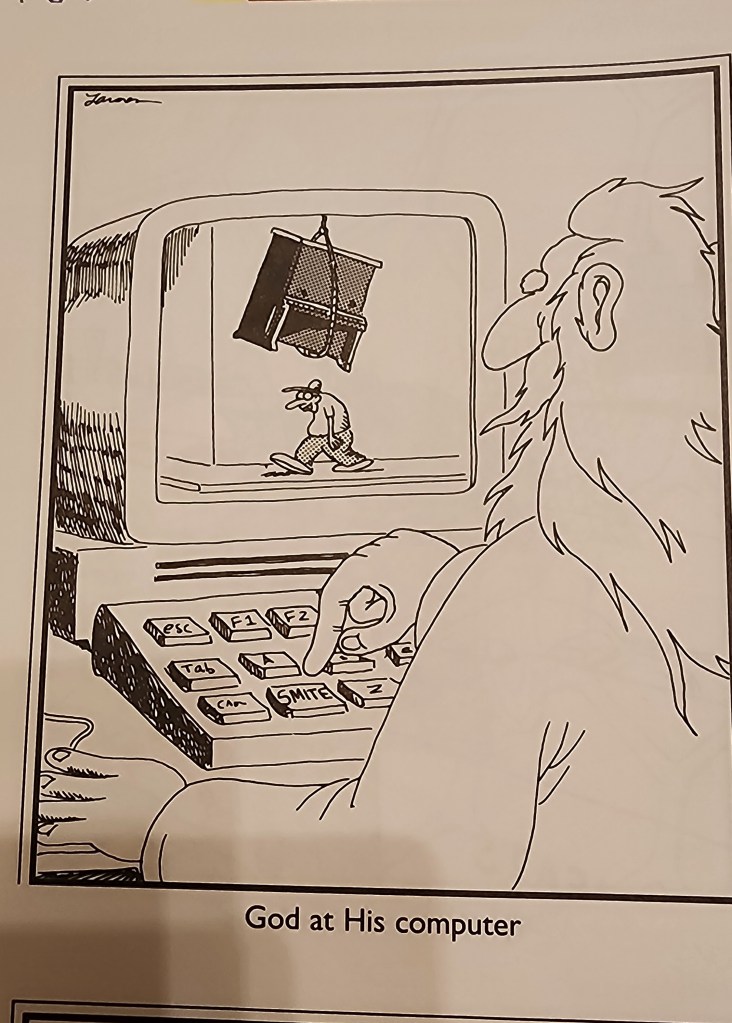
The strip is funny because it speaks to a misconception about God that is prevalent even among believers. The stereotype of God is that he is waiting to lash out against us, if not capriciously, after a multitude of offenses pile up. This is not the God that is presented in scripture. Now some of you will argue with that and say the God we see in the Old Testament is wrathful and hateful. The same people will suggest that Jesus is a different God who is full of mercy, love, and acceptance. Those who say these things haven’t read the scriptures closely, if at all. They also have a very shallow understanding of grace and mercy often equating acceptance and acquiescence with forgiveness.

We have seen that Jesus himself instructs us to be merciful like the Father is merciful. The Old Testament does teach that God has standards and expectations of those who choose to be in relationship with him, but he is not perpetually vacillating between the choice of smiting and pardoning. This is a caricature at best that leads us nowhere closer to understanding the nature of God. I could go through countless Old Testament examples but suffice to share three scriptures that directly contradict the misconception.

Seek the LORD while he may be found.” (Isaiah 55:6)

Because of God’s great mercy we are not consumed.” (Lamentations 3:22)

Jesus Christ is the same yesterday, today, and forever.” (Hebrews 13:8)

Jesus spoke on the nature of natural disaster and accidents when he chastised the crowd, “Do you think that those eighteen on whom the tower in Siloam fell and killed them were worse offenders than all the other people who live in Jerusalem?” (Luke 13:4). These things happen and the takeaway according to Jesus is that it should be a wake-up call for all that life is short, so best to get right with God without further delay.

Some of you will say, well Michael, that’s all well and good about the cartoon and natural disasters but the Four Horsemen IS biblical. That it is, but there is a difference between God’s judgment and God’s wrath. The scriptures are clear that there will come a Day of the Lord when the divine patience will have become fulfilled, and the final judgment is to occur. This is when sin and death will be no more and all will have to face the judgment of God, the second death. To this we should again take Jesus words to heart, for after having compared the End of Days coming like a thief in the night, he urges us: “you too, be ready, for the Son of Man is coming at an hour that you do not expect” (Luke 12:40).

The wrath of God is something altogether different according to Paul. If a person chooses to ignore the truth about God (or, chooses to reject the role of creation to the creator) then God will grant them their wishes. He will withdraw leaving them to their own devices and foolish thinking. “Therefore, God gave them over in the lusts of their hearts to impurity so that their bodies would be dishonored among them. For they exchanged the truth of God for the lie and worshipped and served the creature rather than the Creator who is blessed forever. Amen” (Rom 1:25).

What are we to do then? How do we assure that we do not become abandoned by God and left to our own clouded thinking? Like so much of scripture, the answer is both simple and difficult. Nestled amidst these verses is the simplest and first step in a relationship with the LORD. “For even though they knew God, they did not honor Him as God or give thanks

When my children were young, I often said to them “dogs got to bark, birds got to fly, and fish got to swim. You need to learn what you got to do.” Now chances are good that it went in one ear and out the other. And at different times in a person’s life, one may think of it as a call to consider the right path forward or to learn their natural vocation. These are important things, but the saying is really about the natural purpose of a person. A dog cannot help but bark. Almost all birds are meant to fly. Every fish swims. People are also part of the created order. We have something intrinsic to our being that we are meant to do. That something is to acknowledge God as Creator and to give thanks. It is useful here to be reminded of Psalm 100:

Shout joyfully to the Lord, all the earth.
Serve the Lord with gladness;
Come before Him with joyful singing.
Know that the Lord Himself is God;
It is He who has made us, and not we ourselves;
We are His people and the sheep of His pasture.

Enter His gates with thanksgiving
And His courts with praise.
Give thanks to Him, bless His name.
For the Lord is good;
His lovingkindness is everlasting
And His faithfulness to all generations.

THIS is our first purpose, our prime directive. We are to know God as God and give thanks. The cats that wrote the Westminster Catechism put it this way in the very first question / answer combo saying that the chief end of humanity is “to glorify God and enjoy Him forever”. Wise counsel that.

The photo above was taken by my son on a recent trip into the American West. As Paul writes that “since the creation of the world His invisible attributes, His eternal power and divine nature, have been clearly seen, being understood through what has been made, so that (we) are without excuse” (Rom 1:20).

The truth of God is all around you. Understanding who Jesus is, what salvation and redemption means, and all that the New Testament shares is best understood from this starting point. We have to acknowledge that there is a God, that we are a part of his creation, and that He is worthy of our praise and thanks. Jesus once spoke of a wide way and a narrow way. One is easy but leads to destruction. The other is narrow but leads to life. The easy one is conformity to a world whose base assertion is that there is no God or if there is it doesn’t matter. That path leads to idolatry. The narrow one starts with acknowledgment that we are not God, that we are his creation, and that our proper stance is thankfulness and praise. This path leads to transformation and life.

Next month is November. In the United States it is a month that includes the national holiday of Thanksgiving. In recent years, that holiday has been overshadowed both by Halloween and Christmas (and of course shopping!), a sign of idolatry at work. Why not take the opportunity to turn November into a month where you are intentionally thankful to God every day? Psychologists say that it takes 30 days to cultivate a habit. How providential it is that November as 30 days! I encourage you to start each morning in November with thankfulness expressed to God. You can start with being thankful for another day in this life. Soon you will find yourself thankful for so much more! Make this November your season of gratitude and see what our Lord teaches you.

Peace to you on your own journey; Vaya con Dios!

In the next several posts we will take a look at the principal idols of our day that seek to conform us, but that is for next time. Thank you for reading. If this post blessed you, please share it with someone else. As always it is freely given. You are welcome to use it although it would be nice if you credited where it came from.

The Power of the Gospel

Read Romans 1: 16-17

Why is the Gospel so important? Paul says that it is the power of God for salvation to everyone who believes. Think about that for a moment. Paul says that it is not the power of salvation alone, but the very power of God!

The power of God? The greek word is dunamis; the root from which we get the words dynamic, dynamo, and dynamite. The power of God is something awesome and explosive. That should come as no surprise. The power of God created all that we perceive through his spoken word. The power of God parted the Red Sea. The power of God caused the Israelites to tremble in fear as God descended upon Sinai. That’s just a few instances from the Old Testament. In the New Testament, we see the power of God still storms, cleanse lepers, change water into wine, and raise Jesus from the dead. The power that did all of that, Paul says, is the same power that is inherent in the gospel.

Gospel means good news. Euangellion (where we get our word evangelism) is the singular form of the word. The plural form of the word was a common greeting in the Roman world. It was the equivalent of saying “good tidings” to a stranger or a friend upon meeting. The Christians used the singular form very early to express, in one word, the work and resurrection of Jesus.

They chose this word, because the singular form was used by Greek translators for Isaiah 61:1:

“The Spirit of the Lord is upon me because YHWH has anointed me to bring good news (gospel) to the afflicted; he has sent me to bind up the brokenhearted, to proclaim liberty to the captives and freedom to the prisoners; to proclaim the favorable year of the LORD and the day of vengeance of our GOd…”

You may recall that this is the portion of the scroll that Jesus reads in the synagogue of Nazareth (Luke 4) and when it comes time to provide the commentary on the passage he says, “Today this Scripture is fulfilled in your hearing.” The work of Jesus Christ is the fulfilment of the prophecies of Isaiah about how YHWH would set the world to rights.

When the followers of John the Baptist come to Jesus and ask for confirmation that he is the one to come Jesus replies, “Go and tell John what you have seen and heard: the blind receive sight, the lame walk, the lepers are cleansed, the deaf hear, the dead are raised up, and the poor have the gospel preached to them. Blessed is he who does not take offense at Me.” (Luke 7: 20-23). Essentially, Jesus says do you not see the prophecy of Isaiah playing out in my actions and words?

Paul says he is not ashamed of the Gospel because it is the power of God for salvation. When he says he is not ashamed he likely is referring to the above comment from Jesus and a similar sentiment expressed in Luke 9: 26. The stakes are high for those who choose not to believe the Gospel.

Isn’t it amazing to consider that the very power of creation is available to those of us who believe in Jesus Christ? Remarkably, that is what scripture teaches us. When we profess our belief in Jesus Christ as Lord and Savior (another shorthand for the work and resurrection of Jesus Christ), we are empowered by the very same power that raised him from the dead! You might even say that we are given the power to be transformed (rather than conformed) into something new. We are given the power to live the life of the World to come in the here and now.

The gospel is available to all. This is precisely what Paul means when he says the gospel is for all who believe, to the Jew first and also the Greek. In Jewish though there were two broad groups of people. You were either a Jew (the people of God) or you were everyone else. Because the world in his day was dominated by the culture of Greeks, they were the ethnicity that was chosen to represent the gentiles, meaning all non-Jews. So Paul means the message and the power is meant for the benefit of all. It is universal.

Too often Christians, particularly Western Christians raised in a culture that promotes the importance of the individual, limits this salvation and power simply to the gift of eternal life. Many Christians are only interested in getting into heaven. They want the equivalent of fire insurance! This salvation we experience certainly includes the gift of eternal life. It is also being able to bring all of our concerns (shelter, food, clothing, health, etc.) to the hearing of God. Salvation is the meeting of our needs and the peace that we can have during trials and tribulations. The thing that is often neglected though is that it is more than our individual concerns and needs being met, it is even more than the collection of all of our individual concerns, it is the victory of God over sin and death. The correction to the carnage that our collective sin has unleashed on the world throughout history.

A careful reading of the Old Testament reveals that the purpose of the calling of the Israelites out of Egypt, and the covenant made at Sinai that established them as the people of God, was for the faithfulness of God to continue the blessing promised to all the nations of the earth through Abraham. That’s not the end of the purpose though. As we saw in a previous post, it was also to eventually complete the promise made to Eve by bringing forth Jesus at the right time to achieve the solution to sin.

“He made him who knew no sin to be sin on our behalf, so that we might become the righteousness of God in Him.” (2 Corinthians 5:21). The very righteousness that Paul says is revealed in the gospel from faith to faith. What does that mean?

Scholars agree that Paul quotes the prophet Habakkuk. The prophet says that he will stand at the rampart and await the word of YHWH. He is answered by God, “For the vision is yet for the appointed time; it hastens toward the goal and it will not fail. Though it tarries, wait for it; for it will certainly come, it will not delay. Behold as for the proud one, his soul is not right within him; but the righteous will live by his faith.

The proud person is the one who relies not on the LORD but on their own strength. The proud ones are those who trust in their own righteousness. God says that the righteous though will live by faith.

Why faith to faith? Paul clearly indicates here that there are two faiths at work and that one faith is transferred or passed to another. There are different ways to understand this when taken in isolation. Later in Romans, Paul will ask how anyone can come to proclaim Christ as Lord without hearing the gospel? So, one understanding would be that faithful Christians must share gospel truth to others that they too might confess Christ and experience salvation.

There is little doubt that we are to tell others about our faith in Christ. This is a consistent message of the New Testament, one could even say that it is the mission statement of the Church given that Christ says to “go out into all the world making disciples of all nations…“; however, this is not the meaning that Paul intends. “From faith to faith” is the faith of Christ to the faith of us.

Look again at the verse from 2 Corinthians above. Christ was made sin that we might be made righteous. To this add what Paul wrote to the Philippians explaining the unsurpassable value of knowing Christ, “not having a righteousness of my own derived from the Law, but that which is through faith in Christ, the righteousness which comes from God on the basis of faith…”. This interpretation is made only more likely when we consider that the Greek translation of Habakkuk reads “The righteous one will live by his faith.”

As we will see later in our journey through Romans, Christ is the righteous one, the only sinless one, and his faithful life has accomplished what neither Israel nor anyone else could have done. Through him there is a path to righteousness from God that also justifies us in the sight of the Lord. Sin separates us eternally from God. Christ’s death and resurrection reverses this reality for those who believe.

Won’t you choose today to believe in who Jesus is and what he has done? Now is the time to invite the power of the gospel to transform you forevermore.

A final thought for those who already have put their faith and trust in the Lord Jesus Christ. The passage in Habakkuk is also quoted in Hebrews. There it used to remind the faithful (those who live in the sphere of the Spirit) that they must persevere because of the promised return of Christ. Beginning in 10:36 we are told “For you have need of endurance, so that when you have done the will of God, you may receive what was promised ‘for yet in a little while, He who is coming will come, and not delay. But my Righteous One shall live by his faith; and if he shrinks back, my soul has no pleasure in him. We are not those who shrink back to destruction but those who have faith to the preserving of the soul.”

May it be so among us!

Vaya con Dios!

Feel free to use this Bible Study for your own groups or discussion.  It is freely given. If you do I merely ask that you acknowledge where you got it and if you find it useful that you encourage others to seek it out. It is freely given and written with fear, foreboding, and prayer by a fellow hypocrite who is simply trying to figure out the road ahead.

Website Powered by WordPress.com.

Up ↑