
Read Romans 1:18-25
I am so glad that you chose to open this post because there are two very important things that we are going to learn together about living a transformed life empowered by the Holy Spirit. First, a common misconception about God will be dispelled. Second, we will learn step one in relating to God.
If this is your first time to the Hypocritical Christian, then “Welcome!” We are currently on a journey through Paul’s letter to the Romans. If you wish to start at the beginning, you can do so by going to this post. Our goal is to unpack what Paul meant when he wrote that we are rather to be transformed by the renewing of our minds.
If you are a regular reader of the Hypocritical Christian, then “Thank you!” Please consider subscribing to the email list if you haven’t already. Back to Romans 1:18-25
When you hear the phrase “wrath of God,” what comes to mind? The aftermath of Hurricane Helene whose rains brought devastation to the Appalachian Mountains of North Carolina recently? Do you picture the End of Days with the four horsemen of the Apocalypse riding roughshod on the world? Many of you will think of something like this classic comic from 40 years ago:
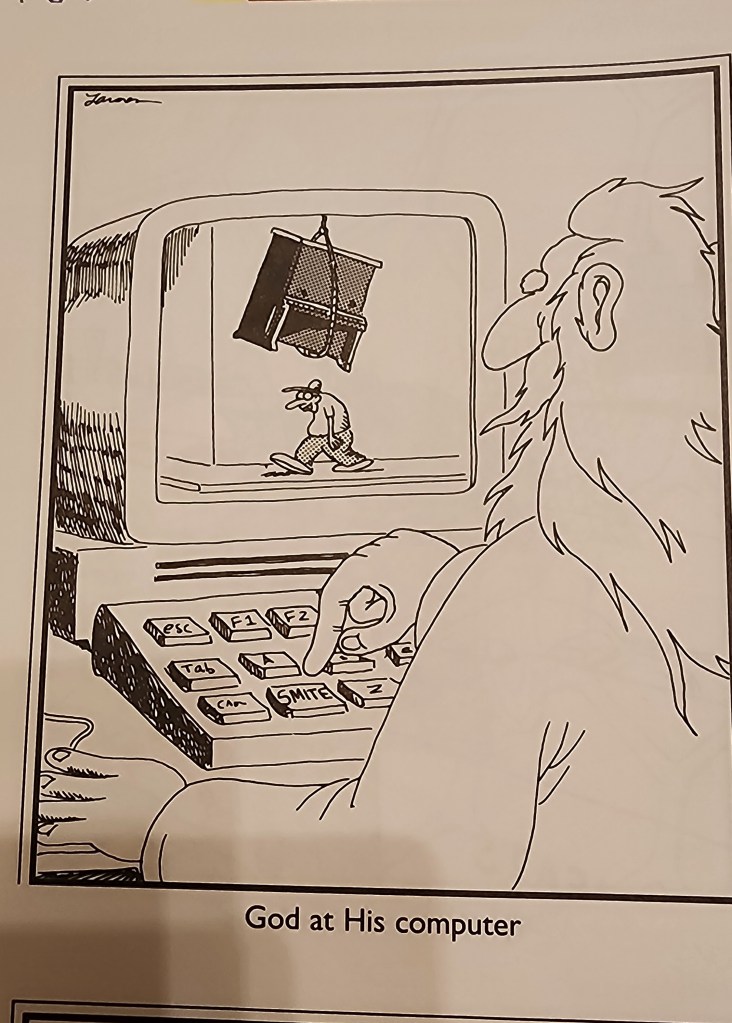
The strip is funny because it speaks to a misconception about God that is prevalent even among believers. The stereotype of God is that he is waiting to lash out against us, if not capriciously, after a multitude of offenses pile up. This is not the God that is presented in scripture. Now some of you will argue with that and say the God we see in the Old Testament is wrathful and hateful. The same people will suggest that Jesus is a different God who is full of mercy, love, and acceptance. Those who say these things haven’t read the scriptures closely, if at all. They also have a very shallow understanding of grace and mercy often equating acceptance and acquiescence with forgiveness.
We have seen that Jesus himself instructs us to be merciful like the Father is merciful. The Old Testament does teach that God has standards and expectations of those who choose to be in relationship with him, but he is not perpetually vacillating between the choice of smiting and pardoning. This is a caricature at best that leads us nowhere closer to understanding the nature of God. I could go through countless Old Testament examples but suffice to share three scriptures that directly contradict the misconception.
“Seek the LORD while he may be found.” (Isaiah 55:6)
“Because of God’s great mercy we are not consumed.” (Lamentations 3:22)
“Jesus Christ is the same yesterday, today, and forever.” (Hebrews 13:8)
Jesus spoke on the nature of natural disaster and accidents when he chastised the crowd, “Do you think that those eighteen on whom the tower in Siloam fell and killed them were worse offenders than all the other people who live in Jerusalem?” (Luke 13:4). These things happen and the takeaway according to Jesus is that it should be a wake-up call for all that life is short, so best to get right with God without further delay.
Some of you will say, well Michael, that’s all well and good about the cartoon and natural disasters but the Four Horsemen IS biblical. That it is, but there is a difference between God’s judgment and God’s wrath. The scriptures are clear that there will come a Day of the Lord when the divine patience will have become fulfilled, and the final judgment is to occur. This is when sin and death will be no more and all will have to face the judgment of God, the second death. To this we should again take Jesus words to heart, for after having compared the End of Days coming like a thief in the night, he urges us: “you too, be ready, for the Son of Man is coming at an hour that you do not expect” (Luke 12:40).
The wrath of God is something altogether different according to Paul. If a person chooses to ignore the truth about God (or, chooses to reject the role of creation to the creator) then God will grant them their wishes. He will withdraw leaving them to their own devices and foolish thinking. “Therefore, God gave them over in the lusts of their hearts to impurity so that their bodies would be dishonored among them. For they exchanged the truth of God for the lie and worshipped and served the creature rather than the Creator who is blessed forever. Amen” (Rom 1:25).
What are we to do then? How do we assure that we do not become abandoned by God and left to our own clouded thinking? Like so much of scripture, the answer is both simple and difficult. Nestled amidst these verses is the simplest and first step in a relationship with the LORD. “For even though they knew God, they did not honor Him as God or give thanks“
When my children were young, I often said to them “dogs got to bark, birds got to fly, and fish got to swim. You need to learn what you got to do.” Now chances are good that it went in one ear and out the other. And at different times in a person’s life, one may think of it as a call to consider the right path forward or to learn their natural vocation. These are important things, but the saying is really about the natural purpose of a person. A dog cannot help but bark. Almost all birds are meant to fly. Every fish swims. People are also part of the created order. We have something intrinsic to our being that we are meant to do. That something is to acknowledge God as Creator and to give thanks. It is useful here to be reminded of Psalm 100:
Shout joyfully to the Lord, all the earth.
Serve the Lord with gladness;
Come before Him with joyful singing.
Know that the Lord Himself is God;
It is He who has made us, and not we ourselves;
We are His people and the sheep of His pasture.
Enter His gates with thanksgiving
And His courts with praise.
Give thanks to Him, bless His name.
For the Lord is good;
His lovingkindness is everlasting
And His faithfulness to all generations.
THIS is our first purpose, our prime directive. We are to know God as God and give thanks. The cats that wrote the Westminster Catechism put it this way in the very first question / answer combo saying that the chief end of humanity is “to glorify God and enjoy Him forever”. Wise counsel that.
The photo above was taken by my son on a recent trip into the American West. As Paul writes that “since the creation of the world His invisible attributes, His eternal power and divine nature, have been clearly seen, being understood through what has been made, so that (we) are without excuse” (Rom 1:20).
The truth of God is all around you. Understanding who Jesus is, what salvation and redemption means, and all that the New Testament shares is best understood from this starting point. We have to acknowledge that there is a God, that we are a part of his creation, and that He is worthy of our praise and thanks. Jesus once spoke of a wide way and a narrow way. One is easy but leads to destruction. The other is narrow but leads to life. The easy one is conformity to a world whose base assertion is that there is no God or if there is it doesn’t matter. That path leads to idolatry. The narrow one starts with acknowledgment that we are not God, that we are his creation, and that our proper stance is thankfulness and praise. This path leads to transformation and life.
Next month is November. In the United States it is a month that includes the national holiday of Thanksgiving. In recent years, that holiday has been overshadowed both by Halloween and Christmas (and of course shopping!), a sign of idolatry at work. Why not take the opportunity to turn November into a month where you are intentionally thankful to God every day? Psychologists say that it takes 30 days to cultivate a habit. How providential it is that November as 30 days! I encourage you to start each morning in November with thankfulness expressed to God. You can start with being thankful for another day in this life. Soon you will find yourself thankful for so much more! Make this November your season of gratitude and see what our Lord teaches you.
Peace to you on your own journey; Vaya con Dios!
In the next several posts we will take a look at the principal idols of our day that seek to conform us, but that is for next time. Thank you for reading. If this post blessed you, please share it with someone else. As always it is freely given. You are welcome to use it although it would be nice if you credited where it came from.




 The Hypocritical Christian