
Search

The Hypocritical Christian

Category

bible study

Dig Deeper

Read Mark 3:1-6

a_boulder

I don’t know if this is true of all kids but it certainly was true of me.  Some times I dug up rocks in the ground.  Whether I was looking for “skipping stones” or just goofing around I sometimes went looking for rocks. More than once, I started digging out a rock and soon realized that the rock was actually much bigger than the part that I had seen at ground level.  Now I live in the Texas Hill Country and if you dig at all in this area you soon learn there can be all sorts of rocks beneath the surface and even the seemingly smallest rock can suddenly be huge!

If you never start digging though the rock always just seems small and small rocks are manageable. Scripture can be the same way. You read a passage from the Bible and it seems simple and straightforward and small.  After doing a little more digging you figure out there is a lot more to it and it is heavy!

In the first three verses of Mark 3, we read a straightforward story. Jesus goes into a synagogue on the Sabbath and ‘yawn’ he is going to heal someone.  Simple, straightforward, nothing complicated: a man needs healing, it is the Sabbath, Jesus is going to do it, and its going to upset those pesky Pharisees all over again.  Really, Mark? we think, can’t you move on we have seen all this before already.  Blah, blah, blah Jesus heals on the Sabbath.  Jesus is Lord of the Sabbath.  We get it.  This story is a pebble.

That impulse isn’t limited to everyday readers of the gospel.  It happens to well-educated trained readers of scripture too.  In fact, you can probably already hear the sermons written from this passage in your head:

“Jesus was a radical who upset the political and religious authorities of his day by disregarding the rules in favor of caring for people in their time of need.  What rules do we need to flaunt today to continue the good work of our political revolutionary Jesus?”

“How are we like the Pharisees allowing our traditions to keep us from doing good or making worship a more inviting place for the weak, the weary, and the downtrodden.  Is not our emphases on music and liturgy a modern expression of the legalism of Pharisees?  How must we change to ensure that the grace of Christ is first and foremost?”  

“The Pharisees felt there power slipping away at the hands of this Jesus who did what was right in a moment when everyone else would not.  This is why they sought to kill him.  Fortunately, we would never make that mistake today as we would welcome Jesus and his miracles into our midst.”

O.K.  That last one is less likely to be preached, but you know you have heard the others.  And they come from a superficial reading of this passage.  Some Christians, mostly progressive, never get farther than considering Jesus to be a better Caesar Chavez.  Other Christians, mostly conservative, never get any deeper in these scriptures than judging the Pharisees for there legalism and failure to recognize the Messiah when he showed up.

Dig a little deeper, sweep away some dirt, find the bigger rock buried in the ground.

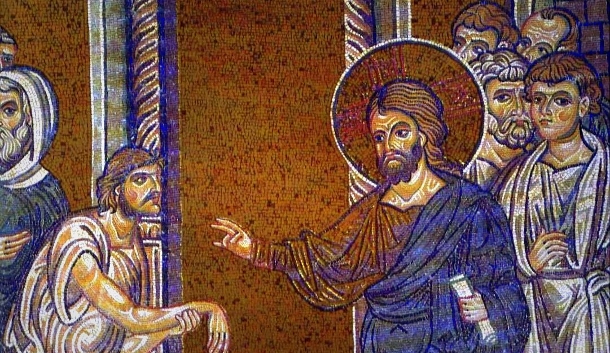
Jesus follows his habits, he is in worship on the Sabbath. (For modern Christians there is a whole sermon in the first sentence!) Mark tells us that there was a man with a withered hand present and that “they” were watching Jesus to see if he would heal him on the Sabbath. Jesus asks the man to come forward to the middle of the synagogue, the center of attention.  Here is where we get confused, because the man has been brought front and center we assume that the healing is the big deal.  But this man will remain anonymous throughout and Jesus is never going to comment on his faith.  This latter point is how we know Mark is telling us something different from the previous arguments about the Sabbath or healing events.  So much for the meaning of the text to be about the poor and needy.

Similarly Jesus begins addressing his detractors and he does so using the common parlance of the rabbis of his day: “Is it lawful on the Sabbath to do good or to do harm, to save a life or to kill?”  The first clause was a common interpretive argument of Rabbis predating Jesus and after.  It is a rhetorical question the answer to which must be: “Of course it is lawful to do good the Sabbath.”  Many rabbis had debated these things and it was determined that saving a life must take precedence over inaction in the law of God.  If we are to love our neighbors first and foremost then doing good is part and parcel of the Sabbath.  To put a modern spin on it, you naturally would have surgeons and EMTs work on the Sabbath.  It couldn’t be unlawful to aid an accident victim.  It would be appropriate to defend a lamb from a wolf on the Sabbath.

Christ-heals-the-man-with-a-paralyzed-hand-610x353

Back to the text: the Pharisees do not say anything.  Their silence upsets Jesus greatly.  Of course they don’t argue with Jesus because the question is rhetorical.  Naturally the Sabbath allows for life saving and other acts of good.  Of course, Jesus doesn’t stop with the basic question.  He has brought the man forward.  Between his question and the presence of the man he is implying that healing the withered hand is the equivalent of “saving a life” and failure to heal the withered hand is the equivalent of killing.  What?

Let’s be clear, Jesus is nobody’s fool.  He knows as well as anyone that the withered hand could wait a day or even 12 hours.  This is the key to understanding that the story is not simply about the perils of legalism or about the way that people become so rigid interpreting right from wrong that they fail to see the effect of such legalism on others.

Here is where the buried rock is revealed.

If you have been following this blog you know that I feel that scriptures are best understood in the broader context of the chapter / book that they are found in.  The Reformers (Luther, Calvin, Zwingli, etc) promoted the notion that scripture should be used to interpret scripture.  That is a great principle and scripture should be used to interpret other scriptures.  That said, it is also important that a reader of scripture first looks to the rest of the current book before jumping to other books in the Bible.  If you have been reading Mark (or this blog) then you know that Jesus is making a claim about the arrival of the Kingdom of God.  According to Jesus, the hour is now that God is acting.  In the healing of the paralytic there was the tacit claim that Jesus (as the Son of Man) has the authority to forgive sins (something that is YHWH’s purview) and in the conversations about Sabbath-keeping the implication is that Jesus is the Lord of the Sabbath (also the purview of YHWH). Throughout Mark, Jesus is saying look at this; see by what I do that what I say is true.

So many people describe the Gospel of John as Christocentric, but how can you miss the fact that in Mark the center of every story thus far and the focus of every point has been Jesus and who he is.  This gospel is extremely Christocentric.

Back to the paradox that healing the withered hand is not a matter of life and death. Robert Guelich, NT scholar, writes, “‘To do good’ and ‘to save a life’ takes on an eschatological ring of the coming of the day of salvation, the fulfillment of God’s promised activity in history.” God is acting, breaking into the world with the arrival of the Kingdom.  The kingdom is present wherever Jesus is present. I think that Jesus before the man in the synagogue is a moment where Mark wants us to recognize ourselves present in the presence of God. For Jesus to do good  / heal meant to give life and to refrain from good / not heal was to kill, meaning depriving another of the benefits of the redemptive / restorative power of God.  Failing to act would be cheating the man and all the gathered community of the right now benefits of the Kingdom of God even as they would have to wait for the ultimate fulfillment of the Kingdom. But the key is that the presence of Jesus brings life and changes things.

This is what we have seen throughout the Gospel of Mark.  A demon possessed man comes before Jesus and is made whole–saved–and Jesus demonstrates power over the forces of evil.  A paralyzed man is brought before him and made whole and Jesus demonstrates the power to forgive sin. A tax-collector is called into his retinue and redeemed from a sinful life and Jesus demonstrates the need for God’s Anointed to be amidst the sinners. Hyper-religious folk judge the followers of Jesus for not following the law more closely and Jesus proclaims an authority over the law itself.  Every aspect of Mark so far has been an effort to nudge the reader to make a decision about the true nature of Jesus. Is he the embodiment of the rule of God among us or not?

Every encounter from the demon possessed to the disciple; from the physically deformed to the self-righteous has been at its core a question of life and death because this is the moment that they have encountered Jesus. How each responded to that encounter is what has mattered most.

So how have you responded?  Have you acknowledged the truth of who Christ is?

How has your limited idea of Jesus prevented another from encountering Christ? If Jesus is just a great teacher why should anyone care? If he is a social radical then why should anyone make a decision for him rather than just see him as another Ghandi or Malcolm X?

Maybe you have chosen for Jesus and welcomed the encounter for yourself and your salvation.  Have your actions and your efforts encouraged others to know who He is?  Have you expressed forgiveness and grace to those whom you see as sinners? Or are you silent in the face of this life and death moment for others?

Maybe you have called out to God in your hours of need, a cancer diagnosis, a child who is sick, or a loss of  job. Upon restoration have you turned your heart over to the Lord or just thanked God glibly for granting your wishes?

Let’s be clear, Jesus is not just healing a man with a withered hand, rather, he is restoring a life.  Just as Jesus does when he brings the alcoholic to sobriety, the addict to wholeness, or reunites estranged family. Jesus acts and the proper response is deeper faith, deeper trust, and deeper praise of who God is for each of us.

Jesus never touches the man.  He tells him to reach out his hand and the as the man does so his hand is restored.  We are not told how the man responded to this act.  We are told that the Pharisees in seeing this incredible moment of life-giving miracle went from that place conspiring to end a life.

A final thought: if Mark wants us to see ourselves as the man with the withered hand, in the presence of God with nothing to account for but our limitations then Mark also wants us to ask ourselves how often are we like the Pharisees.  How often do we see the restorative work of God (an addict finding sobriety, a tax cheat attending worship, a murderer released from a prison sentence, the list is exhaustive) and question the wisdom and grace of God perhaps even to the point of considering the need to stop this radical love rather than celebrating that someone has experienced the overwhelming healing power of Christ?  There are really only two places to be in those moments.  One of them deepens our own salvation and the other leads to rejection of Jesus.

Feel free to use this Bible study for your own groups or discussion.  It is freely given. If you do I merely ask that you acknowledge where you got it and if you find it useful that you encourage others to seek it out. It is written with fear, foreboding, and prayer by a fellow hypocrite who is simply trying to figure out the road ahead.



Ahem, Please Direct Your Attention…

Read Mark 2:18-28

Note: Did you know that you can follow the Hypocritical Christian blog?  At the bottom of the page simply click follow and you can even have the latest blog post delivered to you via email. 

the word jesus

It was a slow day today at the dealership. Eh, it happens.  When it happens there are opportunities to talk with fellow suffering sales colleagues or strike up an argument on Facebook.  Today, I did both.

A colleague of mine came out complaining of the proposal of New York City’s mayor to allocate $10 million in taxpayer’s money for aiding those newly released from New York City prisons in finding employment.  “How Stupid is that?” we were asked.  Being sometimes inclined to cause problems I responded with “why do you let them do that to you?”

“What do you mean?” he asked.

“Well, I mean, you let the people on the news get you all ginned up over things that do not make any difference to you whatsoever.  If NYC decides to spend their tax revenues in that manner it has absolutely no impact on you in Boerne, Texas in any way, shape or form.”

“Well I just think it is stupid.”

“Sure.  It may be but it doesn’t make any difference for you. It is not your money.  It isn’t your time.  I mean if it were the Governor of Texas or the Mayor of Boerne, sure, but this will not impact you at all.”

We sometimes get upset over stuff because we think we should or because it doesn’t follow how we understand things to be best done.  The Pharisees were apparently good at getting upset at how other people were choosing to conduct themselves or live out their faith.  In this they are not alone.  The above is a story from contemporary politics but I could have just as easily referenced the recent kerfuffle at Princeton Seminary over their decision to first award the Kuyper Prize to Tim Keller and then to rescind the same award under complaints from some of their current students, professors, and alumni.

The Facebook argument I got involved in was one about interpretation of the U.S. Constitution of all things.  Like I said it was slow today.  That all started from a reaction to a tweet that Trump made about the Freedom Caucus and the relative constitutionality of the Affordable Care Act and the right of the Federal Government to be involved in health care at all. Seems each of us can get bent out of shape over things that have little direct impact on us.  In the midst of that argument the person I was debating with and I got so caught up in minutiae that I think we both lost the point of the original argument.  We lost the forest for the trees as the saying goes.

I mention these two events as a strange segue to the last 10 verses of Mark.  Pharisees indeed seem throughout the gospels to be really concerned about “the how” of others’ living and in the process lose sight of the forest for the trees.  New Testament scholars sometimes get so caught up in details that they lose sight of the broader point that either a Biblical writer or Jesus is trying to make.

Case in point.  Mark gets a detail completely wrong.  The event of David and his colleagues feasting on the temple showbread did not happen during the tenure of Abiathar as the High Priest but rather occurred when Abiathar’s father was the High Priest.  Liberal Critical scholars and folks who like to undercut Biblical authority (not always the same people) will use this sort of “mistake” to suggest that the Bible is in error.  I think this is being picky. Mark may have gotten this wrong. A copyist may have messed this up (the High Priest at the time was Ahimelech). I think that the “mistake” is original to Mark because both Matthew and Luke rework the episode in their gospels to not include the name of the High Priest at all.  This implies they were cleaning it up if you hold to the theory that they had Mark’s gospel as a source document for their own work.  If you are interested in a reasonable explanation for this “mistake” by Mark, theologian Wiliam Placher provides one.  He suggests that it isn’t an error by the normally very careful Mark but an actual rendering of the words of Jesus. What? Blasphemy you say?  How could Jesus have made the error? Well, Placher suggests that Jesus is intentional in his saying the wrong name to highlight the poor scriptural knowledge of his critics.  Before you roll your eyes, think about the number of people who tell you something that the Bible says that the Bible doesn’t say.  To this day there are a lot of people who believe that “cleanliness is next to godliness” and “God helps those who help themselves” are found in the pages of scripture.  Memory tells me that they are both from Ben Franklin although the latter may very well only be the work of erstwhile nuns. I like Placher’s clever Jesus answer.  I enjoy picturing Jesus appreciating the irony of his critics nodding in agreement as he mistells the story.

No matter, none of this is the point of these 10 verses!

Notice what Jesus does in response to the question about fasting and Sabbath.  He directs the attention to himself.

In the response to fasting it is apparent that Jesus intends for us to realize that he is the bridegroom.  John the Baptist and his disciples fasted in preparation for the arrival of the messiah, but in Jesus, the Messiah is arrived.  The pharisees were fasting to perpetuate an interpretation of the law that did not include the purpose of the law but rather was following the law solely for the sake of the law.  Example: why is there a set belt law or a helmet law?  To encourage safety of motorists and motorcyclists in the event of an accident. The law exists to develop and encourage a habit that is good for the individual and the community.  The Mosaic Law serves a similar purpose, it promotes practices and ways of interaction that are healthier for the spirit of the individual and the community.  Together the practice of the Mosaic law instructs the individual in the manner of Godly living and empowers the community to be a witness to God in the world.  This is precisely what Jesus means when he says that the Sabbath was created for people rather than people being created for the Sabbath.

Fasting in the manner of the Baptizer’s disciples made no sense now that the Kingdom had arrived, but fasting in the manner of the Pharisees was senseless as well since it was not for the purpose of deeper spiritual commitment to God but following the law only to follow the law.  The former is fasting to make ready a way for the Lord (literally building a road) even after the Lord has already arrived on the way created.  The latter is forgetting why the way (road) was being built in the first place!

Jesus focuses the attention on himself and if you think back he did that throughout this whole chapter.  When it came time to heal the paralytic he called attention to his authority to forgive sins. When asked why he was in fellowship with sinners he called attention to his purpose to bring healing to the sinner.  When asked about fasting he asks why fast when he is present and when asked about the Sabbath he claims authority over the strict interpretation of the Mosaic law by saying the Son of Man, he himself, is Lord of the Sabbath.  With this Son of Man comment the chapter comes full circle with Jesus claiming the authority understood to belong only to YHWH.

Do you see what Mark has done?  He is building the case that this Jesus is the one whom the Baptist foretold.  He is establishing step by step that Jesus is whom the demon in the first chapter said he was: “The Holy One of YHWH”!

  • Do you know Jesus to be these things, to be more than a great teacher?
  • Do you ever find yourself following the rules of church all the while losing sight of the why of the rules?
  • How often do you in the midst of controversies take your eyes off of Jesus?
  • Have you ever found yourself, like the pharisees, judging the piety of your neighbor because they aren’t following the law correctly?
  • Do you forget to keep Jesus in the center and in focus?

I suspect that for most of us an honest answer to these questions will give us pause.  Take heart fellow hypocrites, the only answer that matters at the end of the day is how you answer the first question.  And if the answer to that first question is negative then I encourage you to keep reading the gospel of Mark and to pray specifically that the Holy Spirit will convict you of the truth of whom Christ is for you and indeed for all.

And if you answered yes to the first question but struggled with the subsequent questions then I commend to you the words of a well known hymn:

Turn your eyes upon Jesus

Look full in his wonderful face

and the things of earth will grow strangely dim

in the light of His glory and grace.

Feel free to use this Bible study for your own groups or discussion.  It is freely given. If you do I merely ask that you acknowledge where you got it and if you find it useful that you encourage others to seek it out. It is freely given and written with fear, foreboding, and prayer by a fellow hypocrite who is simply trying to figure out the road ahead.


Faith that Heals

faith

Take a moment to reread Mark Chapter 2, 1-12.

In the very first post on the Hypocritical Christian, I suggested the following themes for the gospel of Mark:

  • Origin of the Good News of Jesus Christ
  • Christ is the messiah for the purpose of salvation
  • Christ has authority
  • Repentance is about believing whom Christ is
  • The specific work of Christ is dealing with the sin problem.

Now in the first 12 verse of Mark 2, we see all of this playing out.  In fact at least one commentator has suggested that the entire Gospel of Mark is found in these 12 verses.  Of course that is a little bit of hyperbole, but the point is that in this one story the broadest themes and the major point that Mark is communicating is present in action.

You may recall that the paralytic has been lowered into the presence of Jesus and even though the friends clearly want a healing miracle for their pal what Jesus actually says is pretty astonishing.  “Son, your sins are forgiven.”

So astonishing in fact that there were present some professional religious folk (scribes) who were thinking to themselves, “Wait, what?!?  You can’t do that!”   They knew their Old Testament scriptures quite well and that told them that only YHWH can forgive sins. If you are not familiar with YHWH it is the four consonants of the sacred name of God.  The name given to Moses from the burning bush.  If you have ever heard the phrase “the God of Abraham, Jacob, and Issac” then you know what we mean when we say YHWH.  So the scribes know that only God can forgive sins.  Exodus 34:6-7; Isaiah 43:25 and 44:22 are just a few of the places that make this clear.

Mark tells us that the scribes believe Jesus to be blaspheming.  Blasphemy is a technical term and in Jesus day a religious crime.  Anything that discredited THE NAME (YHWH) was punishable by death through stoning. In the scribes’ minds claiming the ability to do something that only the ONE GOD can do was a serious act of discrediting God. It is hard to think of something that we have in our culture that is the equivalent of this.  Maybe using the parking space of the CEO or drinking from the Admiral’s private liquor cabinet, but these infractions are minor compared to the way they viewed blasphemy.  The closest thing I can think of is identity theft, but identity theft of someone enormously powerful like the President or the Queen of England or OPRAH!

Here is where it gets interesting. Jesus knows what they are thinking and calls them out on it. He issues a challenge for himself to them.  He starts by asking them a question: “Which is easier to say ‘Your sins are forgiven’; or to say ‘Get up.  Take your pallet and walk’?”

Note what is going on here in the question.  Sins are an intangible thing while paralysis is not. If I say to a person who can not walk get up and they do then I have clearly healed them of their paralysis.  If I say to a person that your sins are forgiven there is no way that anyone can prove it just by looking.  On the one hand, it is easier to say the first because no one can disprove you with empirical evidence unlike saying stand up because in the second case the person either gets up or they do not; on the other hand, the latter is the easier of the two because it is not something that only God can claim authority over.  Everyone had seen a faith healer work this sort of miracle before. Even if we only thought in terms of modern science the latter would still be easier because it is both prove-able and there are medical procedures for healing some forms of paralysis. Try and get a prescription for your sins filled at Walgreens!

But Jesus is not stopping with the rhetorical question, he is actually cleverly setting up the scribes because he follows the question up with the following statement: “but in order that you may know that the Son of Man has authority on earth to forgive sins — he said to the paralyzed one ‘I say to you, Rise, take up your pallet and go home.'”

See both the challenge and the set up?  If the paralytic stands up then the Son of Man has the authority (power) to forgive sins on earth. If the paralytic stands up the scribes will have to admit that the sins were forgiven and that no blasphemy took place.

(Note: “Son of Man” is a term that Mark uses about 2 dozen times in his gospel. Another time we can discuss what this title means, but please make note from the bold type above there can be zero question that Jesus means for it to refer to himself.)

Mark makes it crystal clear what happens next.  The paralytic, to the absolute astonishment of the crowd, stands up, picks up his pallet and left this time out the door and not the hole in the roof. Jesus proved his point spectacularly and everyone gave praise to God.

So what does this mean that Jesus claims an authority that the Old Testament scriptures clearly indicate is the sole purview of YHWH? What is the implication? It is pretty inescapable, if Jesus makes the man walk in the way he structured the challenge then he also forgave the paralytic’s sins.  Don’t get caught up in the tortured discussions about how they viewed sin and illness as interconnected in those days and this is Jesus giving them some good old post-enlightenment sensibility about these matters of illness and the separation of the physical from the spiritual.  That is smoke and mirrors and clearly not the intent that Mark has here.  Mark wants to demonstrate here the key points that his Gospel is seeking to share: Jesus is the Christ (Messiah) and uniquely appointed by God to be God’s agent, the presence of the Kingdom on Earth. Jesus has authority.  Jesus is going to correct the sin problem.

Mark is sharing this story to persuade everyone who reads / hears it of the truth of who Christ is.  Remember the demon in the first chapter: “you are the Holy One of God.” Mark is asking all of us to ponder what it means that this Jesus can do something that only God can do.

Consider this.  When the the four bring the paralyzed one to Jesus we are told that when Jesus saw their faith he spoke to the paralytic.  I said in a previous post that what they did in action was demonstrate their faith that Jesus could do what they desired.  In New Testament Greek faith is the word pistis (this is the transliteration of the Greek letters) and it means assurance, conviction, etc. all those synonyms in English that you would expect.  What is interesting is that it is derived from the Greek word peitho which is strictly speaking “to win over; persuade.” With this information we can come to understand that faith is a demonstration of having been persuaded.  It is a confiding belief in the truth, veracity, reality of any person or thing.  In the case of the four, their actions demonstrated a belief in the truth of whom Jesus was and the authority that he possessed.

I think that Mark is trying to persuade us. In the last post I wrote: “faith that heals is faith that trusts.” A careful reader will note that the only difference in the title of the last post and this post is punctuation. Faith that heals is faith that trusts; faith that heals comes from having been persuaded about who Christ is.

I encourage you to spend a little time this week asking yourself what it truly meant that the paralytic got up and walked.  Is it not more than a miracle? Is it not more than the forgiveness of sins?

Mark seems to think so.

Feel free to use this Bible study for your own groups or discussion.  It is freely given. If you do I merely ask that you acknowledge where you got it and if you find it useful that you encourage others to seek it out. It is freely given and written with fear, foreboding, and prayer by a fellow hypocrite who is simply trying to figure out the road ahead.

Faith That Heals?

Years ago I purchased my first house.  It was a 75 year old bungalow made from stone. Over the course of 7 years, the interior of the house was restored to something like what it would have looked in the 1920s.  The work included reinstalling a wall so that one very large room was once again two bedrooms.  When the wall was rebuilt, closets were included to increase the storage. Not only was the wall build, but the trim work around the doors, the crown molding, and the toe moldings all had to be milled by me to make it look like the millwork from 7 decades before.  Some years later I had the opportunity to stop by and ask the current owner if my children could see where they used to live. The host was gracious. The house looked great and it was nice to bring back memories, but one thing was a little irritating.  The wall and closets had been removed again.  Ugh!

I mention this because I have often thought that the first miracle of Mark Chapter 2 is not the healing of the paralytic, but rather that Jesus does not get mad.  Many, many people have heard this tale of four men bringing a paralyzed man on a gurney of some sort to be healed. Kids like the story because the tearing a hole in the roof (literally digging up the roof) is a vivid image.  If you are not careful you will miss a little trivia fact in the start of the story.  This is Jesus’ home. This is Jesus’ roof!

So, just take a moment and ponder that. Imagine what it would be like to be at home, with…um… the whole town over.  They are piling in through the door -some of them are hacking and coughing; some of them have weeping pustules. Some of the people are probably just watching you work and wondering if there is more to drink or something to eat. You are teaching and healing, healing and teaching. You are trapped behind the couch because there is no room left. And then after all of this, four grown men climb up on your roof, dig a hole large enough for a man- a prostrate man- to pass through and they lower him down to you.

And miraculously, Jesus’ reaction is to be impressed with their faith to the point that he does what they ask.

Well, sort of.

What Mark actually tells us is “And Jesus seeing their faith said to the paralytic, “my son, your sins are forgiven.”

This the first of two posts on these 12 verses of Mark.  When I started the Hypocritical Christian blog I expected to write a post a week on a single chapter of a book in the Bible.  I was probably foolish to think that was possible because there is so much in every passage of scripture that it is impossible to skip over stuff. Not only that, but the Holy Spirit keeps telling me to post more often.  I mention this simply to say in this post you may determine that I left out some stuff and you will be right to note I am not covering everything. This post is going to focus on the action of the four men and the revelation that Jesus is “cardiognostes”, the “heart-knower.” The subsequent post will look more directly at the controversy with the scribes with a emphasis on what faith means.

The story is really straightforward.  Four friends carry a man to Jesus.  They cannot reach him.  They go to exceptional lengths to overcome the crowd.  Jesus is impressed and pronounces forgiveness. The scribes think to themselves that Jesus is making a claim to do what only God can do. Jesus reads their minds.

Just these 8 verses force me to ask some questions. Can a person experience healing and salvation because of the faith of someone else? Gosh I hope so because Christians do a lot of praying for health.

  • When was the last time that you prayed extra hard for some oneelse’s healing?
  • When did you last pray for someone whose situation seemed helpless (paralysis is a big deal) with the total conviction that Jesus can make the change happen?
  • When was the last time you went the extra mile to bring someone else into the presence of Jesus?

It seems to me that what Jesus sees in the actions of the four men is their resolve not only to help their stricken friend, but that Jesus is the one who can make the difference. It is that latter part that labels what they do as faith versus just desperation. This conviction they have is what makes the difference for their friend.

I have a friend, Paul Burns, who wrote a book called Prayer Encounters. The book grew in part out of his own experience of leading people in life-changing prayers.  Paul would say to people that the key to effective prayer is the belief that God can do what is asked. Mark doesn’t record the conversation if any between the four and Jesus. All we get are the actions, but those actions demonstrate that these four believe that Jesus can do something.

Too many Christians pay lip-service to prayer.  Too many Christians spend too little time helping those in need get into the presence of the Lord.

In the next post, we will unpack the meaning of faith more fully. For now, consider that Jesus knows what the scribes are thinking in their hearts. We don’t know if that is simply because he sees something in their faces and he intuits their thoughts; or, if he is just straight up reading their minds. The trouble with Jesus is he may be a super-intuitive, smart person and he may just be God and therefore a mind reader.  Mark has an answer in mind that we will get to next time. Somehow Jesus knows. What if he knows what you are thinking as well?

Scared?

We all should be.

  • Have you been hiding some ill-will towards someone you work with? a spouse? a sibling? the President? the neighbor whose political affiliation is different? the person from a different race? The person poorer or richer than you?
  • Do you say one thing to people but “secretly” think another?
  • Do you judge others? do you judge self? do you lust? do you rage?

We could make that list go for a long time. I do not write these things to make any of us feel guilty.  I write them to say that when we read Mark Chapter 2, we should take seriously the reminder that Jesus knows our hearts.  It should remind us that as much as we need God’s healing for the physical things that ail us and as much as we need God’s blessing for the material needs that befall us; we need God’s forgiveness for the sins that plague us.

Ignatius Loyola, the founder of the Jesuits, encouraged his students to spend a few minutes daily doing a personal inventory.  The idea was to contemplate the effectiveness of our thoughts and actions with the intent of improving consistently. I invite you in light of the faith demonstrated by the four who carried the paralytic to do some personal inventory.  I urge you in light of Jesus’ knack for reading minds to take a moment to consider what is most often on your mind. Perhaps these questions can help:

  • When you pray for yourself or others are you convinced that Jesus can answer the prayer?  If not, what would it take for you to change your viewpoint (repent) and pray with more conviction?
  • Is there someone who needs your help? Is there someone who needs the witness of your faith or actions? If Jesus was watching your actions would he see your faith?
  • What secret thought do wish God couldn’t see?  When was the last time you confessed to God your sins? Just as importantly, what past sins do you keep apologizing to God because you doubt that He forgave you?
  • What is one thing that can be different in your life tomorrow that will move you closer to Jesus?

Just as we all need to pray to Christ with the belief that God can do what we ask, we need to pray to Christ to renew our minds and thoughts because our actions will follow. Faith that heals is faith that trusts.

Website Powered by WordPress.com.

Up ↑