Search

The Hypocritical Christian

Category

scripture

The Power of the Gospel

Read Romans 1: 16-17

Why is the Gospel so important? Paul says that it is the power of God for salvation to everyone who believes. Think about that for a moment. Paul says that it is not the power of salvation alone, but the very power of God!

The power of God? The greek word is dunamis; the root from which we get the words dynamic, dynamo, and dynamite. The power of God is something awesome and explosive. That should come as no surprise. The power of God created all that we perceive through his spoken word. The power of God parted the Red Sea. The power of God caused the Israelites to tremble in fear as God descended upon Sinai. That’s just a few instances from the Old Testament. In the New Testament, we see the power of God still storms, cleanse lepers, change water into wine, and raise Jesus from the dead. The power that did all of that, Paul says, is the same power that is inherent in the gospel.

Gospel means good news. Euangellion (where we get our word evangelism) is the singular form of the word. The plural form of the word was a common greeting in the Roman world. It was the equivalent of saying “good tidings” to a stranger or a friend upon meeting. The Christians used the singular form very early to express, in one word, the work and resurrection of Jesus.

They chose this word, because the singular form was used by Greek translators for Isaiah 61:1:

“The Spirit of the Lord is upon me because YHWH has anointed me to bring good news (gospel) to the afflicted; he has sent me to bind up the brokenhearted, to proclaim liberty to the captives and freedom to the prisoners; to proclaim the favorable year of the LORD and the day of vengeance of our GOd…”

You may recall that this is the portion of the scroll that Jesus reads in the synagogue of Nazareth (Luke 4) and when it comes time to provide the commentary on the passage he says, “Today this Scripture is fulfilled in your hearing.” The work of Jesus Christ is the fulfilment of the prophecies of Isaiah about how YHWH would set the world to rights.

When the followers of John the Baptist come to Jesus and ask for confirmation that he is the one to come Jesus replies, “Go and tell John what you have seen and heard: the blind receive sight, the lame walk, the lepers are cleansed, the deaf hear, the dead are raised up, and the poor have the gospel preached to them. Blessed is he who does not take offense at Me.” (Luke 7: 20-23). Essentially, Jesus says do you not see the prophecy of Isaiah playing out in my actions and words?

Paul says he is not ashamed of the Gospel because it is the power of God for salvation. When he says he is not ashamed he likely is referring to the above comment from Jesus and a similar sentiment expressed in Luke 9: 26. The stakes are high for those who choose not to believe the Gospel.

Isn’t it amazing to consider that the very power of creation is available to those of us who believe in Jesus Christ? Remarkably, that is what scripture teaches us. When we profess our belief in Jesus Christ as Lord and Savior (another shorthand for the work and resurrection of Jesus Christ), we are empowered by the very same power that raised him from the dead! You might even say that we are given the power to be transformed (rather than conformed) into something new. We are given the power to live the life of the World to come in the here and now.

The gospel is available to all. This is precisely what Paul means when he says the gospel is for all who believe, to the Jew first and also the Greek. In Jewish though there were two broad groups of people. You were either a Jew (the people of God) or you were everyone else. Because the world in his day was dominated by the culture of Greeks, they were the ethnicity that was chosen to represent the gentiles, meaning all non-Jews. So Paul means the message and the power is meant for the benefit of all. It is universal.

Too often Christians, particularly Western Christians raised in a culture that promotes the importance of the individual, limits this salvation and power simply to the gift of eternal life. Many Christians are only interested in getting into heaven. They want the equivalent of fire insurance! This salvation we experience certainly includes the gift of eternal life. It is also being able to bring all of our concerns (shelter, food, clothing, health, etc.) to the hearing of God. Salvation is the meeting of our needs and the peace that we can have during trials and tribulations. The thing that is often neglected though is that it is more than our individual concerns and needs being met, it is even more than the collection of all of our individual concerns, it is the victory of God over sin and death. The correction to the carnage that our collective sin has unleashed on the world throughout history.

A careful reading of the Old Testament reveals that the purpose of the calling of the Israelites out of Egypt, and the covenant made at Sinai that established them as the people of God, was for the faithfulness of God to continue the blessing promised to all the nations of the earth through Abraham. That’s not the end of the purpose though. As we saw in a previous post, it was also to eventually complete the promise made to Eve by bringing forth Jesus at the right time to achieve the solution to sin.

“He made him who knew no sin to be sin on our behalf, so that we might become the righteousness of God in Him.” (2 Corinthians 5:21). The very righteousness that Paul says is revealed in the gospel from faith to faith. What does that mean?

Scholars agree that Paul quotes the prophet Habakkuk. The prophet says that he will stand at the rampart and await the word of YHWH. He is answered by God, “For the vision is yet for the appointed time; it hastens toward the goal and it will not fail. Though it tarries, wait for it; for it will certainly come, it will not delay. Behold as for the proud one, his soul is not right within him; but the righteous will live by his faith.

The proud person is the one who relies not on the LORD but on their own strength. The proud ones are those who trust in their own righteousness. God says that the righteous though will live by faith.

Why faith to faith? Paul clearly indicates here that there are two faiths at work and that one faith is transferred or passed to another. There are different ways to understand this when taken in isolation. Later in Romans, Paul will ask how anyone can come to proclaim Christ as Lord without hearing the gospel? So, one understanding would be that faithful Christians must share gospel truth to others that they too might confess Christ and experience salvation.

There is little doubt that we are to tell others about our faith in Christ. This is a consistent message of the New Testament, one could even say that it is the mission statement of the Church given that Christ says to “go out into all the world making disciples of all nations…“; however, this is not the meaning that Paul intends. “From faith to faith” is the faith of Christ to the faith of us.

Look again at the verse from 2 Corinthians above. Christ was made sin that we might be made righteous. To this add what Paul wrote to the Philippians explaining the unsurpassable value of knowing Christ, “not having a righteousness of my own derived from the Law, but that which is through faith in Christ, the righteousness which comes from God on the basis of faith…”. This interpretation is made only more likely when we consider that the Greek translation of Habakkuk reads “The righteous one will live by his faith.”

As we will see later in our journey through Romans, Christ is the righteous one, the only sinless one, and his faithful life has accomplished what neither Israel nor anyone else could have done. Through him there is a path to righteousness from God that also justifies us in the sight of the Lord. Sin separates us eternally from God. Christ’s death and resurrection reverses this reality for those who believe.

Won’t you choose today to believe in who Jesus is and what he has done? Now is the time to invite the power of the gospel to transform you forevermore.

A final thought for those who already have put their faith and trust in the Lord Jesus Christ. The passage in Habakkuk is also quoted in Hebrews. There it used to remind the faithful (those who live in the sphere of the Spirit) that they must persevere because of the promised return of Christ. Beginning in 10:36 we are told “For you have need of endurance, so that when you have done the will of God, you may receive what was promised ‘for yet in a little while, He who is coming will come, and not delay. But my Righteous One shall live by his faith; and if he shrinks back, my soul has no pleasure in him. We are not those who shrink back to destruction but those who have faith to the preserving of the soul.”

May it be so among us!

Vaya con Dios!

Feel free to use this Bible Study for your own groups or discussion.  It is freely given. If you do I merely ask that you acknowledge where you got it and if you find it useful that you encourage others to seek it out. It is freely given and written with fear, foreboding, and prayer by a fellow hypocrite who is simply trying to figure out the road ahead.
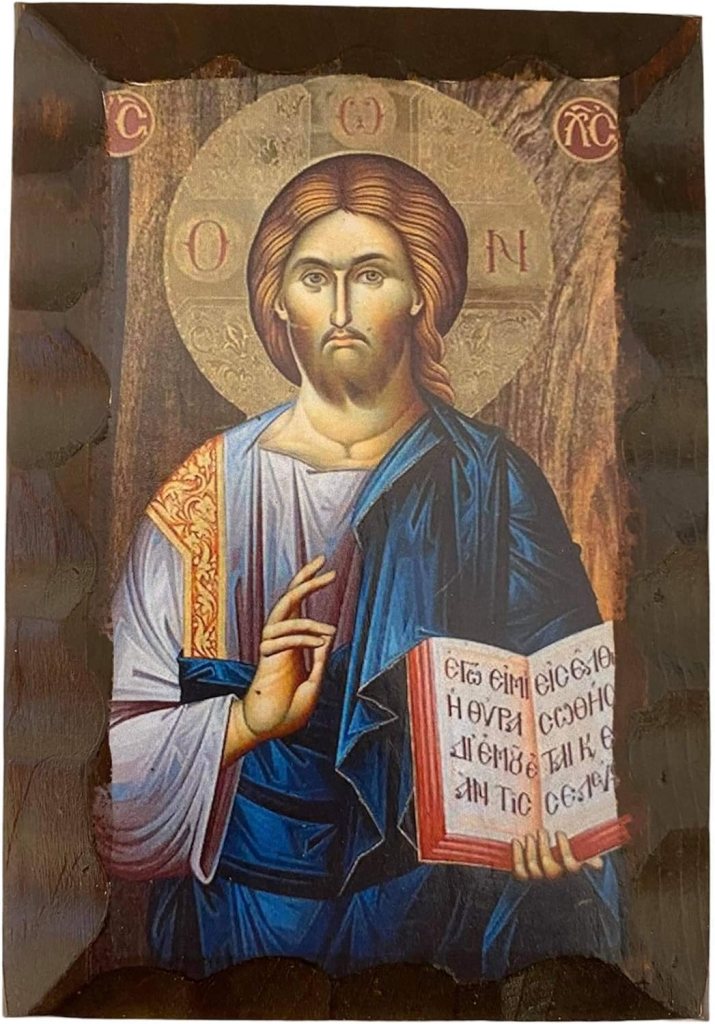

Jesus Christ is Lord

Read Romans 1: 1-11

There are portions of the Bible that folks tend to read through quickly because they seem a little monotonous. The list of names in Chronicles or the dietary laws in Deuteronomy come to mind. Almost every letter Paul wrote to Churches begins with an introduction of himself that can seem “old hat” to the student of scripture. We allow ourselves to be lulled into a false sense of “heard this all many times before”.

When it comes to the Letter to the Romans, we would be wise to pay close attention.

Paul was last Apostle called directly by Jesus for the working of spreading the gospel. Not the last person called to this task only the last person whom Jesus spoke to directly. All the apostles before Paul had been called in a person-to-person conversation. Paul saw Jesus in a vision and heard him speaking to him directly. He begins this letter calling himself the bond-servant of Christ.

The real word is slave. Most modern English translations soften the language because of the long history of slavery in the Western World. While this is understandable something is lost even in this first verse because we do not understand the word the way Paul’s audience would have understood it. In the Roman Empire there were slaves of many types. The important thing was a slave was not thought of as property so much as the consequence of one group being dominated by another. Slaves were the people who had been conquered and now had to live out a life bound to the will of the family that they served. There was a Paterfamilias (the Parent of the Family) at the top that held the power of life or death over the slave. The Paterfamilias was also called by the title Dominus or the one whom had dominion. All of this and more can be read about in Wikipedia.

Reflect now on how the first listeners heard these words. In a few syllables, Paul communicates he was one who had been conquered by Christ Jesus, that Christ Jesus was the Paterfamilias, the Dominus, and Paul was slave to that household. Had they been aware that Paul was a Roman citizen the claimed status of slave would be even more striking. He goes on to say that his servitude was for the purposes of the gospel, to explain what that gospel message is about.

When was the last time you read the Old Testament? If it has been a while you may want to go back and dive in. Why? Because according to Paul the gospel is contained in the Old Testament. Check out the second verse (which in reality is a clause in a much longer run-on sentence that culminates at verse 7!): “which he promised beforehand through His prophets in the holy Scriptures; concerning his son…

Paul is not alone in saying that the message of the Gospel is found in what we today call the Old Testament. Twice, Jesus demonstrates this same truth. In Luke, the travelers to Emmaus encounter a stranger along the way who asks the question, “was it not necessary for the Christ to suffer these things and enter into His glory? Then beginning with Moses and with all the prophets He explained to them the things concerning Himself in all the scriptures.” (Spoiler Alert! the stranger is Jesus.)

Later he appears to the first disciples and says “These are My words which I spoke to you while I was still with you, that all things are written about me in Law of Moses and the Prophets, and the Psalms must be fulfilled. Then he opened their minds to understand the Scriptures.”

Jesus read the Old Testament. So should we.

The writer of Hebrews begins his great letter with no introduction but with these words: “God, after he spoke long ago to the fathers in the prophets in many portions and in many ways, in these last days has spoken to us in his Son, whom he appointed heir of all things, through whom he also made the world…“. We will get back to that last part soon enough, but there it is again that the Old Testament contains the truth of the Gospel.

It was the Old Testament that Paul went back and studied after he regained his sight (figuratively and literally) to understand how it was that the crucified Jesus of Nazareth could be alive and speaking to him when he had traveled to Damascus. Luckily for us Paul gives us the shorthand version in the salutation of this letter.

“...His son, born of a descendant of David according to the flesh, who was declared the Son of God with power by the resurrection according to the Spirit of Holiness, Jesus Christ our Lord.” Here we see that Jesus is the promised Messiah (heir to the throne of David) and that after the resurrection he has been empowered as the Lord. (Jesus, the Christ, our Lord would be an acceptable alternative translation.) This is the shortest way that you can summarize the story of Jesus found in the Old Testament. A little longer way to flesh it out would be to say that Jesus is the one promised to Eve who will defeat Satan. Jesus is the heir of Abraham through whom all the people of the world shall be blessed. He is the heir promised to David who shall sit on the throne for all eternity. He is the one Jeremiah spoke of who would bring about the new covenant in which the law would be written on the believer’s hearts and God would remember their sins no more. He is the Suffering servant of Isaiah by whose stripes we are healed. The one who would be YHWH returning to his temple promised in Ezekiel. The son of righteousness rising with healing in his wings according to Malachi. (The list is virtually endless!)

Still, there is more in this quick summary than meets the eye. A long running argument (controversy, even heresy depending on how one views these things) exists in the Christian world about the divinity of Christ. In the earliest centuries of Church history, the argument took the form of adoptionism. The idea being that Jesus was just a man like any other until God chose to adopt him as his son. When the adoption took place was argued both at the baptism and after the resurrection. In more recent times the argument centers around when did Christians decide that Jesus was God. This controversy reignited late in the last century over the idea that there were so called gnostic Christians who were shut out by the orthodox but who had the right idea all along about who Jesus really was. Our enemy, the eternal liar, wants people to question the divinity of Jesus. A Jesus who is nothing special is a Jesus who can be ignored.

Some of those who argued for adoptionism pointed to this verse in Romans. To them, even Paul is suggesting that Jesus is appointed to his special role after the resurrection. This is a poor understanding of Paul and the early Christians. So as not to get bogged down into translation issues I will remind you of four different voices of the first generation of Christians who suggest otherwise.

We will start with Paul. To the Philippians he writes of Jesus, “Although he existed in the form of God, he did not regard equality with God as something to be grasped but emptied himself taking the form of a slave being made in the likeness of man.”

Luke writes that the angel Gabriel told Mary, “The Holy Spirit shall come upon you and the power of the Most High shall overshadow you; and for that reason, the holy child shall be called the Son of God.

In Hebrews (continuing the passage quoted above), “and He is the radiance of His Glory and the exact representation of His nature and upholds all things by the word of His power. When he made purification of sins, he sat down at the right hand of the Majesty on High...”.

And our fourth witness is the Gospel of John where we read “In the beginning was the Word and the Word was with God and the Word was God… and the Word became flesh and dwelt among us, and we saw His glory, glory as of the only begotten from the Father, full of grace and truth.”

The Bible is quite clear that Jesus is God.

Paul is not saying that Jesus became the Lord after the resurrection but rather in the same way that a prince is always the king even before the coronation, Jesus is declared the Lord after the resurrection. He does not become it in that moment but is revealed as always having been that from the beginning. One needs to look no further, in my estimation, than the repeated use of Lord as a title for Jesus. Paul was a good Jew. A faithful well-educated rabbi. He knew that the word Lord was the word that the Jews had used for centuries to avoid saying the sacred name (YHWH) aloud. He would never have used the title lightly for Jesus.

Many scholars like to side-step this reality by saying that the use of Lord for Jesus was a political statement to draw the distinction between Jesus and Ceasar (the emperor cult in Rome was already, at this point, beginning to deify Caesar) who was known as Lord of the Earth. It is true that declaring Jesus as Lord was a political statement in that day (as it is in our own context), but that fact does not diminish the truth of who the first century Christians understood Jesus to be.

And if he is Lord, then he is worthy of our faith and obedience, which is what Paul says is the purpose of the preaching of the gospel. “Through whom we have received grace and apostleship to bring about the obedience of faith among all the gentiles for His name’s sake, among whom you also are the called of Jesus Christ.”

So, we can draw 3 conclusions from this short passage. First, that Jesus is the promised one of the Old Testament. Two, that Jesus is the Lord God. Three, he is worthy of our faith and obedience.

Wow. Isn’t scripture amazing?

If this is your first time to The Hypocritical Christian, welcome, I am glad that you are here. Honored that you would consider reading at all. Thank you for reading to this point in the post. We are in the midst of a journey through Romans, where we are seeking to understand how we are to be “transformed by the renewing of our minds” (Rom 12:2). Along the way we are going to incorporate other portions of scripture from throughout the Bible but principally from Luke, Philippians, and Hebrews.

At the risk of going too long, I want to highlight briefly two words that will be essential to our understanding of Romans and Paul’s desire that we are not conformed but transformed (this I believe is the spiritual gift that Paul wishes to impart mentioned in Romans 1:11); flesh and spirit.

Paul, a good student of the Old Testament, believes that with Christ’s resurrection a new age has begun. This new age is the age of the Spirit. The Age of the Spirit (wherein believers exist in the power of the Holy Spirit) continues until the return of Jesus and the world is finally set to right again as described in Revelation 21-22. The age of the Flesh is how the world operated until the advent of Jesus and continues to operate for non-believers until the second coming of Christ.

For now, think of it this way. All of us exist in the sphere of the Flesh. We will spend the next several posts discussing the sphere of the flesh and the ways in which it manifests itself individually and collectively all around us. Then we will begin discussing how the age of Spirit, which has broken in, changes us as we become believers (or continue on as believers) and how the influence of that Age should impact our thoughts and behaviors.

This image can help us understand:

As believers we currently exist in a bifurcated world. We are perpetually influenced by both the world (Age of the Flesh) and the presence of the Holy Spirit (Age of the Spirit). To put it simply these two spheres are the influence which seeks to conform us and the influence that has the power to transform us.

But all of that is for future posts.

Peace to you on your journey. Vaya Con Dios!

Feel free to use this Bible Study for your own groups or discussion.  It is freely given. If you do I merely ask that you acknowledge where you got it and if you find it useful that you encourage others to seek it out. It is freely given and written with fear, foreboding, and prayer by a fellow hypocrite who is simply trying to figure out the road ahead.

Fearing Trembling and Knowing

Read Mark 5: 21-43

If you have been waiting for nearly 3 years to find out what happened to Jesus after he healed the “crazy” man in chains by banishing his many demons into a herd of pigs, I have 2 things to say:   1) I am really sorry and I promise not to let such a long period of time pass between posts to this blog any more.  2) Seriously?!? Do you even remember what happened? If for some reason you want a refresher you may read it here.

So having been uninvited from the land of the Gerasenes, Jesus and his cohort head back to the other side of the Sea of Galilee.  Here, in contrast to the angry mob that they just left, is an expectant crowd gathered to greet them.  We aren’t entirely sure of what has drawn the crowd.  It could be that word is spreading about what Jesus is capable of in terms of healing, that they have heard about the destruction of the pigs, or they know what Jairus is about to ask of Jesus and they have come for the show.

Jairus is described to us as a leader in the synagogue.  This means he is a prominent person in the community.  Here in Texas, he might be compared to someone who was not only an elder / deacon / alderman in a local congregation but also like a local office holder.  Some thing like being a councilman or a constable.  The point is that Mark wants us to realize that he is significant.  We do not know yet if seeking out Jesus is akin to political suicide (remember Nicodemus met Jesus at night) but the circumstances demand that he find Jesus soon.  His twelve year-old daughter is dying.

So they set off.  Jesus, the disciples, Jairus, and the crowd.  There is jostling and bumping, elbowing and maneuvering.  Probably the group formed into some sort of line working their way through the crowd each member occasionally looking back to the person who should be behind them and ahead to the person they should be following.  You have been in crowds like that before haven’t you?  Maybe to make it to the entry point of a popular ride at Disney World?  I have been in lines like that to get to parking lot after a concert.  No doubt Jairus was moving as fast as possible up ahead looking back frantically to make sure Jesus was still coming and Jesus was probably trying to make sure that the disciples were still in the group.

Mark tells us about only one other person in the crowd that day; a woman who has been actively bleeding for twelve years!  Mark says that she has been to the doctor so many times and nothing has helped.  She has spent all of her resources and, according to the Greek, having benefited nothing but into worse having come she has decided to do the only thing that is left for her.  She has heard about the things Jesus has done and she is going to find him and she believes that if she can even just touch his robe she will be healed.

Let’s stop right there for a minute and consider a few things.  Why would she be convinced of something being magical about Jesus’ robes?  Obviously this is a pre-scientific mindset but there are plenty of people today that adopt some magical thinking even though our world is mostly steeped in scientific thought.  Whatever logic she is using is not important, I really only ask to point out that every one around her that day would be convinced that they could be made ceremoniously unclean simply by touching her robes because she was bleeding. In a world where people can become unclean by touching someone’s clothes then certainly they might be healed by the clothes of a righteous person, right?

This would be the every day for this woman.  In fact so long as she was bleeding she probably had to announce to people that she was unclean as to warn them.  For more than a decade she has had to let people know that being near her is a threat.  What sort of fellowship did she have? what sort of community?  Did she always eat alone?  Did she have to go to the well for water at odd times?  She may have been a person of means and didn’t have those issues, but did her servants look at her with judgment instead of pity.  She wasn’t allowed in the synagogue; couldn’t go to the temple during Passover.  Was she married, did she have children?  Were her family members treated differently because of their connection to her? There hasn’t been anything that can fix it for her and nothing can change the pain that she has already endured.

Have you ever felt that sort of isolating pain before?

As I write this the world is in the midst of the Corona Virus outbreak.  Most of the United States is in some sort of imposed isolation.  In our efforts to “flatten the curve” of infection, a good thing, we are dealing with tremendous economic hardship and isolation.  For families this has been a time when they can grab some rare togetherness and connection and that has been a blessing.  For the single people it has been the opposite because it is hard to make connection from 6 feet away with a stranger.  I think many people, like myself,  eventually go out for either a walk or to get something from the store. It is surreal to see so few people out and about but also because of the looks that you receive when you encounter someone.  There is this moment where heads turn away or a glance signifies the unspoken question “are you safe?”.  Most of us have used more soap and hand cleansers in the past month than we did in the previous year.

It gives us a little insight into this Biblical woman’s life.  We do not know her name, but we do know her faith.  If she can just touch the robe she knows that something good will happen– that she will be healed.

Somewhere in the crowd she sees Jesus trying to keep up with Jairus making his way through the throng.  She herself presses and elbows and pushes and finally gets close enough that she can just touch his robe.  It happens.  Her flow stops.  She has lived with it so long she knows.  She knows!

Jesus knows too.  Mark relates that he felt power go out from him.  Someone in this crowd has experienced the healing touch of God.  He immediately stops to figure out who.  Salvation has been received Jesus would like to meet the recipient.  I don’t believe that Jesus is angry, I believe that he wants to affirm an act of faith, I believe he wants the relationship that comes from the grace granted.

Jesus asks who it was that touched him.  The disciples do not know.  Jairus doesn’t know and is frustrated by the delay.  No one knows except the woman.  She ventures forth Mark says “fearing, trembling, having known” falls at Jesus feet and tells him everything.

Jesus replies with grace and love, commends her faith, and sends her out with a declaration of peace and the assurance that she is forever healed of that affliction. I submit to you that it is not just her belief that touching Jesus robe would heal her that did heal her, but it was also her response to what Jesus had done for her.

fearing, trembling, having known

Having known what?  That she was healed, certainly.  That she had been healed despite having reached a point in her life where she was convinced that she would never find release from this sickness that gripped her perpetually?  Was she fearful and trembling because she had felt unworthy for so long that she believed the lie that she was fundamentally unclean and in that one moment experienced not only healing but that unbelieveable cleansing that comes from realizing that God does love you despite how unloveable you have felt or how unloveable you have allowed others to make you feel? Was she fearful and trembling because she now knew what Jesus could do and as a result who Jesus must be?  Recall the function of Mark’s gospel is to share with us the beginning of the gospel of Jesus Christ, the Son of God.

Many years after this, the Apostle Paul would write to the Christians in Phillipi one of the most significant passages in all of the Bible.  After  reminding them of who Christ Jesus is he implores them to work out their salvation with fear and trembling.  WOW.

I always wondered what Paul meant and I never realized the parallel language with this story.  So what did the woman do?  She sought out God. She found salvation and healing.  She recognized what God had done and she responded with appropriate awe and respect.  Her knowledge of God expanded by recognizing what he had done for her and she responded with the appropriate fear of the Lord and confession.  She entered into a deeper relationship by telling God everything.

What has God done for you? How has He made you whole? When have you experienced His power and might? What prayers has He answered? What hope has He sustained in you?

Whatever the answer keep telling God everything;  deepen the relationship. The One who has created everything that is is The One who has done this for you.  A little fearing and trembling at the truth of who God is appropriate; a lot of sharing is more so.

The story of chapter 5 isn’t over though.  No sooner does this encounter finish, then someone comes to Jairus and informs them that his daughter has died. There is no longer any need to trouble Jesus to help. Mark tells us that Jesus gives a call to deeper faith.  Do not be afraid but believe.

At this point a lot happens.  Jesus presses on with Jairus and only 3 of the disciples.  When they arrive the professional mourners are already at work playing the appropriate sad music and weeping.  When Jesus suggests that the girl is merely still asleep they laugh at him.  Not just a mild laughter but based on the Greek mocking laughter, derision.  Nothing to this point is helping Jairus with his trusting faith.

Jesus enters the room where the daughter is with just the 3 disciples and her mother and father.  Taking her hand and with a word (literally little girl get up) she opens her eyes and gets up.  Jesus tells her to feed their daughter and asks that no one say anything about what transpired.

This is the God that we worship, follow, serve, seek to know.  Sometimes He works in the pubic throng.  Some times he works in private and seeks no publicity.  But He is bigger than anything in this world, even death.

So get to fearing and trembling and knowing all that has happened to you and tell God everything.


The Fear of the Disciples

the-freak-liquid-mountains-of-lake-erie_880

Read Mark 4:35-41

Jesus has just finished a long day of teaching near the shores of the Sea of Galilee. The time has come for them to head to the opposite side of the lake and begin healing and teaching in the communities there.  We are told a couple of pertinent details about the journey.  A significant storm began as they were making there way across the 7 mile span and Jesus was taking a well deserved nap.

I grew up around lakes in Texas and I can tell you that storms on a lake are no small thing.  Apparently, this is particularly true of the Sea of Galilee because of the unique topography around it.  All of Isarel, west to east, is a series of radical changes in elevations in a comparatively short distance.  As a result the Sea of Galilee is in a basin of sorts that channels the wind across the water when a storm rages through the region.  A similar dynamic can be experienced when the wind is channeled through office buildings in a modern city or even apartment complexes in a smaller town.  The point is that the storms on the Sea of Galilee can be nasty and we need to remember that these guys are not in some modern style watercraft, but a homemade boat designed for fishing and not much else.

Have you ever napped on a boat?  It’s glorious! The boat rocks back and forth and if you are sleeping directly on centerline it is the closest thing to being in a cradle that you can experience.  When you consider the crazy compacted schedule that Jesus has been keeping and the incredible amounts of physical and mental energy he has exerted it is no wonder that he is “dead to the world” in the back of the boat.

We are told that when the disciples, all of whom are experienced fishermen, decide to wake Jesus. They are worried about dying because the boat was already taking on water.  I think it is important to pause here and really put yourself in the moment.  The storm is wicked, perhaps there was rain and perhaps there was just wind and waves.  Even without rain the waves alone could be devastating and frightening.  The image above is described as one of the “mountains of water” that form on Lake Erie during a storm.  A fishing boat in those days would have had a very low side to make it easier to haul a net of fish onto the boat.  It wouldn’t take much for a series of significant waves to begin filling the hull up.  Water is coming into the vessel, each wave striking the boat would have begun to feel like invisible fists pounding the side threatening to capsize her or worse break her apart. If the worst happens it is several miles to shore in storm driven waters.  Every one of these men grew up around these waters and every one of them likely has known someone who has drowned there. No wonder they were afraid!

That last point about the deadliness of the sea is pretty crucial for really understanding this story.  In the ancient Jewish tradition, the sea represents evil and chaos.  The sea is unpredictable and kills.  You see this in the very first verses of the scriptures.  God’s spirit hovers over the waters of the void and begins to bring order out of chaos.  The sea is given its limits but is always there as a symbol of the forces that are opposed to God.  You see it in the final pages of scripture when the beast rises up from the sea in Revelation and when the new creation is finalized, we are told that the sea is no more.  So, while the story is about the day that the disciples nearly died on a boat trip across the Sea of Galilee it metaphorically means so much more.

The disciples rouse Jesus from his deep sleep and level an accusation against him, “Do you not care that we are perishing!

Jesus stood and rebuked the wind and commanded the sea, ” Be silent” and the lake became calm.

calm lake

Take a moment and meditate on the two images.

How would you feel?

Try to imagine the feelings of fear and dread of the waves and the storm replaced with the feelings of relief and dread at what just happened.  The fellow next to you in the boat just told the weather to stop and it did.  Not impressed? Try it yourself sometime.  You won’t get very far.   As I write this it is 80 degrees Fahrenheit before 10 AM in Texas.  You don’t think I want to make it cooler with the sheer power of my will?  How many brides would kill to be able to control the weather before their outdoor wedding?  Each of us is powerless against the forces of heat, cold, wind and rain.  Each of us except Jesus.  That is by the way I think Mark’s point in his retelling.  Recall that Mark is a gospel bent on guiding every reader / hearer into making a decision about who Jesus is and in this moment he wants you to realize that Jesus commands the forces of nature and they obey.

In verse 41, the disciples ask “who is this that even the wind and the sea obey him?”  They would have had the benefit of growing up hearing the dozens of references in the psalms, proverbs, Job and prophets that YHWH does this very thing.  They would have grown up being told to remember how YHWH had delivered their people from Egypt by commanding the sea to part and allowing them to cross over on dry land.  This is what they were dealing with and why we are told a great fear (literally a mega phobia) gripped them in the wake of Jesus action.

“Who is this guy?”

That is the question with which we must wrestle.

Now some of you will respond to this with a ho-hum.  Maybe you are a life-long Christian and you settled on the answer “who is this guy?” a long time ago.  You may ask, what about the storms of my life?  My boat is floundering.  Where is the word for me, the reassurance that Jesus will calm my storms?  I have come to this post wanting to know that Jesus can stop the storms in my life.  I have job trouble.  I have debts.  I have addictions.  I have marital strife.  I have cancer.  What about me?  Doesn’t Jesus care that I am perishing?

The very same accusation that the disciples leveled against Jesus is on our own lips many times.

And Jesus said to them, “Why are you so cowardly; do you still have no faith?”

It is not two questions as most translations put it but a single question.  The nature of Jesus question, condemnation really, is to link the fear with the faith.  In other words, if you had faith, you would not fear but rather trust.  I know this because the Greek word used is particular.  It is not, phobos, from which we get the word phobia.  Phobos is the word used in verse 41 to describe the awe-struck fear that has overcome them.  Phobos is the word used throughout the New Testament (Phillipians 2 for example) to render the “fear of the Lord” that is the beginning of wisdom as the Old Testament (proverbs 1) so succinctly summarized the journey of faith in YHWH.  Here though, in verse 40, the word is deilos, a word that used in ancient Greek to describe the cowardice of soldiers who desert in battle and the inaction of the farmer who is paralyzed by fear of the future.  Deilos is always used negatively and connotes a paralyzing fear.  This seems backwards for English speakers because the word phobia was picked up in psychology to describe the rational and irrational fears that affect us.

We are also used to thinking of faith as a matter of the mind alone.  To many of us, having faith is having the correct belief.  In linking faith and cowardice Jesus is linking faith with action.  The person who has faith is the person who trusts.  The person who does not have faith is the person who is paralyzed by fear.  It is not simply understanding (mind) who Jesus is but knowing (heart and mind) who he is and allowing that deeper knowledge to guide our actions and our responses.  Jesus is surprised that after watching him cast out demons and healing people that the disciples are still so timid when the storm comes.

Think back on your life and recall the times that God has provided for you what you needed: the doors that have opened, the healings that have occurred, the resources that were given. The life of faith is not simply understanding who God is but allowing that understanding to put you in a place of trust where you can live in a relationship towards God that is a life marked by the expectation that God will provide.

The accusation was “Do you not care that we are perishing?”  The answer is if you trust me then you know that I care and that you matter.

I do not think that the life of faith means that there is never a reason to fear.  There are scary things out there: violence, war, famine, disease, divorce, unemployment, snakes… it is a long list.  There is nothing wrong with the instinct to fear but faith calls us to get past the fear to trust that the Lord will carry us through all things, even death, when that day comes.

So how do we live it?

Be assured.  Fear not.  The Lord knows your circumstance and your need before you ever vocalize it.  Use the Lord’s prayer as your guide and pray that pattern daily: Praise God, ask for your needs, seek forgiveness and grant forgiveness, ask for deliverance from the evil that is out there, expect and look for the will of God to be done more than your own solutions, and finish reminding yourself that all glory and honor will forever belong to God.  Doing so will train your heart and mind to trust in God’s provision and in God’s timing. When in doubt recall what God has done and know that God will do what is necessary.

Amen.

Questions:

  • What makes you afraid?
  • Are there areas of your life where you are not acting because of fear?
  • When was the last time you prayed the Lord’s prayer?
  • What is one thing you could do today to trust God more?

Are you enjoying the Hypocritical Christian? If you are then share the website with someone else and encourage them to try it out. If you receive it through email and choose to share it with some else let them know where they can find new posts for themselves. Also note that you are welcome to ask questions or even “argue” back through the comments.  Dialogue is always encouraged.  I ask that you suggest the website to others because knowing that people are going to the website encourages me to keep posting.

As always, the above reflection is given freely. If you choose to share it in a group bible study of your own or as a devotional before a small group meeting, etc. please let folks know where you got it.  It is written with fear, foreboding, and prayer by a fellow hypocrite who is just trying to figure out the road ahead.

Be Patient for the Kingdom Comes

Read Mark 4:26-34

Christians are always concerned about the Kingdom of God and how long it seems to be taking to arrive. Do you suppose it has always been this way?  Could it be that Christians in the West have become so conditioned for instant gratification that they more impatient for the Kingdom of God than their predecessors?  The anecdotal evidence is that every generation of Christian from the beginning have been anxious for the ultimate fulfillment of the Kingdom just read Acts 1:6-7.

In North America, denominations are very focused on the Kingdom of God albeit in very separate ways.  The more conservative a Church / Christian the more focused they seem to be on teasing out the signs of the imminent return of Christ. Like “Preppers” storing up for the downfall of civilization, their bug-out-bag is their zippered, handle-covered Bible and instead of a sign indicating they reserve the right to shoot trespassers they warn the trespassers they will be “left behind” that their cars will be driver-less in the event of the rapture through a thoughtfully placed bumper sticker.  Their counterparts in the more liberal arms of the Church have seemed to have forgotten that Jesus promised to return at all, focused instead on doing all this hard kingdom work themselves through political rallies for the justice issue du jour. In case your curious they often decorate their car with bumper stickers encouraging coexisting religious faiths / sects as though the true arrival of the Kingdom of God will look like a joint summit meeting.

These two short parables in Mark suggest where the Kingdom of God is concerned patience is required.

Jesus told them that the Kingdom of God was like a man who cast seed on the ground.  At first, we may naturally think of the parable of the sower we recently looked at but here the emphasis is not on the action of the sower but rather on the seed itself.  Jesus says the Kingdom of God is like the person who casts seed on the ground and while they sleep the seed sprouts and grows “– HOW; he himself does not know“.

Maybe this parable has lost some of its strength in a world where so many people have looked at pictures of a bean sprout plant growing in schoolbooks.  There are even a select few people who really do understand how it all works.  But it seems the point Jesus is trying to make in his pre-scientific method world is that it just happens over time, and it seems almost magical.

Coupled with the Parable of the Sower, we have been given some simple instructions. We are to scatter the Word of God and then let the Word do its thing.   Apparently even while we are sleeping the Word of God is at working sprouting and developing into a great big crop ready for harvest.  When the harvest comes there is more work to be done.

This parable although short works on two levels.  On the one hand it is a reminder to Christians that their efforts do not end with the sharing of the gospel but that they also need to be ready when the harvest is evident.  So, if you have been demonstrating the truth of Christ through words and actions you need to be ready when the one with whom you share is ready for the next step be it accepting Christ, attending worship, or being baptized.  The parable also works on the cosmic level.  Jesus will return when the harvest is ripe some day in the future.  Patience fellow Christ-followers, the Ancient of Days, like a seasoned farmer, will know the right time.

The second parable is another call to patience.  Jesus says that the Kingdom of God is like a Mustard Seed though it is small it grows into a tremendous plant.  There are some critics out there that mock Jesus because as they point out the mustard seed is neither the smallest seed nor is the mature plant the largest on Earth.  C. S. Lewis once commented that it was incumbent upon us to read the scriptures like adults. I suspect this is the sort of ill-conceived criticism he was referencing.

Allow me to update the parable imagery so that anyone can understand Jesus’ point.

Sequoia-Seed-on-Fingertip

Then Jesus said, “How can we picture the Kingdom of God or to what can we compare it to? The Kingdom of God is like this seed on my finger that breaks off from the seed pod on the ground and although it is so tiny and insignificant grows to become an awesome and amazing tree like this: 

sequoia

a tree so large that it can’t be captured on film in its entirety, and it would take more than a classroom of children to encircle its trunk. 

The point of the parable isn’t about the literalness of the seed or the plant, but the fact that the Kingdom is growing all the time, slowly, unseen into something massive and beautiful and only God knows when the harvest will be complete.

The mustard seed, or Sequoia seed, is Jesus.  A poor builder, a crucified criminal, in the furthest reaches of the Roman Empire two millennia ago couldn’t be more small and insignificant; yet, the 2.2 billion Christians alive today all trace their lineage back to this one man and his Resurrection around 34 C.E. (AD).  Not only that, but the estimated 13 billion confessing Christians of the past 2000 years — a Giant Sequoia indeed!

And the Kingdom of God is still growing at its own divinely ordained pace until that promised day when every knee will bow and every tongue confesses that Jesus Christ is the LORD to the glory of God.

What to do between now and then?  Well, one don’t smugly look for signs of THE RETURN and forget to do the work of sowing the gospel.  To do so is to risk a self-righteousness that awaits the judgment of the neighbor without practicing the love of neighbor God requires.  Two, don’t go about trying to rework the whole world into the Kingdom of God as you think it should look because the outcome is guaranteed to be a vision of justice viewed through sinful eyes.  Third, focus on living out Romans 12:9- 13:11  as best you can individually and collectively seeking guidance always first and foremost through scripture, prayer, and confession.

And be patient for the Kingdom is both growing and coming.

Questions:

  • Do you pray regularly for the return of Christ? If so, why? If not, why?
  • When you pray for THE RETURN are you secretly hoping that it come so others will face their comeuppance? 
  • What is the kingdom working balance in your life between prayer and study and good works? 
  • Do you read the Bible regularly? Pray daily? Are you looking for the chance to spread the gospel? 
  • How are you harvesting the growth that is ready until THE RETURN?
  • What are you or your faith community doing to serve God by serving others?

As always the above reflection is given freely. If you choose to share it in a group bible study of your own or as a devotional before a small group meeting, etc. please let folks know where you got it.  It is written with fear, foreboding, and prayer by a fellow hypocrite who is just trying to figure out the road ahead.

Are you enjoying the Hypocritical Christian? If you are please share the website with someone else and encourage them to try it out. If you receive it through email and choose to share it with some else let them know where they can find new posts for themselves. Also note that you are welcome to ask questions or even “argue” back through the comments.  Dialogue is always encouraged.  I ask that you suggest the website to others because knowing that people are going to the website encourages me to keep posting.

The Parable of the Sower

Read Mark 4:1-20

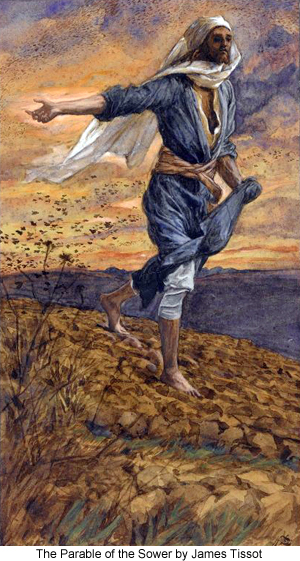
James_Tissot_The_Parable_of_the_Sower_300

“Behold a Sower went out to sow…”  thus begins one of the more famous parables of Jesus and the only one that is given a full explanation by the man himself.  Ironically, this parable is often interpreted by theologians and preachers independently of the explanation Jesus gives when the most complete explanation that we can give someone is read verses 13-20 if you have any questions.

Instead we are given sermons where people are asked “what kind of soil are you?”  We get messages about not worrying about those who are yet to believe because they are just not as fertile a soil as you the faithful listener here this Sunday morning. I almost fell back into that trap myself by very nearly writing a blog post where I intended to ask myself and you how our actions and decisions were impacting the soil of other people’s hearts.

Why are we so quick to try and add to or change the meaning Jesus gives this parable? The cynic in me says that some people want to avoid the fact that Jesus flat out mentions Satan in the explanation.  While I do think that the notion of Satan is disturbing to a great many “modern-minded” Christians, I suspect that the real reason efforts are made to come up with clever extensions of the parable or outright changes in the meaning is because we want the parable to be about us.

The parable is not about us.

The sower sows the word.  The word is the gospel and the gospel is thus: in the person of Jesus, God has initiated the Kingdom of God.  If you are still struggling with that being the fundamental truth of the gospel please reread the first three chapters of Mark, or review this blog post.

In this point in Mark, Jesus is sharing this parable to explain to those who believe in him (presumably the disciples) why some folks, like the pharisees, are so unbelieving that they wish to have him eliminated and other folks, like his immediate family, think that he is bonkers.  “Bonkers” is a technical term in this instance that theologians use so we don’t have to conjure up a confusing word like egotheistical.

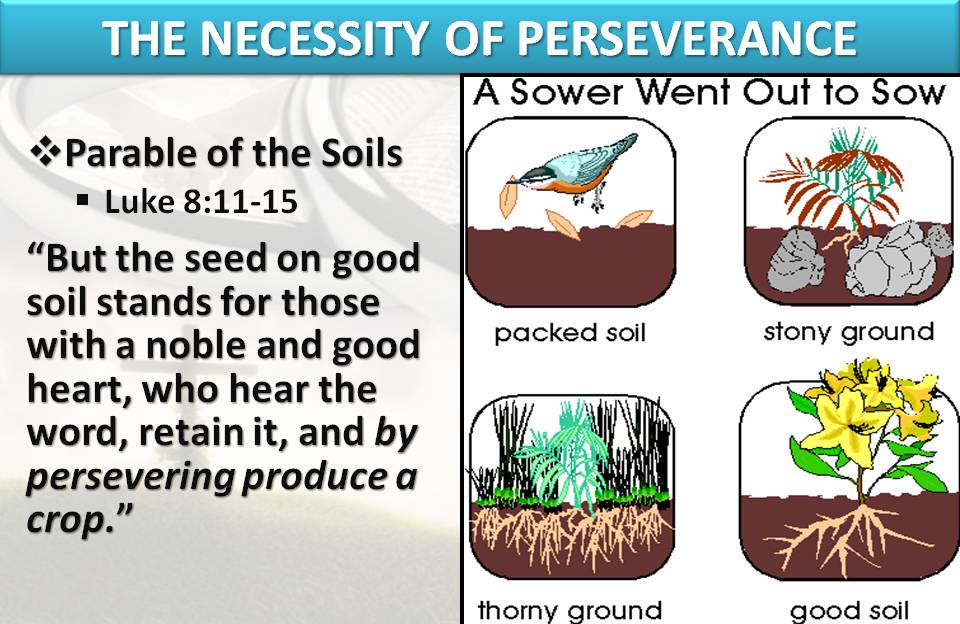
There are a lot of reasons why people fail to believe in Jesus. Some are hard soil and there is no way for the truth to take root before the birds and such eat it. Some are rocky and there is an initial taking hold but the plant doesn’t survive the heat and the wind, like the flowers that I put on my west facing apartment balcony. Others get choked out by the weeds. Finally there are those who are the good soil and the gospel takes root in the heart and grows strong and true and yields fruit.

That’s the meaning plain and simple.

sower images

I am not going to try and change that interpretation, but I am going to try and draw a couple of interpretative lessons out of that explanation.  Personally, I come from a family of farmers although I admit I know more or less nothing about farming.  I only know a little about gardening.  When I was a kid I wanted to help my mother plant a garden so she showed me how. We bought some seeds and we created a pretty good sized garden in the land next to our house. It had several rows that we had created with a tiller that mom borrowed for the purpose.  By the time we were done it was that classic Norman Rockwell style garden with little posts on the end to mark the rows and the seed packet stapled to them so we could remember whether that row was radishes or corn.  What I learned over that weekend was that gardening is hard work.

The first lesson that I would point out to from this sower story is this: the Word is not an annual. This gospel is not a one time yield sort of crop here today and gone tomorrow.  You will note that most of the times that Jesus gets all horticultural on us it is about vineyards or trees.  The Gospel when it takes root is going to be a perennial plant.  This is important because whenever we try to make the parable about us (focusing on the soil rather than the sower /seed) we can become fixated on whether or not we are good soil.  If we are good soil, then the yield can become a way for us to qualify ourselves among the other good soil out there i.e. am I yielding 30 times or 60 times? We can either compare ourselves this way to make ourselves feel like we are better Christians or we can get down on ourselves because we aren’t bearing as much fruit as someone else.

Stop it.

Sometimes the vineyard has a bumper crop.  Some years are lean.  Some years a fruit tree will produce more fruit than you know what to do with and some years there aren’t any fruits at all.  When I lived in Corpus there was a grapefruit tree in the backyard that produced far more grapefruit than I could have ever consumed.  Truth be told, even one grapefruit is generally more than I want to consume. Right across the fence in the neighbors yard, not even 10 feet away there was a grapefruit tree that was a perennial disappointment.  So much so that the neighbor always made sure I knew that he didn’t want me to prune the limbs that stretched over the fence from the superstar tree because he wanted to harvest those grapefruits.

It is like that with Christians.  We have seasons when we produce much fruit in our own lives or in the lives of others and there are seasons when the pickings are slim.  Both are OK.  Both bring glory to the Father because throughout it all we are good soil.   Jesus says, “they are the ones that hear the word and accept it” meaning that the good soil are those who have begun to orient themselves around the truth of Jesus Christ.  What does that mean?  Read Romans 12.  Most people think that the gospel is doing all those things, but those things flow out of understanding the truth about Jesus (Romans 1-11) not the other way around.

In short, if you want to be bear more fruit, then double down on your understanding of who Christ is and the fruit will follow.

Why is that? Because the word is being sown haphazardly all the time.  I mentioned earlier that when it came time to plant the garden my mother and I prepped the plot of land.  We tilled and readied the soil for the seed.  Not this sower named Jesus, this guy is chunking that seed all over the place. I once thought that this was really silly and not the most effective way to plant anything but I recently learned that this was common practice in his day.  A sower would sow the seed and then go back and till the ground turning over the dirt, rocks, weeds, etc whatever with the seed.  They did this for two reasons.  One, they didn’t always have the best soil to work with in the first place.  Let’s face it, Israel ain’t Kansas.  Two, there wasn’t a place down the road to buy potting soil and fertilizer and Weed-B-Gone.  You turned over the dirt and everything in it good and bad to have whatever nutrients you could get in the soil for the plant and you hoped that the Lord would bless you with rain and the right combination of stuff to find out where the good soil was and grow you some produce.

And therein lies the second take away from the parable for the believer: you WILL BE tilled.

Far too many Christians think that the after accepting Christ into their hearts life is going to be a long period of perfect.  When the tough stuff happens they ask themselves “Why is the Lord doing this to me?”  They ask themselves why God is punishing them.

“We rejoice in our suffering because we know that suffering produces perseverance and perseverance produces character and character produces hope and hope does not disappoint because God has poured out His love for us through the Holy Spirit.” (Romans 5:4)   


parable-of-soils

Ignore every preacher you hear (most of them are on TV) that try to sell you this Pollyana notion that the life of the Christian is smooth sailing.  Do your best to ignore your well-meaning Christian friends who try to tell you the same.  As my good buddy Sam used to say “It is hard to be a Christian”.  But when the stuff happens keep in mind that you are being tilled, the Sower is working His soil to make you produce fruit.

I will speak for myself.  Too often I have asked myself what does God want me to learn from this experience.  Too often I have listened to other people ask me that same question to which I have had very little in the way of answer.  What if our question became “God, how do I bear fruit in this moment?”   Don’t hear what I am not saying.  I am not suggesting that there is never a lesson or a pruning of the vine where we need to get ourselves aligned with God more closely.  What I am saying is that always asking the the first questions is putting the focus on us and our experience, pain, and hurt rather than putting the focus on God and asking how we can grow and bloom.

Questions:

  1. Have you found yourself focused more on the soils (you) in the story than on the seed (word)?
  2. Have you ever judged yourself for the amount of fruit your life is yielding for the Lord?
  3. Have you asked yourself recently “Why me Lord?”
  4. How would your walk of faith be different if you asked God to help you bear fruit in times of trial and suffering?
  5. What can you do to focus more on the word during this season of your life?

Are you enjoying the Hypocritical Christian? If you are please share the website with someone else and encourage them to try it out. If you receive it through email and choose to share it with some else let them know where they can find new posts for themselves. Also note that you are welcome to ask questions or even “argue” back through the comments.  Dialogue is always encouraged.  I ask that you suggest the website to others because knowing that people are going to the website encourages me to keep posting.

As always this is given freely and if you choose to use it in a bible study of your own or as a devotional before a small group meeting, etc. please let folks know where you got it.  It is written with fear, foreboding, and prayer by a fellow hypocrite who is just trying to figure out the road ahead.


To the Moon and Back Again… Why The Believer Shouldn’t Fear Blasphemy of the Holy Spirit

Read Mark 3:20-30


to the moon and back

I Love You to the Moon and Back is a popular book for little children.  My guess is that it was written by someone inspired during a reading of Do You Know How Much I Love You? given that the latter ends with this very phrase.  It is a fitting sentiment of parental love and has inspired a cottage industry of wall art like the image above and posters and wedding invitations and coffee mugs and who knows what else.

The moon is officially 238900 miles away from the Earth.  Imagine how large the moon must be to be so visible in the night sky? Interesting fact, at apogee, the moon is over 250000 miles away from the earth. So when someone says they love you to the moon and back they are saying a lot. In fact you would circle the earth’s equator 7.5 times to equal the distance to the moon and a total of 15 times to go there and back.  So, I guess when a person says that they love you to the moon and back they are saying that they would chase a you around the world 15 times to woo or save you.  Most parents have felt like they have chased their children that far at one time or another.  No one ever says I love you to the Sun and back (186 million miles) probably because the Sun is not out when you are trying to get a child to go to bed; except in Texas where the sun is seemingly always out!

we_are_so_tiny-100047037-large

This image is from the Jet Propulsion Laboratory at CalTech.  The larger dot is the Earth and the smaller dot is the moon seen from 900 million miles away! In case you are wondering that is a picture taken from a spacecraft near Saturn. Brief conspiracy note: I have no way of proving that this is a picture from 900 million miles away. It could be zoomed out capture of a light bright with a pinprick in the paper for all I know.  Still if Saturn which I have seen through a telescope is 900 million miles away then why don’t we start saying “I love you to Saturn and back”?

Since we are going for hyperbole of the highest order here, the furthest known visible distant “object” from earth is a galaxy, MACS0647-JD, that is 13.3 billion light years away. If you are curious how many miles that is it is 13.3 billion multiplied by 5.87 trillion or 7.81 e+22 miles.

“I love you to MACS0647-JD and back” just doesn’t have the same appeal as the Moon or Saturn; nor does it lend itself easily to wall art you can find at Hobby Lobby.  Truth be told 7.81 e+22 miles only makes sense to like 2% of the population.

Thus far in Mark’s gospel, Jesus has been healing folks, casting out demons, preaching and sharing the truth about the arrival of the hour of the Kingdom of God.  Demons have recognized him.  People have begun following him.  The powers that be in Jerusalem have taken notice and especially since he has healed people on the Sabbath.  Now, in these verses, we learn the smear campaign that has begun.

Jesus is possessed of some sort of unholy spirit or is using the power of Beelzebub to perform magic and seduce the people.  In fact, the presence of the Scribes may very well be a sign that the Sanhedrin are conducting an official investigation into whether or not Capernaum has been seduced by evil.  This was a very real thing in first century Palestine.  We also know from documents in the second century that the idea of Jesus as sorcerer and seducer of minds was still a charge leveled against him by Jewish authorities and pagans in their arguments with Christians.

Jesus answers the charge here with a simple parable: a house divided against itself can not stand.  If I am empowered by Satan then how can Satan succeed if the things you see me do are actively working against the demonic powers in the world? This is the question that Jesus asks.  It is sound logic.  After all, an army never turns its guns on itself and shoots half the troops before engaging in battle.  There are lots of places we can look for examples of this wisdom.  If a husband and wife are struggling we sometimes see the symptoms in the children. If the offense unit and defense unit of a football team do not respect each other or the coaching staff the team is seldom successful.  Abraham Lincoln famously applied this saying to the competing sides of the War Between the States. Even today, we see it in the struggles of the Democratic and Republican parties not to mention the Congress as a whole. Indeed, when a house struggles against itself it cannot stand. Thus, it was ridiculous to consider that Jesus might be invoking the power of Satan to attack the demonic forces in the world.

Jesus goes on to talk about the inability to plunder the strong man’s house without first binding the strong man. For years I could not follow this notion because I did not know who the strong man was.  I always supposed that the strong man was God and that no one would be able to enter into his kingdom and bind him up and pillage.  Sometimes I even wondered how to apply it to the life of a believer.  How can we be the strong man and avoid the binding and the robbing?  Now I am older and hopefully a little wiser and I have come to realize that the strong man is Satan.  Jesus is not describing what Satan is trying to do to God or us, as I always thought; rather, Jesus is describing what he is doing while on Earth.  He is the one who is entering into the realm of the strong man where he will bind him up and loot the house.

Recall way back in chapter 1, specifically verses 7 and 8 where John the Baptizer says that one is coming who is greater than he who baptizes with the Holy Spirit. Jesus is this greater than.  Not only is the bringer of the Holy Spirit greater than John the Baptizer, he is greater than  the strong man, Beelzebub.  The mission of Jesus includes His entering into the house of the devil, binding him up, and spoiling his house.

What are the spoils of Jesus work of binding Satan?   Read his next statement, the beautiful sublime truth about what Christ does in his spoiling of the Devil’s domain.

“Truly,  ALL sins shall be forgiven the sons of men, and whatever blasphemies they utter…”  I realize that this is half the verse but it is so crucial that we linger here for bit.  Three little letters (only 5 in Greek) but so complete and full.  ALL.  Think of the ways that word is used in our own language:  All expenses paid.  All-inclusive. Open all the windows. Deal all the cards.  The team won all of their games.   It means every.  It means completely.  It means in-totality. ALL means ALL and it never means less than every last thing that it references.

ALL SINS shall be forgiven (sons of men is a colloquialism for people) and whatever blasphemies they utter.  What does Jesus plunder from the strong man’s house?  Our guiltiness.  Satan is the accuser.  He is the district attorney who brings the charges against people before God. Jesus enters into the house and takes from him the power of sin over us by providing for the forgiveness of ALL our sins.  As the great hymn puts it “my sin not in part but in whole.” ALL.

Whatever you are doing right now, stop.  Stop and let that truth sink in and devastate your heart.  Give the Holy Spirit the silence to work and reveal and wash.


Every single sin you can think of from your past or present is forgiven.  

The sins you are yet to commit, for the believer they too are forgiven. 

ALL

This is what Christ has done.  Here in this moment he is foreshadowing, but when he utters “it is finished” on the cross, the work is done. His death the atoning sacrifice for your sins. The only sacrifice that you will ever need.  The only work that will ever suffice for your sin.  Done!

Praise God for his love for you.  Confess with your mouth that Jesus Christ is Lord and believe in your heart that He has completed this mighty work for you and for all who put their faith and trust in Him. This is the gospel.  This and nothing else.

but whoever blasphemes against the Holy Spirit never has forgiveness, but is guilty of an eternal sin!”

This is why I asked you to stop and ponder the beauty of all your sins being forgiven, because if you read too quickly you will become afraid of this half of the verse.  There is but one unpardonable sin and that is blasphemy of the Holy Spirit.  Unpardonable means that it cannot be forgiven.  The inability to forgive it is what makes it an eternal sin.

The gospel of John tells us that the work of the Holy Spirit is straightforward.  The Holy Spirit is tasked with convicting the hearts of people about sin and with the truth about who Christ is.  To make it simpler, it is to reveal your guilt before a just and Almighty God and then reveal the pardon that is available to ALL who believe that Christ has died and risen to secure that pardon.

This is why blaspheming the Holy Spirit is unpardonable because it literally means denying the truth of who Christ is and what he has done.  When a person rejects this truth, that person has placed themselves at complete antagonism to God’s will.  So, if you are a believer in Christ, be encouraged for you have already avoided the one eternal sin.

The scribes with their claims that Jesus was an operative of Satan were treading very dangerous ground.  They were at risk of the ultimate blasphemy.  For rejecting Jesus is to reject God himself.

If you are reading this then you are most likely a believer in Jesus Christ; therefore, fear not blasphemy of the Holy Spirit.  Embrace the profound love of Christ that would forgive you ALL of your sins.

  • What are you holding onto that is sinful?
  • What guilt from past action or inaction do you still feel?
  • What sins of other believers are you still holding against them?
  • If God has forgive you much shouldn’t you forgive others?

ALL

The universe is suspected to be 46 billion light years across or around 2.6 sextillion miles, with the visible expanse of space a mere 13.3 billion light years.  I sometimes like to ponder the expansion of the universe from the Big Bang as the creation of the universe rocketing way from its source, God.  My head cannot completely picture that and I have absolutely no reference for the exceptional distance the universe is from one side to the other.  What I know (and I use know in the sense of deepest truth not just in my mind) is that the Divine Author of all that is exists outside of the limitations of time and space.  What I know is that before all was created Jesus was meant to happen.  I mean, Jesus knew when the creation began that there would be a cross and a death. God chose to create all that is from love.  Jesus chose to love by agreeing to create and therefore to die. The Holy Spirit chose to love by binding the hearts of people and the glories of creation to the Creator.  So, Jesus traveled those sextillion miles that all of your sins might be forgiven.

Or in other words, “God loves you to MACS0647-JD and back!”

And then some.


Feel free to use this Bible study for your own groups or discussion.  It is freely given. If you do I merely ask that you acknowledge where you got it and if you find it useful that you encourage others to seek it out. It is written with fear, foreboding, and prayer by a fellow hypocrite who is simply trying to figure out the road ahead.

Dig Deeper

Read Mark 3:1-6

a_boulder

I don’t know if this is true of all kids but it certainly was true of me.  Some times I dug up rocks in the ground.  Whether I was looking for “skipping stones” or just goofing around I sometimes went looking for rocks. More than once, I started digging out a rock and soon realized that the rock was actually much bigger than the part that I had seen at ground level.  Now I live in the Texas Hill Country and if you dig at all in this area you soon learn there can be all sorts of rocks beneath the surface and even the seemingly smallest rock can suddenly be huge!

If you never start digging though the rock always just seems small and small rocks are manageable. Scripture can be the same way. You read a passage from the Bible and it seems simple and straightforward and small.  After doing a little more digging you figure out there is a lot more to it and it is heavy!

In the first three verses of Mark 3, we read a straightforward story. Jesus goes into a synagogue on the Sabbath and ‘yawn’ he is going to heal someone.  Simple, straightforward, nothing complicated: a man needs healing, it is the Sabbath, Jesus is going to do it, and its going to upset those pesky Pharisees all over again.  Really, Mark? we think, can’t you move on we have seen all this before already.  Blah, blah, blah Jesus heals on the Sabbath.  Jesus is Lord of the Sabbath.  We get it.  This story is a pebble.

That impulse isn’t limited to everyday readers of the gospel.  It happens to well-educated trained readers of scripture too.  In fact, you can probably already hear the sermons written from this passage in your head:

“Jesus was a radical who upset the political and religious authorities of his day by disregarding the rules in favor of caring for people in their time of need.  What rules do we need to flaunt today to continue the good work of our political revolutionary Jesus?”

“How are we like the Pharisees allowing our traditions to keep us from doing good or making worship a more inviting place for the weak, the weary, and the downtrodden.  Is not our emphases on music and liturgy a modern expression of the legalism of Pharisees?  How must we change to ensure that the grace of Christ is first and foremost?”  

“The Pharisees felt there power slipping away at the hands of this Jesus who did what was right in a moment when everyone else would not.  This is why they sought to kill him.  Fortunately, we would never make that mistake today as we would welcome Jesus and his miracles into our midst.”

O.K.  That last one is less likely to be preached, but you know you have heard the others.  And they come from a superficial reading of this passage.  Some Christians, mostly progressive, never get farther than considering Jesus to be a better Caesar Chavez.  Other Christians, mostly conservative, never get any deeper in these scriptures than judging the Pharisees for there legalism and failure to recognize the Messiah when he showed up.

Dig a little deeper, sweep away some dirt, find the bigger rock buried in the ground.

Jesus follows his habits, he is in worship on the Sabbath. (For modern Christians there is a whole sermon in the first sentence!) Mark tells us that there was a man with a withered hand present and that “they” were watching Jesus to see if he would heal him on the Sabbath. Jesus asks the man to come forward to the middle of the synagogue, the center of attention.  Here is where we get confused, because the man has been brought front and center we assume that the healing is the big deal.  But this man will remain anonymous throughout and Jesus is never going to comment on his faith.  This latter point is how we know Mark is telling us something different from the previous arguments about the Sabbath or healing events.  So much for the meaning of the text to be about the poor and needy.

Similarly Jesus begins addressing his detractors and he does so using the common parlance of the rabbis of his day: “Is it lawful on the Sabbath to do good or to do harm, to save a life or to kill?”  The first clause was a common interpretive argument of Rabbis predating Jesus and after.  It is a rhetorical question the answer to which must be: “Of course it is lawful to do good the Sabbath.”  Many rabbis had debated these things and it was determined that saving a life must take precedence over inaction in the law of God.  If we are to love our neighbors first and foremost then doing good is part and parcel of the Sabbath.  To put a modern spin on it, you naturally would have surgeons and EMTs work on the Sabbath.  It couldn’t be unlawful to aid an accident victim.  It would be appropriate to defend a lamb from a wolf on the Sabbath.

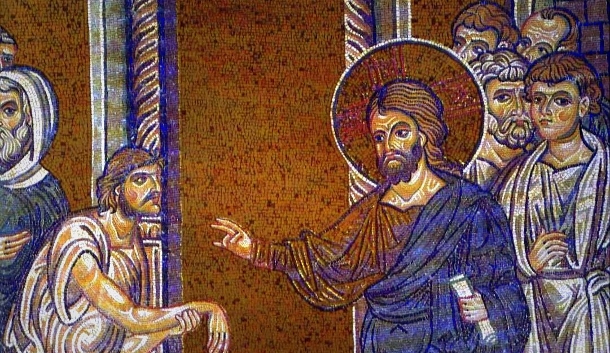
Christ-heals-the-man-with-a-paralyzed-hand-610x353

Back to the text: the Pharisees do not say anything.  Their silence upsets Jesus greatly.  Of course they don’t argue with Jesus because the question is rhetorical.  Naturally the Sabbath allows for life saving and other acts of good.  Of course, Jesus doesn’t stop with the basic question.  He has brought the man forward.  Between his question and the presence of the man he is implying that healing the withered hand is the equivalent of “saving a life” and failure to heal the withered hand is the equivalent of killing.  What?

Let’s be clear, Jesus is nobody’s fool.  He knows as well as anyone that the withered hand could wait a day or even 12 hours.  This is the key to understanding that the story is not simply about the perils of legalism or about the way that people become so rigid interpreting right from wrong that they fail to see the effect of such legalism on others.

Here is where the buried rock is revealed.

If you have been following this blog you know that I feel that scriptures are best understood in the broader context of the chapter / book that they are found in.  The Reformers (Luther, Calvin, Zwingli, etc) promoted the notion that scripture should be used to interpret scripture.  That is a great principle and scripture should be used to interpret other scriptures.  That said, it is also important that a reader of scripture first looks to the rest of the current book before jumping to other books in the Bible.  If you have been reading Mark (or this blog) then you know that Jesus is making a claim about the arrival of the Kingdom of God.  According to Jesus, the hour is now that God is acting.  In the healing of the paralytic there was the tacit claim that Jesus (as the Son of Man) has the authority to forgive sins (something that is YHWH’s purview) and in the conversations about Sabbath-keeping the implication is that Jesus is the Lord of the Sabbath (also the purview of YHWH). Throughout Mark, Jesus is saying look at this; see by what I do that what I say is true.

So many people describe the Gospel of John as Christocentric, but how can you miss the fact that in Mark the center of every story thus far and the focus of every point has been Jesus and who he is.  This gospel is extremely Christocentric.

Back to the paradox that healing the withered hand is not a matter of life and death. Robert Guelich, NT scholar, writes, “‘To do good’ and ‘to save a life’ takes on an eschatological ring of the coming of the day of salvation, the fulfillment of God’s promised activity in history.” God is acting, breaking into the world with the arrival of the Kingdom.  The kingdom is present wherever Jesus is present. I think that Jesus before the man in the synagogue is a moment where Mark wants us to recognize ourselves present in the presence of God. For Jesus to do good  / heal meant to give life and to refrain from good / not heal was to kill, meaning depriving another of the benefits of the redemptive / restorative power of God.  Failing to act would be cheating the man and all the gathered community of the right now benefits of the Kingdom of God even as they would have to wait for the ultimate fulfillment of the Kingdom. But the key is that the presence of Jesus brings life and changes things.

This is what we have seen throughout the Gospel of Mark.  A demon possessed man comes before Jesus and is made whole–saved–and Jesus demonstrates power over the forces of evil.  A paralyzed man is brought before him and made whole and Jesus demonstrates the power to forgive sin. A tax-collector is called into his retinue and redeemed from a sinful life and Jesus demonstrates the need for God’s Anointed to be amidst the sinners. Hyper-religious folk judge the followers of Jesus for not following the law more closely and Jesus proclaims an authority over the law itself.  Every aspect of Mark so far has been an effort to nudge the reader to make a decision about the true nature of Jesus. Is he the embodiment of the rule of God among us or not?

Every encounter from the demon possessed to the disciple; from the physically deformed to the self-righteous has been at its core a question of life and death because this is the moment that they have encountered Jesus. How each responded to that encounter is what has mattered most.

So how have you responded?  Have you acknowledged the truth of who Christ is?

How has your limited idea of Jesus prevented another from encountering Christ? If Jesus is just a great teacher why should anyone care? If he is a social radical then why should anyone make a decision for him rather than just see him as another Ghandi or Malcolm X?

Maybe you have chosen for Jesus and welcomed the encounter for yourself and your salvation.  Have your actions and your efforts encouraged others to know who He is?  Have you expressed forgiveness and grace to those whom you see as sinners? Or are you silent in the face of this life and death moment for others?

Maybe you have called out to God in your hours of need, a cancer diagnosis, a child who is sick, or a loss of  job. Upon restoration have you turned your heart over to the Lord or just thanked God glibly for granting your wishes?

Let’s be clear, Jesus is not just healing a man with a withered hand, rather, he is restoring a life.  Just as Jesus does when he brings the alcoholic to sobriety, the addict to wholeness, or reunites estranged family. Jesus acts and the proper response is deeper faith, deeper trust, and deeper praise of who God is for each of us.

Jesus never touches the man.  He tells him to reach out his hand and the as the man does so his hand is restored.  We are not told how the man responded to this act.  We are told that the Pharisees in seeing this incredible moment of life-giving miracle went from that place conspiring to end a life.

A final thought: if Mark wants us to see ourselves as the man with the withered hand, in the presence of God with nothing to account for but our limitations then Mark also wants us to ask ourselves how often are we like the Pharisees.  How often do we see the restorative work of God (an addict finding sobriety, a tax cheat attending worship, a murderer released from a prison sentence, the list is exhaustive) and question the wisdom and grace of God perhaps even to the point of considering the need to stop this radical love rather than celebrating that someone has experienced the overwhelming healing power of Christ?  There are really only two places to be in those moments.  One of them deepens our own salvation and the other leads to rejection of Jesus.

Feel free to use this Bible study for your own groups or discussion.  It is freely given. If you do I merely ask that you acknowledge where you got it and if you find it useful that you encourage others to seek it out. It is written with fear, foreboding, and prayer by a fellow hypocrite who is simply trying to figure out the road ahead.



Ahem, Please Direct Your Attention…

Read Mark 2:18-28

Note: Did you know that you can follow the Hypocritical Christian blog?  At the bottom of the page simply click follow and you can even have the latest blog post delivered to you via email. 

the word jesus

It was a slow day today at the dealership. Eh, it happens.  When it happens there are opportunities to talk with fellow suffering sales colleagues or strike up an argument on Facebook.  Today, I did both.

A colleague of mine came out complaining of the proposal of New York City’s mayor to allocate $10 million in taxpayer’s money for aiding those newly released from New York City prisons in finding employment.  “How Stupid is that?” we were asked.  Being sometimes inclined to cause problems I responded with “why do you let them do that to you?”

“What do you mean?” he asked.

“Well, I mean, you let the people on the news get you all ginned up over things that do not make any difference to you whatsoever.  If NYC decides to spend their tax revenues in that manner it has absolutely no impact on you in Boerne, Texas in any way, shape or form.”

“Well I just think it is stupid.”

“Sure.  It may be but it doesn’t make any difference for you. It is not your money.  It isn’t your time.  I mean if it were the Governor of Texas or the Mayor of Boerne, sure, but this will not impact you at all.”

We sometimes get upset over stuff because we think we should or because it doesn’t follow how we understand things to be best done.  The Pharisees were apparently good at getting upset at how other people were choosing to conduct themselves or live out their faith.  In this they are not alone.  The above is a story from contemporary politics but I could have just as easily referenced the recent kerfuffle at Princeton Seminary over their decision to first award the Kuyper Prize to Tim Keller and then to rescind the same award under complaints from some of their current students, professors, and alumni.

The Facebook argument I got involved in was one about interpretation of the U.S. Constitution of all things.  Like I said it was slow today.  That all started from a reaction to a tweet that Trump made about the Freedom Caucus and the relative constitutionality of the Affordable Care Act and the right of the Federal Government to be involved in health care at all. Seems each of us can get bent out of shape over things that have little direct impact on us.  In the midst of that argument the person I was debating with and I got so caught up in minutiae that I think we both lost the point of the original argument.  We lost the forest for the trees as the saying goes.

I mention these two events as a strange segue to the last 10 verses of Mark.  Pharisees indeed seem throughout the gospels to be really concerned about “the how” of others’ living and in the process lose sight of the forest for the trees.  New Testament scholars sometimes get so caught up in details that they lose sight of the broader point that either a Biblical writer or Jesus is trying to make.

Case in point.  Mark gets a detail completely wrong.  The event of David and his colleagues feasting on the temple showbread did not happen during the tenure of Abiathar as the High Priest but rather occurred when Abiathar’s father was the High Priest.  Liberal Critical scholars and folks who like to undercut Biblical authority (not always the same people) will use this sort of “mistake” to suggest that the Bible is in error.  I think this is being picky. Mark may have gotten this wrong. A copyist may have messed this up (the High Priest at the time was Ahimelech). I think that the “mistake” is original to Mark because both Matthew and Luke rework the episode in their gospels to not include the name of the High Priest at all.  This implies they were cleaning it up if you hold to the theory that they had Mark’s gospel as a source document for their own work.  If you are interested in a reasonable explanation for this “mistake” by Mark, theologian Wiliam Placher provides one.  He suggests that it isn’t an error by the normally very careful Mark but an actual rendering of the words of Jesus. What? Blasphemy you say?  How could Jesus have made the error? Well, Placher suggests that Jesus is intentional in his saying the wrong name to highlight the poor scriptural knowledge of his critics.  Before you roll your eyes, think about the number of people who tell you something that the Bible says that the Bible doesn’t say.  To this day there are a lot of people who believe that “cleanliness is next to godliness” and “God helps those who help themselves” are found in the pages of scripture.  Memory tells me that they are both from Ben Franklin although the latter may very well only be the work of erstwhile nuns. I like Placher’s clever Jesus answer.  I enjoy picturing Jesus appreciating the irony of his critics nodding in agreement as he mistells the story.

No matter, none of this is the point of these 10 verses!

Notice what Jesus does in response to the question about fasting and Sabbath.  He directs the attention to himself.

In the response to fasting it is apparent that Jesus intends for us to realize that he is the bridegroom.  John the Baptist and his disciples fasted in preparation for the arrival of the messiah, but in Jesus, the Messiah is arrived.  The pharisees were fasting to perpetuate an interpretation of the law that did not include the purpose of the law but rather was following the law solely for the sake of the law.  Example: why is there a set belt law or a helmet law?  To encourage safety of motorists and motorcyclists in the event of an accident. The law exists to develop and encourage a habit that is good for the individual and the community.  The Mosaic Law serves a similar purpose, it promotes practices and ways of interaction that are healthier for the spirit of the individual and the community.  Together the practice of the Mosaic law instructs the individual in the manner of Godly living and empowers the community to be a witness to God in the world.  This is precisely what Jesus means when he says that the Sabbath was created for people rather than people being created for the Sabbath.

Fasting in the manner of the Baptizer’s disciples made no sense now that the Kingdom had arrived, but fasting in the manner of the Pharisees was senseless as well since it was not for the purpose of deeper spiritual commitment to God but following the law only to follow the law.  The former is fasting to make ready a way for the Lord (literally building a road) even after the Lord has already arrived on the way created.  The latter is forgetting why the way (road) was being built in the first place!

Jesus focuses the attention on himself and if you think back he did that throughout this whole chapter.  When it came time to heal the paralytic he called attention to his authority to forgive sins. When asked why he was in fellowship with sinners he called attention to his purpose to bring healing to the sinner.  When asked about fasting he asks why fast when he is present and when asked about the Sabbath he claims authority over the strict interpretation of the Mosaic law by saying the Son of Man, he himself, is Lord of the Sabbath.  With this Son of Man comment the chapter comes full circle with Jesus claiming the authority understood to belong only to YHWH.

Do you see what Mark has done?  He is building the case that this Jesus is the one whom the Baptist foretold.  He is establishing step by step that Jesus is whom the demon in the first chapter said he was: “The Holy One of YHWH”!

  • Do you know Jesus to be these things, to be more than a great teacher?
  • Do you ever find yourself following the rules of church all the while losing sight of the why of the rules?
  • How often do you in the midst of controversies take your eyes off of Jesus?
  • Have you ever found yourself, like the pharisees, judging the piety of your neighbor because they aren’t following the law correctly?
  • Do you forget to keep Jesus in the center and in focus?

I suspect that for most of us an honest answer to these questions will give us pause.  Take heart fellow hypocrites, the only answer that matters at the end of the day is how you answer the first question.  And if the answer to that first question is negative then I encourage you to keep reading the gospel of Mark and to pray specifically that the Holy Spirit will convict you of the truth of whom Christ is for you and indeed for all.

And if you answered yes to the first question but struggled with the subsequent questions then I commend to you the words of a well known hymn:

Turn your eyes upon Jesus

Look full in his wonderful face

and the things of earth will grow strangely dim

in the light of His glory and grace.

Feel free to use this Bible study for your own groups or discussion.  It is freely given. If you do I merely ask that you acknowledge where you got it and if you find it useful that you encourage others to seek it out. It is freely given and written with fear, foreboding, and prayer by a fellow hypocrite who is simply trying to figure out the road ahead.


Website Powered by WordPress.com.

Up ↑