Search

The Hypocritical Christian

Category

Uncategorized

Mark 2:1-12 (NASB)

sourced from http://www.biblegateway.org

The Paralytic Healed

When He had come back to Capernaum several days afterward, it was heard that He was at home. And many were gathered together, so that there was no longer room, not even near the door; and He was speaking the word to them. And they *came, bringing to Him a paralytic, carried by four men. Being unable to [a]get to Him because of the crowd, they removed the roof [b]above Him; and when they had dug an opening, they let down the pallet on which the paralytic was lying. And Jesus seeing their faith *said to the paralytic, [c]Son, your sins are forgiven.”But some of the scribes were sitting there and reasoning in their hearts, “Why does this man speak that way? He is blaspheming; who can forgive sins [d]but God alone?” Immediately Jesus, aware [e]in His spirit that they were reasoning that way within themselves, *said to them, “Why are you reasoning about these things in your hearts?Which is easier, to say to the paralytic, ‘Your sins are forgiven’; or to say, ‘Get up, and pick up your pallet and walk’? 10 But so that you may know that the Son of Man has authority on earth to forgive sins”—He *said to the paralytic, 11 “I say to you, get up, pick up your pallet and go home.” 12 And he got up and immediately picked up the pallet and went out in the sight of everyone, so that they were all amazed and were glorifying God, saying, “We have never seen anything like this.”

Images of Healing the Paralytic

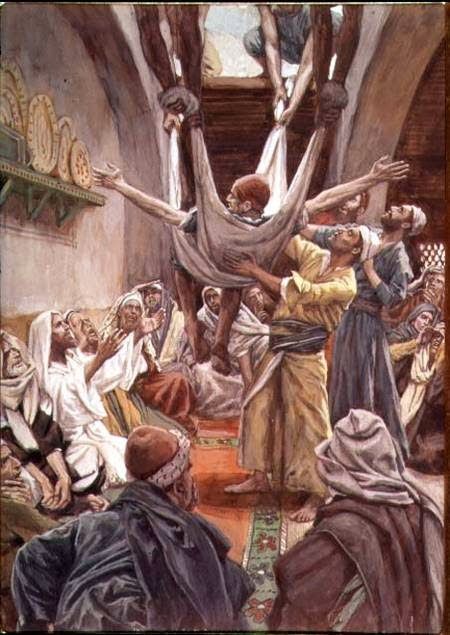
Below are three separate images depicting the healing of a paralytic man as told in Mark Chapter 2. The images come from different times.  This first one looks like one that I might have seen in school when I was a kid.  I went to Catholic school and they didn’t have child friendly pictures back then. While at first glance the image looks middle eastern, closer examination shows that all the folks in the image have European features regardless of how swarthy their skin is.

paralytic

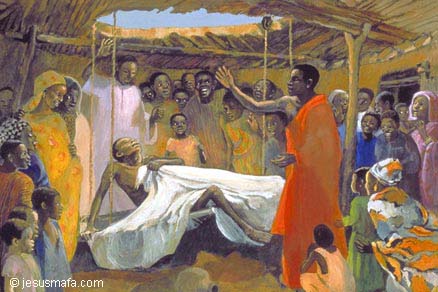
This second image is from the Jesusmafa images.  My understanding is that these images came out of a partnership between indigenous Mafa Christians and French missionaries in Cameroon. It is a great example of how the stories of the gospel can be inculturated, or put into a localized context, where ever they told.

jesusmafa_healing_paralyzed_man

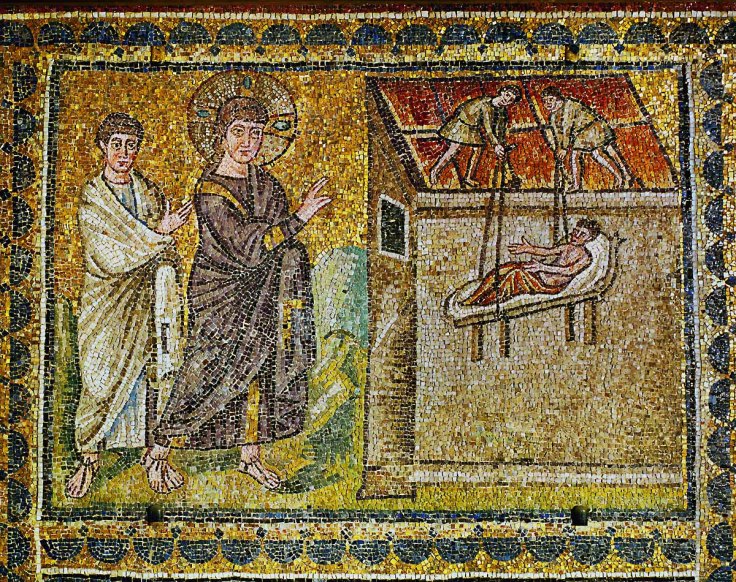
Finally there is this apparently even older image of the story. I am not sure where it came from but it is in a mosaic style that was fairly prominent in the first 500 years of Christianity.

The paralytic lowered from the roof, Jesus and an apostle. Mosaic (6th)

The Expectations of a Leper

“What’s up with your face?” I was asked recently.

“What do you mean?” I responded.

“You look like you scratched yourself; did you scratch yourself? Do you own a cat?” I self-consciously touched my cheek and realized that this person was rather inelegantly commenting on the bit of eczema that I have been unsuccessful in getting rid of from my face.  Until that moment I had not really thought to be self-conscious about it, because no one had commented on it before.  It has been a little odd for a forty-something to develop eczema and truth be told I was more annoyed at the notion that I would own a cat.  I am not good at treating the eczema with the steroid cream I have been given because I have this hang-up about grease on my hands.

Of course, the minor irritation of someone noticing a facial blemish and thinking I scratched myself is incomparable to what those people in Biblical times went through if they had “leprosy”.   I use quotations because we are fairly certain that the modern illness known as leprosy was not likely to have been in the Ancient Near East at the time of Jesus.  Leprosy in the Bible is much more likely to be a catchall phrase for the gamut of skin conditions (i.e. rash, eczema, psoriasis) that can befall a person.

Regardless of which condition the leper had they were excluded from the community until declared clean by a priest. They often were not allowed in worship spaces.  They were asked to announce themselves as “unclean” in crowds lest people touch them and become unclean themselves.   To our modern ears this seems silly, but just watch a commercial advertising Stelara and you will realize that even today people feel excluded from lots of activities because of skin conditions. This shunning is the sort of life that the leper at the end of Mark Chapter 1 was experiencing when approaching Jesus for the chance to be made whole.

Before we discuss that though, we need to make note of something that seems terribly out of character for Jesus. We are told by Mark that Jesus has made quite a name for himself in Capernaum.  His teaching in the synagogue has impressed.  His exorcisms have been hugely successful.

He even healed Peter’s mother-in-law, bedridden with fever.  The news about Jesus had spread from his teachings and the whole demon expulsion stuff, but apparently it is the garden variety healing that begins to draw the crowd. It makes sense given that this is a time where there is very little medicine to speak of and no Walgreens on the corner to dispense remedies.

Mark says the whole city gathered at his door. I can believe it.  No one likes being sick.  I live in the Texas Hill Country and  believe me if a person appeared who could wave their hand and cure people of sinus infections and cedar allergies there would be the largest traffic jam in the history of the world on the street where they lived.

Before the next morning Jesus skips out and goes off alone to pray.  The disciples hunted for him. When they find him they point out that there is a tremendous crowd looking for him.  Jesus’ response is “let’s go somewhere else then.”

Wait? What?

Jesus is the great physician right?  He heals people.  I do not remember being taught about a Jesus who turns away people wishing to be healed. To make it even more strange, in just a few short verses, Mark relates a healing of this one leper who approaches Jesus.  What does this leper have that the sick people in Capernaum, some of whom no doubt have skin conditions, haven’t got.

The answer apparently is a belief in who Jesus is or more to the point an acknowledgement that Jesus is the Christ, the anointed one of God.  Let’s read between the lines, because I think that is what Mark wants us to do.  Jesus suggest that he needs to move on in order that he may preach.  Perhaps the crowds that now form are no longer gathering to hear the message of “repent for the kingdom of God has begun” but are gathering instead to get their needs met – and only their needs met.  The former expects something of them, the latter expects something only of Jesus.

  1. What does this mean for those tens of thousands of Christians today who seem to think that being Christian is about getting the blessings of this life?or  a promise of second life?
  2. What does this mean for those tens of thousands of Christians whose prayer time consists of praying for healing miracles and nothing else?
  3. What does this mean for those Christians that pray for their own needs (wants?) and never find time to pray for others or to pray for a deeper dependence on God?
  4. What does it mean for those Christian groups who promote meeting the needs of the poor, the hungry, the needy but never include a message of the gospel?

The leper, John the Baptizer, and the demon exorcised in the Capernaum synagogue all have something in common.  Each it their own way identified in Christ that God was at work. The demon knows because he says as much that Christ is the “Holy One of God.”  John the Baptist demonstrates through his humble preaching that he was awaiting the arrival of one that he was unfit to even bow down to untie the sandal straps of his feet.  The leper doesn’t say these things but rather indicates an awareness that something unique of God is happening in Jesus. “if YOU will it I will be clean.”

How many people had desired the leper to be clean.  His mother? most assuredly.  His wife? His children? His best friend? His well meaning rabbi? Depending on his age, there is no telling how many people wanted him to be clean.  He may even have owed someone money who wished for him to be clean so that he could work again and pay back his debts.  None of their desires were sufficient for his wholeness, but he is certain that if Jesus simply wills it it will come to pass-such faith!

And Jesus, who left Capernaum rather than heal the city gathered at his door, not only wills it but actually touches the leper and declares him cleansed.  Cleansing a leper, this is something that only God can do according to the rabbis in Jesus day and before.

Please do not read these words and think that I am suggesting that the difference between those who are healed and those who are not is the depths of their faith.  That is not at all what I am saying although there are a great many misguided Christians who say that very thing to people all the time.  There are also a great many Christians who heap tons of guilt upon their own spirit because they have prayed and prayed to no avail.  They question their faith.  The Christians who suggest that someone should just believe harder are hypocrites because there own faith is insufficient in some area of their life.  The ones who have made themselves feel guilty would not have done so if so many other Christians had not hypocritically told them their faith was weak.

What I am suggesting is that Mark wants us to see the difference between the needy crowds that are being avoided and the faith-filled leper who is cleansed. The leper recognizes the authority of Christ and functions out of that belief that the Divine Will is at work in Jesus. The leper has the expectation that this Jesus can do the things that only God can do.

Jesus sends the cleansed leper away with instructions to be quiet about the healing and to present himself to the priest and offer his sacrifices according to the law.  Presumably when the leper speaks with the priest he is to tell the story because Jesus comments that he is to follow the law of Moses as a testimony to them.

In those instructions there is an important point regarding the law that we can infer.  The law of Moses, whether you mean the 10 commandments or all of the Levitical code, is a tool but not a cure.  The law can be used to discern (i.e. a leper is either clean or unclean); the law cannot heal.

I sell cars. In all of the 2017 Chevrolets that I sell there is a warning message that comes on when you turn the car off. In the information center or the touch screen display, words reminding you to check the back seat appear.  The message is there for the purpose of helping prevent people from leaving pets and children in the car.  In most places it the USA doing either is illegal because of the danger that the heat of a parked car can cause for a baby or a puppy. As much as we would hope that this would never happen it does.  Some parents are so harried and busy that they forget.  If the pet is asleep an owner could easily forget that the animal is in the car.  People are not perfect.  The law exists to remind us that the behavior is deadly.  But the existence of the law does not end the occurrence of the crime. No law can end crime simply through its existence.

The law cannot prevent nor can it heal. The law is a tool of discernment. I am either speeding or I’m not.  That is the law. Likewise, the law of God deems us sinners with respect to a commandment or not a sinner.  In our culture only the judge or an appropriate authority can deem me innocent or not guilty regardless of my crime be it a local judge or a governor’s pardon.  In these roles they represent the lawgiver.  Christ represents the lawgiver.  Only God can declare us righteous.

Our mistake as Christians is made when think that we can follow our way to wholeness. When we think that obeying the law will make us righteous before God. If the whole law can be summed up in the command to love God with the whole self and the neighbor as we love ourselves then we are all sinners before the law. Only God can heal us and make us whole. Only God can grant us pardon and give us life.

As Christians we should endeavor to follow the commandments of God but we must be mindful that the following no matter how perfect does not do the healing or the saving. The only following that works is staying close to Christ: trusting and believing in him.

  1. How are you doing in this sort of trust?  Do you only trust God when things are going well or do you trust God in all circumstances?
  2. Have you ever judged someone else as not redeemed / saved because they were a sinner in your eyes?
  3. The Christian is freed from the law because of the saving work of Christ. Have you questioned God’s ability to pardon you because of your own failures to keep the law of God correctly?
  4. What would the church look like if we trusted God to heal/ save the sinners in our community?

Feel free to use this Bible Study for your own groups or discussion.  It is freely given. If you do I merely ask that you acknowledge where you got it and if you find it useful that you encourage others to seek it out. It is freely given and written with fear, foreboding, and prayer by a fellow hypocrite who is simply trying to figure out the road ahead.


Mark 1:32-43

Sourced from Bible Gateway.  The Message paraphrase of Mark 1:32-43

Mark 1:32-45The Message (MSG)

32-34 That evening, after the sun was down, they brought sick and evil-afflicted people to him, the whole city lined up at his door! He cured their sick bodies and tormented spirits. Because the demons knew his true identity, he didn’t let them say a word.

The Leper

35-37 While it was still night, way before dawn, he got up and went out to a secluded spot and prayed. Simon and those with him went looking for him. They found him and said, “Everybody’s looking for you.”

38-39 Jesus said, “Let’s go to the rest of the villages so I can preach there also. This is why I’ve come.” He went to their meeting places all through Galilee, preaching and throwing out the demons.

40 A leper came to him, begging on his knees, “If you want to, you can cleanse me.”

41-45 Deeply moved, Jesus put out his hand, touched him, and said, “I want to. Be clean.” Then and there the leprosy was gone, his skin smooth and healthy. Jesus dismissed him with strict orders: “Say nothing to anyone. Take the offering for cleansing that Moses prescribed and present yourself to the priest. This will validate your healing to the people.” But as soon as the man was out of earshot, he told everyone he met what had happened, spreading the news all over town. So Jesus kept to out-of-the-way places, no longer able to move freely in and out of the city. But people found him, and came from all over.

Mark Chapter 1

sourced from Bible Gateway

Mark 1 (NASB)

Preaching of John the Baptist

The beginning of the gospel of Jesus Christ, the Son of God.

As it is written in Isaiah the prophet:

Behold, I send My messenger [a]ahead of You,
Who will prepare Your way;
The voice of one crying in the wilderness,
Make ready the way of the Lord,
Make His paths straight.’”

John the Baptist appeared in the wilderness [b]preaching a baptism of repentance for the forgiveness of sins. And all the country of Judea was going out to him, and all the people of Jerusalem; and they were being baptized by him in the Jordan River, confessing their sins. John was clothed with camel’s hair and wore a leather belt around his waist, and [c]his diet was locusts and wild honey. And he was [d]preaching, and saying, “After me One is coming who is mightier than I, and I am not fit to stoop down and untie the thong of His sandals. I baptized you [e]with water; but He will baptize you [f]with the Holy Spirit.”

The Baptism of Jesus

In those days Jesus came from Nazareth in Galilee and was baptized by John in the Jordan. 10 Immediately coming up out of the water, He saw the heavens [g]opening, and the Spirit like a dove descending upon Him;11 and a voice came out of the heavens: “You are My beloved Son, in You I am well-pleased.”

12 Immediately the Spirit *impelled Him to go out into the wilderness.13 And He was in the wilderness forty days being tempted by Satan; and He was with the wild beasts, and the angels were ministering to Him.

Jesus Preaches in Galilee

14 Now after John had been [h]taken into custody, Jesus came into Galilee, [i]preaching the gospel of God, 15 and saying, “The time is fulfilled, and the kingdom of God [j]is at hand; repent and [k]believe in the gospel.”

16 As He was going along by the Sea of Galilee, He saw Simon and Andrew, the brother of Simon, casting a net in the sea; for they were fishermen. 17 And Jesus said to them, “Follow Me, and I will make you become fishers of men.” 18 Immediately they left their nets and followed Him. 19 Going on a little farther, He saw [l]James the son of Zebedee, and John his brother, who were also in the boat mending the nets.20 Immediately He called them; and they left their father Zebedee in the boat with the hired servants, and went away [m]to follow Him.

21 They *went into Capernaum; and immediately on the Sabbath He entered the synagogue and began to teach. 22 They were amazed at His teaching; for He was teaching them as one having authority, and not as the scribes. 23 Just then there was a man in their synagogue with an unclean spirit; and he cried out, 24 saying, “What [n]business do we have with each other, Jesus [o]of Nazareth? Have You come to destroy us? I know who You are—the Holy One of God!” 25 And Jesus rebuked him, saying, “Be quiet, and come out of him!” 26 Throwing him into convulsions, the unclean spirit cried out with a loud voice and came out of him. 27 They were all amazed, so that they debated among themselves, saying, “What is this? A new teaching with authority! He commands even the unclean spirits, and they obey Him.” 28 Immediately the news about Him spread everywhere into all the surrounding district of Galilee.

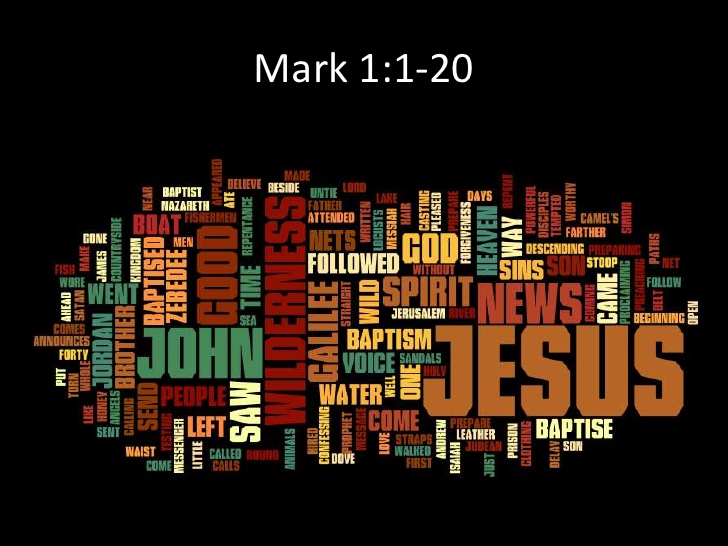
A Useful Word Art Of Mark Chapter 1

What Does it Mean to Repent

The gospel of Mark is generally considered to be the very first of the four gospels written.  It starts without much introduction; in fact, the very first sentence is not a sentence at all but rather a concept.  The beginning of the Good News (gospel) of Jesus Christ.

In whichever translation or copy of the Bible you read, Mark chapter 1 will seem to be a collection of vignettes that are distinct from one another. Do not be fooled.  While you may have been taught each of them individually, Mark was written as one long book and the themes of the entire book are all centered around that opening “sentence” and laid out in those first sections that are deceptively separate.  This is the discussion of the Gospel, the good news, of Jesus the Christ.

The themes of Mark as laid out in the first chapter are:

  • The origin of the Good News
  • Christ is the anointed one of God (Messiah) for the purpose of salvation
  • Christ has authority
  • Repentance is about believing who Christ is
  • The specific work of Christ is dealing with the sin problem

For this first post, I want to focus specifically on the second and fourth of these themes.

We see that Mark starts by saying this is the beginning of the Good News of Jesus the Christ, the Son of God. Beginning implies that you are seeing the start of something that is ongoing; or, that you are seeing the start of something that has an ending. Either way, the beginning is the start.  When we get to the end of Mark, you will see that there is no ending to this Good News, but that is for a much later post.

John the Baptist arrives on the scene (1:4) preaching a baptism of repentance for the forgiveness of sins.  

What does it mean to repent? For most people and many Christians it means “stop it”. What is to be stopped is whatever thing you are doing that is against the will of God. Sin is the word we Christians like to use for everything that we do that is outside of God’s will. I know a thing or two about sinning.  Truth is that I have many years experience in sinning.  Some of my sins are public and spectacular and some are private and mundane.  Most of us can look no further than the 10 commandments to realize that we got plenty of sin in our lives.  Christians are always hypocrites because we are always sinning.  And let me tell you that we do ourselves no favors with our very limited concept of repenting.

More than once when I was a pastor I had a people approach me about some person in the church that we were letting be a part of the fellowship of the congregation whom they knew were sinners. They wondered if we had asked these people to repent before they were allowed to join. Ironically, they never saw this admonishing of the church leadership for our poor standards as being judgmental or gossipy; after all, their motives were always pure – they wanted to keep the Church community clean from these sinners.  the problem of course is that if we did that then no one would ever be in the community, because, honestly, every single one of us is sinning in some way every single day.

Take a look at Mark 1:15.  Jesus begins his ministry by saying “the time is fulfilled and the kingdom of God is at hand; repent and believe in the gospel.  This statement is LOADED with meaning.  Depending on how you read it, “the time is fulfilled” seems like either hyperbole or simply a statement that the hour as come.  Nope!  Ancient Greek, the language of the New Testament, has two words for time: Kairos and Chronos.  The latter is the word from which we get the English words chronological  and chronometer.  This is measured time like minutes and hours and days and years.   Kairos is used in the New Testament as a short hand for God’s timing.  I like to think of it as the “right time”.  An illustration may help with the difference:  when a woman is pregnant the baby is said to be due in 9 months. That 9 months is “chronos” or the measured out time of gestation for a baby.  Now, any woman will tell you that the doctor’s prediction of the day a child will be born is as about as useful as the weatherman telling you when it will rain.  The actual birth is “kairos”, the time of the fulfilling, when the baby is ready. Don’t spend a lot of time saying but wait don’t babies  sometimes come too early? Yes, but they come when they come and that is the aspect of kairos I want you to understand.  What Jesus is saying is that the moment of the kingdom of God has come and the appropriate response is to repent and believe. 

Repent means to change direction.  Repent means to think differently.  And the way that Jesus meant it was to say, “Hey! God is acting now and you best believe that something wonderful is unfolding, RIGHT NOW”.

This isn’t different from John the Baptist.  John was saying “Hey, God is about to act and you better stop what you are doing and get ready for the arrival of what God is doing.”  You could even say that John was trying to tell every one that they need to change their way of thinking to believing that God was about to do what God promised.

I know that a lot of people will say that I am crazy to suggest that the principle meaning of repentance is to believe rather than to stop your sinning. Let me be clear: repenting is not not about stopping sin, but it is more so about trusting what God is doing and in this passage it is first and foremost about believing in who Christ is.

Case in point.  Mark starts by telling us that this is the good news of Jesus the Christ, the Son of God. Then in 1:11, the baptism of Jesus occurs where God says to the gathered that this is my beloved SON. Jesus says the time is now and the Kingdom of God (the very presence of God on earth if you will ) is happening in front of them.  Next, Jesus calls people to this repentance in action by saying “follow me” and then we have this curious moment in 1:21-28 where Jesus encounters a demon possessed person and the demon says “I know who you are- the Holy One of God”.

See the pattern? Everything is driving toward this one central point that Jesus is the Christ, the Holy One, the Anointed One, the Son of God.  Something special and unique (in the truest sense of this word) is happening right before their eyes and their belief in the same is of the utmost importance!

Questions

  1. Where are you in believing that Jesus is the Christ?
  2. Many Christians like to downplay or even deny the uniqueness of Christ?  If this a sin; is it hypocritical?
  3. Is Jesus of Nazareth just a great teacher or is Jesus of Nazareth something more?
  4. Is it more important to stop sinning or is it more important to start believing in the truth about Jesus?

Feel free to use this Bible Study for your own groups or discussion.  It is freely given. If you do I merely ask that you acknowledge where you got it and if you find it useful that you encourage others to seek it out. It is freely given and written with fear, foreboding, and prayer by a fellow hypocrite who is simply trying to figure out the road ahead.


Website Powered by WordPress.com.

Up ↑