Search

The Hypocritical Christian

Tag

bible

Take Me to the Other Side

We have been travelling on a journey of transformation, trying to understand Paul’s letter to the church in Rome. In the previous post, we began unravelling the mystery of God’s mercy. If you read that post, then you now know that the mercy of God is his forgiveness and provision for those who love him. In this post, we will look at the other side of mercy.

As a reminder, Paul tells us in Romans 12, that it is because of the mercies of God that we are to be living sacrifices, transformed by the renewal of our minds and not conformed to the way of the world. Last time we looked at Jesus’ story of the Samaritan to illustrate the provision and compassion of God that mercy requires of us. Today, we start with another of the parables in Luke that illustrates mercy.

Tax Collectors and sinners gathered regularly around Jesus. We are told in Luke that one of the frequent complaints of the good people about Jesus is that he welcomed these people and ate with them. The world is always good at labelling sinners. The “un-desireables” vary from generation to generation and culture to culture, but there are always those whom the world labels and gives up on. Jesus gave up on nobody.

In Luke 15, the religious people are concerned about how Jesus welcomes any and all. So, he replies with parables like the lost sheep and the lost coin. He tells them that Heaven itself is filled with rejoicing when one of the lost returns to the Lord. Each of those parables starts as a rhetorical question, “who among you would fail to act the same?” Then Jesus brings it so very close to home.

He says that a certain young man tells his father to give him his coming inheritance. In that culture it was the equivalent of a child telling their parent to “drop dead”. The young man then travels to what is described as a far country where he squanders his inheritance in loose living and find himself at what the alcoholics refer to as rock bottom.

The young man decides to swallow his pride and return to his father. He will throw himself at his father’s feet and become a servant rather than an heir because he has learned the errors of his ways. Anyone hearing this story would have connected with the parent who was wronged. Judgment of the son upon his return was the anticipated result.

Instead, Jesus tells us that when the son was still a long way off, the Father ran! Again, this was not a culture in which grown men ran for anything but fear and battle. Yet the father ran to meet the son! Before the son can even give his rehearsed speech, he is met with forgiveness and love. He is given a choice robe, the signet ring that marks him as an heir, and a celebration will be had with a fatted calf. He experiences mercy, unconditional love and provision.

Here at the end of the story Jesus reveals that there is an older brother; a sibling who has not done anything wrong. He has served the father in the proper ways and has not squandered any of the resources entrusted to him. He has been patient and dare we say righteous in his relationship to the Father. The older brother refuses to participate in the celebration because he cannot see past the behavior of his sibling.

The father comes out to urge the other son to join the party. The son reminds the father of all that the younger brother did no doubt certain that his judgment against the son is correct. Where is the justice in these actions you have taken to welcome him back in? That is the question on his mind.

The father replies “My son, you are always with me and all that I have is yours, but we had to celebrate your brother’s return because he was dead but now, he is alive; he was lost and now is found.”

Let’s be clear. The Father in the story is God. The inheritance is the loving provision, protection, and salvation that God provides. All of us are in some way the younger brother who rejects God and seeks to live life on our own terms, until we experience the revelation that we need God in our lives. The tragedy is that many of us after experiencing the salvation of God found in Jesus Christ become the older brother.

Content in the love of God and his forgiveness, too many Christians become judgmental. We no longer look at others with eyes of mercy. We are quick to count faults, remember past misdeeds, and think that God should lead with judgment instead of mercy towards those who wish to return. Somehow, the people of faith, who have experienced mercy, are quick to withhold the same grace from others. In their hearts they believe that they are maintaining the sanctity of the faith, but in reality, they have missed the truth of God’s grace from the beginning. If God has forgiven you of your sins, then he will forgive anyone of their sins.

“The mercies of the LORD are new every morning,” Jeremiah says. If that is true (and it is!) then those mercies are fresh and new each day for everyone. Those who have been transformed know this. Not only do they know this, but they join in the celebration when those who were lost are found. They do not sit outside and go “tsk, tsk”. They do not say “yeah, but what about…”. Instead, they say “Praise the LORD, for his mercy is from everlasting to everlasting!”

In Hebrews 9:11-28, we are told how the blood of Jesus on the cross is so much more effectual than the blood of the bulls and goats that were sacrificed on the altar in the temple. You can read the whole passage following the link above, but the point is driven home with these words: “how much more then will the blood of Christ, who through the eternal Spirit offered himself unblemished to God, cleanse our conscienses from the acts that lead to death, so that we may serve the living God! For this reason, Christ is the mediator of a new covenant, that those who are called may receive the promised inheritance — now that he has died as a ransom to set them free from the sins committed under the first covenant.

This is the mercy that Paul is referring to when he writes “I urge you therefore because of the mercies of God to present yourselves as a living sacrifice, holy and pleasing to God, this is your true and proper worship.

True Christians have experienced the forgiveness effected by the cross of Christ. True Christians are committed to extending this same mercy to everyone. Not conformed (the world seeks to judge and lessen) but rather transformed (the spirit person is merciful and edifies) by the renewal of the mind. True Christians know that God has forgiven them, and they should then forgive others. Be merciful because your Father in Heaven is merciful.

Why do so many Christians get this wrong? I suspect that it is pride. Once forgiven it is easy enough for a person to think they somehow earned or deserved that forgiveness. Pride tells us God loves us because we deserved that love. Pride tells us that we are more deserving than others. These thoughts are not the mindset of those living as the transformed.

There is an Aerosmith song entitled Take Me to the Other Side. It is not a gospel tune. Small surprise there, right? It does however contain this lyric. “Forget about your foolish pride. Take me to the other side.” Perhaps that should be our prayer. “Lord help me to forget my foolish pride and take me to the other side.” The other side is where Christ is waiting.

Peace to you on your own journey. Vaya con Dios!

Mercy, Mercy Me

The previous post began our journey through Romans. You can read it here. If you are up to date, you know that we ended that post by saying that “it all begins with mercy.”

“Therefore, I urge all of you because of the mercies of God” Paul writes in Romans 12:1. The therefore at the start of 12 is the culmination of all that Paul has written to the church in Rome up to that point; so, if this is the culmination of his argument, then mercy is a key thing to understand.

Mercy is everywhere in the scriptures. These posts on Romans are an effort to synthesize a three-year bible study that I led. The first year we walked through the Gospel of Luke. We encountered mercy over and over again. For Example: when Mary begins to prophesize after the angel Gabriel has come, she recites Psalm 103: “His mercy is upon generation after generation toward those who fear Him.” Likewise, Zacharias says “because of the tender mercy of our God with which the Sunrise from on high will visit us” referring to the promised messiah. Perhaps most importantly though Jesus himself highlights mercy to his followers.

Jesus in the midst of the beatitudes and preaching in Luke says “Be merciful, just as your Father is merciful.” This is not just a suggestion; it is something that is to be true of those who follow God. We are to be merciful. The parallel passage in Matthew expresses the same point differently. There the word is perfect. “Study to be perfect as your father in heaven is perfect.” Now that can cause a lot of grief for a person, because I don’t know about you, but I fail at perfection usually in the first hour of my day. Perfection is an ideal. But Luke helps us to understand that being perfect like God means being merciful!

We will come back to that thought in a minute but first we need to consider another place where Jesus highlights mercy. One day, a lawyer challenges Jesus to explain what it means to love your neighbor by asking “who is my neighbor?”. Jesus replies with a parable (the story of the good Samaritan) that culminates in this question, “Whom do you suppose was the neighbor to the man who was left for dead?”; the answer given “the one who showed mercy to him” is met with the response “go and do the same.”

The underlying Greek word for mercy is eleos. It is a word with a rich and deep meaning. In the New Testament the word means more than forgiveness, although it does mean forgiving a debt or providing pardon. Eleos also means compassion, generosity, and provision. The Samaritan did all of this in the story. In that manner he acted like his Father, God.

In Exodus 34, God offers a self-description to Moses: “The LORD, the LORD God, merciful and gracious, slow to anger and abounding in lovingkindness (hesed) and truth…“. Mercy is so important to the character of YHWH that it is the first adjective used in his self-description!

Hebrew scholars note that the word for mercy and the word for womb have the same trilateral root. In Biblical Hebrew, all words are built outward from three core consonants. These “roots” provide insight into the meaning behind the word. We do something similar in English. You can understand the English word enlightenment if you know the meaning of light as to illumine or make something easier to see. The womb is a place of love, safety, and provision for the baby. It is in the womb that the strong bonds of love are first formed between mother and child. The womb is a place where the growing child is kept safe and where all that is needed is provided.

Saying God is merciful is to say that he loves unconditionally, that God forms us, and we grow when connected to him. Saying God is merciful means that he provides everything that we need. We see aspects of this mercy throughout Luke, not only with the Samaritan, but also when Jesus feeds the 5000, heals the demoniacs, and when he promises the thief on the cross that that very day, he would join him in Paradise. Mercy all around!

The writer of Hebrews shares “we have a great high priest who has passed through the heavens, Jesus the Son of God… therefore lets us draw near with confidence to the throne of grace, so that we may receive mercy and find grace to help in time of need.

What does this have to do with Paul and his Letter to the Romans?

Paul grew up learning all that we know as the Old Testament. Early in his life, he felt that he understood all of who God was, what it meant that he was merciful and gracious; righteous and just. Paul was so certain of his understanding he persecuted the Christians in Jerusalem and other places because he was certain that they were heretics sharing falsehoods about God. Then it all changed. After encountering Jesus in a vision, he rededicated his understanding of those scriptures to comprehend what it meant for someone to have risen from the dead. By the time Paul is writing to Rome, and by the grace of God to us as well, he is able to say because of the mercies of God (his provision, his protection, his transforming spirit, and his salvation) we are to provide ourselves as living sacrifices.

Our forgiveness and justification in Christ Jesus are just the starting point. Now we are to live out mercy-filled lives in response to what God has done for us. This is our “rightful worship”. The path of your transformation follows opportunities of mercy, and it means so much more than just being more forgiving.

Some will recognize a Marvin Gaye song from the title of this post. Not particularly theological, but the song begins “oh mercy, mercy me, things aren’t what they seem to be, no.” In our next post we will start at the beginning of Romans and start seeing that the world isn’t what it seems. Until then the title of this post is a prayer you can live this week.

In Exodus when God describes himself it is written that he descended from the cloud and proclaimed the Name of the Lord. “YHWH, YHWH ELOHIM, a god of Mercy…” mercy is not just what God does but it is who God is! So, the title is a prayer best read this way: “MERCY, mercy me.”

Thank you for reading. If this post blessed you, please share it with someone else. As always it is freely given. You are welcome to use it although it would be nice if you credited where it came from.

Peace to you on your own journey, Vaya con Dios!

The Martha Moment

Read John Chapter 11.

The eleventh chapter of John outlines the raising of Lazarus from the dead, an act that is the final straw for the Jewish authorities who are threatened by the ministry of Jesus of Nazareth. After this miracle we are told that the powers that be make the decision that the Jesus movement must be stopped.

John sets the stage quickly for us. He tells us that a certain man named Lazarus, loved by Jesus, has taken deathly ill. Lazarus has two sisters well-known to NT readers, Mary and Martha. When word reaches Jesus he intentionally delays his journey back to Bethany by two days. There is a discussion amongst Jesus and the disciples about the wisdom of going back to Judea especially to a town so near to Jerusalem given the heightened tensions between Jesus and the authorities. Jesus and the twelve return and Jesus confronts death with victory to reveal the glory of God.

Why does Jesus delay?

Chances are good that your Bible has a subtitle to this chapter like “the death of Lazarus” or “the raising of Lazarus”. Because of this it is easy to miss out on something profound. I want to suggest to you that this is really a story about Martha.

We are told that Jesus loves Lazarus and his family. John actually tells us this in two different ways and the difference is significant. When the message is sent to Jesus about how sick Lazarus is the wording is “Lord, behold, he whom you love is sick.” (11:3). The word for loved used her is philo, the Greek word that describes the bonds of fidelity and friendship that yokes people together one to another. It is a word for love that captures that connection but can also be used for the love that is appreciative. In the United States, the city of Philadelphia, gets its name from this Greek word: hence, “the City of Brotherly Love”. In verse 5 though a different word is used, “Now, Jesus loved Martha, and her sister and Lazarus.” Agape is the word used here. Agape is the word for the sacrificial love that renders itself selflessly for the other. This is the love that exists regardless of the worth of the other; love that continues regardless of the response of the other. It is the love that God shows in John 3:16 and the love that Jesus commands for us to show one another in John 14:34.

Two things have been revealed in verse 5. The depth of the love Jesus had for Martha, Mary, and Lazarus; and that Martha is mentioned first. This is our clue that the story is about her.

Jesus delays his return for two days and then sets out for Bethany and arrives too late. Lazarus has been dead for four days. When he arrives, he remains on the edges of town. The community and the family are gathered together in mourning. Today we would say that they are sitting Shiva, a designated week of mourning, to show respect to the deceased and their loved ones. Martha receives word that Jesus has arrived and goes out to greet him. They have a terse exchange. “Lord, if you had been here my brother would not have died” (verse 21). I cannot help but think that she has an anguished, perhaps even accusatory tone. Her brother, whom she loves is dead, and the one that she knows could have done something to prevent it has not acted.

You know this feeling.

All of us have lost a loved one to death. All of us have known a tragedy where we had hoped and prayed that God would change the outcome. All of us know this pain.

Some will say, but wait, Martha also indicates that even in this pain she knows that Jesus can do something. She is not angry she is simply stating the obvious and asking him to act now. While I can see that in the rest of the verse as well, the fact that Mary says the same thing a few verses later tells me that the recrimination is there. Also, it is human nature. Grief is deep pain. I think the story speaks more truthfully when we hear it with all the angst we know she must have felt. “Lord, if you had been here my brother would not be dead”.

It is useful to compare verses 20 and 32. Martha we are told went out to Jesus and spoke to him. Mary when she goes out “quickly” to meet Jesus she falls at his feet and says the very same words “Lord if you had been here my brother would not have died”. See the distinction? Martha confronts Jesus. Mary takes a prostrate position, a worshipful stance. Mary’s response reads more like the lament of the faithful, seeking to understand God’s inaction.

Before we go on a reminder of what else we know about Martha and Mary. In Luke’s gospel we have a short story about a time that Jesus stayed in the sisters’ home. Mary remains at the feet of Jesus neglecting the usual hosting duties of a Jewish woman. Martha is left to handle all the details. Remember Jesus has an entourage of disciples there were likely a great many people about the house that day. When Martha asks the Lord to tell Mary to help Jesus replies “Martha, Martha you are worried and bothered by so many things, but only one thing is necessary. Mary has chosen the better part which shall not be taken from her” (Luke 10:41-42).

Back to John chapter 11. We might say that Martha and Mary are still “on brand”.

Why did Jesus delay? Because this story is about his love for Martha. This is Martha’s moment. This is when she will be moved from an understanding of who Jesus (knowledge) is into a relationship with Jesus (knowing). To put it a different way, Jesus has delayed so that he can reveal the truth about himself in such a way that Martha will no longer just have a faith that is all in her head but a faith that is mind, heart, and soul.

Allow me to show you what I mean. There is a pattern in John’s gospel wherein conversations with Jesus result in statements and questions geared toward bringing the person into a deeper faith and understanding about who Jesus truly is (Nicodemus and the Samaritan woman for example). When confronted by Martha, Jesus responds saying “Your brother will rise again”. Martha says “Yes, Lord, I know that he will arise again in the resurrection on the last day”. Good theologian, Martha, she knows the facts about the resurrection on the day of Judgment when some are raised to eternal life (second life) in the kingdom come and some are raised to judgment and damnation (second death).

I am the resurrection and the life; he who believes in me will live even if he dies and everyone who lives and believes in me will never die. Do you believe this?” (John 11:25-26).

Even in English we can see the distinction that is present. Martha says that she knows that her brother will rise for the judgment at the end of the age. Jesus wants to take her into a deeper understanding. Knowledge alone is not good enough. He is asking about belief, about faith. Not to get too granular in detail but know that there are two different verbs at work in this exchange. There is a different Greek word Martha has used for knowledge than the Greek word that Jesus has answered back as belief.

Jesus question is a next-level question. He wants to move Martha past an understanding of who he is based on knowing the “right” answers into a relationship with him that produces a living faith. He wants her head knowledge to be strengthened by heart knowledge that renders a faith that produces trust. Jesus wants to help Martha reach the sort of faith that is found in the greatest commandment: “you are to love the Lord your God with all your heart, soul, mind, and strength.”

Martha’s answer reveals that she isn’t quite there yet. “I have believed that you are the Christ, the son of God, the one coming into the world.” Don’t get me wrong, this is a strong statement. Everything that she says of Jesus is true; and she uses the same Greek word in response to Jesus that gets translated as belief. All this is good, but her answer does not answer the question Jesus asked.

I am the resurrection and the life; he who believes in me will live even if he dies and everyone who lives and believes in me will never die. Do you believe this?” (John 11:25-26). The question that was asked was not does she believe that he is the Christ, the son of God. Jesus knows that she knows this. The question being asked is does she believe in him; does she trust him?

Martha has the right knowledge, but it hasn’t moved from things that she knows like other stuff that she knows into something that changes the way that she lives. There are literally millions of Christians just like her. Perhaps you are one of them.

Have you ever heard a sixth-grade band concert? It is a painful experience. Why? Besides the fact that some of the kids are just there because they didn’t want to use athletics as an elective the concert is painful because the notes are just being performed as the individual notes. Each player of each instrument is remembering the difference between a quarter note and a dotted quarter note and where that note is on the staff to produce a sound. In other words, they are beginners. They have knowledge but they do not have the heart component yet. They are not feeling the music.

Some of those young players will go on to be pretty good at their instruments and some will play in a stage band. Here you will begin to hear real music. The players have moved passed the basic understanding of notes into feeling the rhythm and movement of the song. They have made a step passed simple knowledge and it has impacted their musical talent and results of their playing.

Now, contrast that with a professional jazz trio or quartet. Here you see something altogether different and wonderful. These players work off of one another and are able to seamlessly perform solos and improvisations of the theme and melody of the music. They have something beyond simple knowledge of music theory they have a trust in the theory and in each other. They become limitless as musicians when they achieve this level.

Do you see how this can be compared to the believer that learns to love the Lord with all their heart, soul, mind, and strength? Those believers know how to trust in the Lord in every season and in every instance. Likewise, they also are able to learn how to love their neighbor in all instances because they have integrated their head and heart knowledge to Christ.

Lest you think that knowledge–belief–trust is a continuum, I want you to picture it more like this:

This is not the best rendering (figuratively and literally) but the point is to not think that you start with knowledge and go into belief to get to trust. A person can start with either belief or knowledge, but what the Lord desires is for them to develop trust. Martha’s sister, Mary, seems to be on the belief side of the equation. This is seen in that although she comes out to greet Jesus with a worshipful stance she still says, “Had you been here my brother would not have died”.

Some readers may not be convinced about these assertions, but they do continue playing out in this story about Martha. They arrive at the tomb and Jesus tells them to unseal it. Martha questions the wisdom of this because of the stench that is sure to be unleashed. Head knowledge, again. Her brother has been dead for four days. Note the response that Jesus says to her, “Did I not tell you that if you believed you will see the glory of God?”

(I was today’s years old when I learned that in John 11:4 when Jesus says that the sickness of Lazarus is not unto death, but that God will be glorified that this is the message that he sent back to the sisters and not something that he said to the disciples when he received the message.)

Jesus had told Mary and Martha that their brother’s illness would not be unto death. This is why the conversation about him being the resurrection and the life happens. This is why the recrimination in the statement ‘had you been here my brother would not have died”. This is why the delay. Jesus has not only created the conditions for the great sign-act of raising Lazarus from the grave, but he has also created a moment to draw Martha deeper into faith.

At the tomb, there is a representative of all of us. There is Martha, full of knowledge, worried about a great many things but lacking the deeper move into the trust that that knowledge should lead. There is Mary who believes in Jesus but also still needs to go deeper into trust. There are folks in the crowd that want to wait and see what will happen. There are some in the crowd who believe in Jesus but who still doubt what he can do. Finally, there are those who do not believe at all and are even antagonistic to the whole thing.

If you find yourself in the latter groups, the time is now for you to start a relationship with Jesus. Do not delay.

Scripture warns that we are to seek out the Lord while he may be found. While the good news is that Jesus comes to us, through the Holy Spirit, calling us both into faith and into faith deeper still, the admonition to seek while he may be found reveals that there is a time when it will be too late.

John has recorded for us Martha’s moment. For all of us there will come a time, maybe even several moments, when the Lord is going to call us into a deeper trust of who He is. How we respond will make all the difference. For even Jesus himself warned there will be those who will insist that they called him Lord and he will reply that he never knew them.

Have you had your own Martha moment? Ask the Lord for eyes to see and ears to hear so that you do not miss the next one.

Feel free to use this Bible Study for your own groups or discussion.  It is freely given. If you do I merely ask that you acknowledge where you got it and if you find it useful that you encourage others to seek it out. It is freely given and written with fear, foreboding, and prayer by a fellow hypocrite who is simply trying to figure out the road ahead.

The Text That Was Added (Mark’s Longer Ending)

With this post my reflections of the Gospel According to Mark come to a close. When I started this project I mistakenly, perhaps foolishly, thought that it would be approximately 16 posts (give or take) on Mark’s Gospel. That was 7 years ago. I did not realize then that the Lord would lead me on a long journey to more fully grasp who he was and what he was revealing in the words of Mark. Such is the nature of faith and the Christian life. Anyone who is in a real relationship with the God of all creation is also in an ongoing conversation with the Creator.

That is the phrase that my Old Testament professor, Andy Dearman, used to describe the Bible on the first day of my Into to the Old Testament class. He said that we were being invited into the longest ongoing conversation in the history of the world. The conversation between God and his creation.

Read Mark 16:9-20.

I have two very old family Bibles. One belonged to my maternal great-grandmother and the other to a paternal relative. I do not know which one, only that it predates my father’s father. In both instances they simply have Mark 16:9-20 as the completion of the Gospel of Mark. My own Bibles, regardless of translation, indicate that scholars disagree that these verses were penned by Mark. Chances are good that your Bible (particularly if it is a Study Bible) has similar notes and annotations.

Why is this significant? Modern scholarship has settled on the theory that these verses were added to the gospel and are not penned by Mark. The implication is that they are not to be considered original. For many this opens the question of whether they should be held as authoritative. This leads some to conclude if we cannot trust these verses how can we trust any of the rest of the Gospel of Mark; and, if we cannot trust any of the Gospel of Mark, how do we trust any of the scriptures as the authoritative word of God?

Full disclosure: I am not a trained textual critic. What you receive in this post are the reflections of a trained theological thinker and fellow sojourner in the faith. I will seek to explain a little bit of how textual criticism of the Bible works (from an elementary understanding), the conclusions that have been drawn, and a suggest an approach to the last 12 verses of the Gospel of Mark for the believer.

Textual Criticism is the study of the transmission and authenticity of the scriptures. In other words, it is a mostly scientific study of how we got the Bible that we have and whether or not what we are reading is reliably close to the original text.

What we have as the Bible (New and Old Testaments) are copies of copies of copies, because until the advent of the printing press the only way to get a copy of any written document was for someone to make a handwritten copy of the original. Therefore, one of the fundamental principles of textual criticism is that the older a copy is the more likely it reflects the original version. As it happens, two of the oldest total copies of the entire Bible known as Codex Vaticanus and Codex Sinaiticus (from the 4th century AD), both of which include the entire New Testament written in Greek, do not contain Mark 9-20. This has led many scholars to conclude that these verses were not original to Mark. This is why your modern Study Bible puts brackets around or has footnotes concerning these verses.

This seems reasonable. This is not the whole story.

Allow me to dig a little deeper. The New Testament is the single most well-attested ancient document in existence. What do I mean by that? There are more fragments, sections, complete copies of individual New Testament Books, and entire copies of the New Testament in existence today than any other work from ancient times. And it is not even close. The next most well documented ancient work that is not the New Testament are the writings of Homer. There are just shy of 650 copies of Homer reflecting 95% of the current text dated to within 500 years of the original. We have around 5600 ancient copies of the New Testament reflecting 99.5% of the current text dated to within 200 years of the life of Jesus!

Wow! When you add fragments (portions of a text) and incomplete copies of books or the whole NT the number skyrockets even further. All this is to say the reliability of the New Testament text that you have on your shelf, your nightstand, and on your iPhone is astronomically high. So read with certainty fellow Christians and Seekers!

I will not bore you with a lot of details, a google search and curiosity will give you more than enough information about the 12 verses at the end of Mark’s Gospel. I will point three things that you will learn if you undertake the aforementioned Google search.

One, there are over 1600 copies of Greek manuscripts of Mark that contain verses 9-20 as the conclusion of chapter 16. Two, many 2nd century Christian writers quoted portions of Mark 9-20 indicating that they were familiar with it as a part of the Gospel of Mark and considered it scripture. Three, there are other portions of the New Testament that Codex Sinaiticus omits that no one questions are a part of scripture indicating that the copyist who produced Sinaiticus had an agenda at work perhaps for the intended patron of the copy.

The other argument that is made against 9-20 being original is that it is different in language and grammar from the rest of Mark. This argument falters because other textual critics have pointed out that a person can choose different 12 verse sections of the rest of Mark and conclude that there is a difference in grammar and word choice from the rest of the gospel.

It is true that the Gospel of Mark can end at verse 16:8 without any problems. This has troubled some because the tomb is empty, but the women leave afraid and speaking to no one. Therefore, they conclude that later copyists also concerned about this ending compared to Matthew, Luke and John chose to add another ancient reflection on the resurrection of Jesus to make Mark align more with the other three.

Needless to say, this is all speculation and the stuff of doctoral dissertations!

I suggest the following two conclusions.

Let’s assume for a moment that a later copyist sought to enhance Mark’s gospel with a resurrection appearance (9-20) by borrowing from some other ancient source. If that is the case (and some scholars think that 9-20 is a reading for 1st century churches to use after Easter during worship) then what we have in our New Testament are 6 witnesses to the resurrection instead of 5 (Matthew, Mark, Luke, John, and Paul) which would make the story of the empty tomb more authentic not less.

The second conclusion is one that is admittedly faith-based and may not satisfy any critic of the New Testament. I believe that the New Testament remembers the person and significance of Jesus of Nazareth. I believe it shares with us that he was God with us, and that his death and resurrection was the action of God to redeem the entire creation. I believe that the tomb was in fact empty and that in reflecting on this reality the first Christians came to understand that in some way he was YHWH among us. I believe that he has ascended into heaven and has the name above all names. I believe that there is no other name under heaven by which people can be saved. I believe that he intercedes on behalf of believers, and he will come again to usher in the final age of history wherein he shall reign forevermore. Since I believe all of this, it is no small thing to also believe that God can ensure that the 27 books of the New Testament as I have received them are precisely what he wanted me to receive in their entirety.

Finally, is there anything in verses 9-20 that should give me pause?

vss 9-14: Jesus revealed himself alive to Mary Magdalene, the disciples on the road to Emmaus, and the 11 members of the inner circle of Jesus? Check.

vss 15-16: Jesus instructed them to go and preach the gospel and baptize? Check.

vss 17-18: amazing things accompanied them as they followed the command to spread the gospel? Check.

verse 19-20: He sat down at the right hand of the Father and signs and wonders confirmed the preaching of the first Apostles? Check

If verses 9-20 are original to Mark, there is nothing therein that is not in accordance with the rest of scripture that is accepted as authentic and authoritative. If they are not original to Mark, there is nothing therein that is not in accordance with the rest of scripture that is accepted as authentic and authoritative.

We are left with the same outcome.

The tomb is empty. Jesus has risen.

What decision will you make in living your life in response to this truth?

Please consider sharing this site with just one friend.  Remember that if you wish to use this post or any of the others as a bible study, or meditation at the start of a meeting, or for any other purpose all I ask is that you let people know from where you got it in the first place.

The Most Significant Person Ever

In the previous post, I suggested that the most significant day in history was the day of the resurrection since it is the only historical day that has significant impact for both the world and the individual. No other day in history until the end of the world is going to be as globally significant.

While at the end of the last post I zoned in on the reality that if Christ rose from the dead, every person has a decision to make. If Jesus rose from the dead, then everything else he said is true. That’s significant.

If Jesus of Nazareth rose from the dead, then he is the most significant person to ever live.

Before we plunge into that pool more deeply, a bit of housekeeping. When I began this blog many years ago, and I fully admit I have been an inconsistent blogger, the outline I was following was simply to go through the gospel of Mark. Not an exhaustive study of Mark but somewhat of an overview. I have reached the end of Mark and so there will be one more Mark centric post after today with a little look at the end of chapter 16 which may or may not have originally been written by Mark. After that I will begin a new and somewhat ambitious journey that the Lord has put on my heart born from a series of Bible Studies I led over the past several years for friends of mine. Normally, I say this at the end but, this blog is freely written and freely given. Share it or even use it for yourself, but please let others know where you got it. If any of the posts herein bless you then share those with friends that they might also benefit. My goal is simply to utilize a gifting and help people understand Jesus better and the Bible along the way.

If Jesus of Nazareth rose from the dead, then he is the most significant person to ever live.

What we read in the New Testament is a series of books that in various ways try to explain the significance of the Resurrected Jesus. The gospels seek to explain this using his words and recollections of his actions leading up to and in some cases after the empty tomb. Acts seeks to explain that significance through stories of how the good news of the resurrection event spread form Jerusalem around the Roman Empire. Pauls’ letters to the various churches and the other epistles all try to answer practical implications for believers all the while sharing the significance of who Jesus is. Finally, the Revelation of John, shares the future return of Jesus but even still seeks to explain what happened because of the Jesus event. So there is a theme running through the entirety of the New Testament.

Here is a small sampling of things said about Jesus in the New Testament:

  • “In Christ Jesus God was reconciling the world to himself” 2 Corinthians 5:19
  • “while we were still helpless, at the right time, Christ died for the ungodly.” Romans 5:6
  • “He is the radiance of His Glory and the exact representation of His nature and upholds all things through the power of His Word.” Hebrews 1:3
  • “He himself will come to have first place in everything for it was the Father’s good pleasure for all the fullness to dwell in him.” Colossians 1:18-19
  • “When I saw him I fell at his feet like a dead man. He placed his right hand on me saying, ‘Do not be afraid; I am the first and the last, and the Living One: and I was dead and behold I am alive forevermore…'” Revelation 1:17-18.
  • “awaiting eagerly the revelation of our Lord Jesus Christ who will also confirm you to the end blameless in the day of our Lord Jesus Christ” 1 Corinthians 1:8

The most significant person to ever live.

I would be remiss if I did not explain two words used so often with Jesus. Christ is the Greek word for Messiah which means “anointed one” and indicates someone on who God has placed a special status or blessing. It is a title and that is why we see it used on either side of the name Jesus by the various writers of the New Testament. Conversely Lord, is from the Greek word kurios, and while it can be used as a title in the sense of master or as a knight might refer to their Queen as “my Lord” in the Greek translation of the Old Testament the word is used almost exclusively for the place of YHWH, the name of God. Scholars argue, but the New Testament makes a lot more sense when we assume that these Jewish writers writing to Greek listeners about the significance of Jesus knew exactly how they would hear it as a statement of divinity.

Back to those verses. In order they lay out these truths of the significance of Jesus. The purpose of Jesus’ death and resurrection was to reconcile God and sinners (Ephesians 2). This happened at the right time in the history of the universe and nothing about us as individuals or a community warranted it (Galatians 4). God anointed Jesus, the Man, with the Spirit and the fullness of who He is (two natures human and divine) and in him we can know the very nature of God (John 1). He has all power and authority (Phillipians2). On the last day those who believe in Him and trust him will be found blameless and like Jesus himself will live forevermore (1 John 2:25).

There you go the theme of the New Testament in 5 verses. You might note that the summary contains references that are different from the verses. I did that so you would know I wasn’t cherry-picking or simply proof-texting. Now let’s go just a little deeper into the concept of a New Testament.

The earliest use of the term New Testament to describe these writings is from the Second century (think years that are in the 100s) and is a translation from Latin. We tend to hear two things from that phrase. One we think testimony because testament is not a word that we use often in English anymore outside of the phrase last will and testament. It is true that testimony is from the same Latin root that we get the word testament. It is also true that there is a “witnessing” element throughout much of the New Testament. There is however another meaning that is locked away in the word.

Back to the example of a will. A will is at its core a covenant agreement. The deceased has shared that these are their wishes after death for the matters of their estate. The covenant is with those who have been named in the will as executor and beneficiaries to carry out those wishes. It is not a contract. Dear old Grandma doesn’t call you in and say here sign with me a contractual promise that when I die you get my rocking chair. No, she has her lawyer write a clause saying Sally I leave you my rocking chair. The expectation is that everyone, including cousin Julie who always wanted the rocking chair, will abide by the wishes of the dearly departed. What does this have to do with the significance of Jesus? The older meaning of the word Testament as it is used in Latin during the second century is covenant.

Covenant is a rich Biblical word. God makes a covenant, most famously with Abraham, but also with Adam, Noah, Moses, and David. They are promises made by God that He pledges to keep regardless of what the other party does. Starting with Adam and going forward these are the pledges of YHWH. To Adam he promises that one day there will be a descendant of humanity that will overcome the curse of sin. Noah is promised that never again will YHWH seek to destroy every living thing and start over. Abraham is promised that his descendants will be as numerous as the stars of the sky. Moses is promised that when it comes to the people who have been brought out of Egypt YHWH will be their God and they will be his people. David is promised that one of his heirs will reign forever.

In Jeremiah, the prophet shares the word of the Lord: “Behold the days are surely coming… when I will make a new covenant with the house of Israel and the people of Judah. It will not be like the covenant that I made with them when I brought them out of Egypt…this is the covenant that I will make… I will put my law in their hearts; I will be their God and they will be my people.”

The New Covenant is promised.

What we call the New Testament is the good news that the New Covenant has begun!

You can read a little more about the time that Jesus made the arrival of the new covenant explicit here.

The second thing we here is concerning the word new. We have been conditioned by marketing to assume that new means better than the old. With the exception of New Coke, there is an assumption that the new formula, the new car model, the new iPhone, etc. is always a replacement of the old. This was also the assumption of many second century Christians. The New Testament replaced the Old Testament. Except that is not true. The promises of God exist eternally so those previous covenants are all still in effect.

In this case the title New Testament is a collective proof that the covenant promised by the prophets has arrived in the life, death, and resurrection of Jesus Christ.

The most significant person to ever live.

A theologian of the last century summarized it thus: “he has assumed human nature… united it to his Divine person so that our humanity belongs to him…. from the standpoint of reconciliation and justification effected in him, it means that, bearing our punishment, achieving the obedience we did not achieve and keeping the faith we did not keep, he acted once and for all in our place.”

Put a different way. Jesus is the one promised to Adam. Jesus is the first born of a new Creation whereby God will make all things new without simply destroying every living thing. Through Jesus the children of Abraham spans millions around the world. Jesus is the one who can keep the covenant law promised to Moses. Jesus is the heir of David who shall reign forever.

The most significant person to ever live.

And one of the great miracles of God is that you can know this Jesus, not like you know George Washington or William Shakespeare or Elenore Roosevelt, but like you know your best friend. Even better, you can know Jesus as you know yourself. It starts with the smallest amount of faith and seeking him while he can be found.

The most significant person to ever live is Jesus.

God Doesn’t Care…

Read Mark 14:53-15:40

…He suffered under Pontius Pilate; was crucified, died, and was buried.

So goes a small phrase of the Apostles’ Creed, an early memory device taught to people to encapsulate the Christian faith in a few brief words. Today when churches and organizations write statements of faith they are normally wordy, not pithy. That is the result of over thinking and unlimited paper.

The Apostles’ Creed works on an economy of words. There is much of Jesus life that is not mentioned: no miracles, no healings, no excorcisms, no teaching, and no baptism. Not every Christian denomination or group uses the Apostle’s Creed (“We have no creed but JESUS!”), but you might be hard pressed to find a group of Christians that can not agree with at least 95% of the creed.

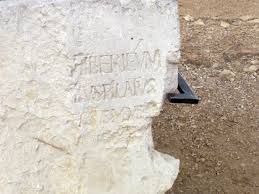
Christianity has always been a faith that is rooted in a specific, verifiable, historical time. Pontius Pilate is mentioned outside of the Bible in documents that still exist. He was a real person who had imperial responsibilities in a region that included Jerusalem during the years in and around 30 CE.

This is archaeological evidence of the existence of Pontius Pilate

Of course the Apostles’ Creed doesn’t say why Jesus was crucified. The creed is not an evangelism tool, it’s function is not to convince someone of the faith, but rather to be an acknowledgement of the faith by a believer.

This blog has been a project that has taken far too long to work through the Gospel of Mark. It is also been primarily aimed at someone who already knows about Jesus and who he is. For better or worse that is how it has played itself out.

The title of this post is a shorthand. “God Doesn’t Care…” That ellipsis is your clue. The rest of the sentiment is as much as we do about the things that we care about.

Why did Jesus have to die? Because people care way too much about the wrong things. Here are a list of the wrong things that Jesus did during his public ministry that led him to being arrested, beaten, and turned over to the Roman authorities for capital punishment.

  1. He healed people on the Sabbath, in other words he felt it was more important to do good on the day of rest than to blindly honor the day of rest.
  2. He ate with outcasts and people whom the “good” people of society deemed to be on the outside. He cared more about a community that ever expanded with mercy and grace at its center than the lines and boundaries that were drawn between people.
  3. He was willing to be in contact with lepers, blind people, children, and women who were menstruating. Not one person was ever unclean in his eyes.
  4. He called out religious leaders and people who came up with narrow interpretations of God’s law to make it ever harder and harder for people to feel a part of good society as the real vipers and sinners.
  5. He openly questioned whether station in society mattered, whether wealth and success equaled the blessing of God, and if making money off of poor people through burdensome taxes, bad exchange rates at the temple, and other forms of organized corruption were just.
  6. He suggested that the religious authorities of his day might value their positions of honor more than their piety.

That list can go on and on. Interestingly enough he did not openly question the authority of the Roman Empire to rule over the traditional land of Israel. In fact, he told people that they should do whatever a roman soldier asked and more. Jesus was even quoted as suggesting that the taxes paid were to be paid because they were Caesar’s due. To get Rome to put him to death the local authorities of Jerusalem had to convince Pilate that Jesus was seditious and claimed to be the King of the Jews.

So why does he have to die? As I mentioned above the Apostle’s Creed leaves the stuff of Jesus life out and focuses on the fact that he “was crucified dead and was buried.” Now to be clear all of the things that Jesus did in that list of 6 were good things and worthy of our attention and response. Those 6 things are simply not reason enough for the only begotten Son of God to die.

Many Christians think that they are reason enough. I suspect that they have a view of Jesus that makes him like Ghandi or Rev. Martin Luther King Jr. namely a peace-loving person who speaks truth to power and becomes a threat to the powers that be and therefore must be stopped. That is often the fate of the person who bucks the system; crushed by the machinations of power to maintain the status quo. I suggest that is also too little a reason for Jesus death.

Later in Apostles Creed after the section on Jesus there is a brief litany of doctrines that the Christian believes in: “I believe in the holy, catholic church (little C), the forgiveness of sins, the resurrection of the body and the life everlasting.”

This is the part that the other Christians emphasize. Jesus is not just some worthy do-gooder who runs afoul of the authorities. That’s no savior for the world. For these Christians, the death of Jesus is about the forgiveness of sins. It is safe to say that for them the death of Jesus is ONLY about the forgiveness of sins.

That forgiveness would include the things I mentioned above in that list of 6 things that Jesus did to cause trouble; however, they tend to focus on the things that people do individually that violate the 10 commandments. So, under that formulation, Jesus’ death pays the penalty for all who believe in Jesus for their murders, lies, adulteries, stealing, idolatry, and coveting. They say that Jesus dies to free each of us from the penalty of our sin which is death. His death provides a means to be right with God because his blood is shed for us vicariously and becomes our substitute in judgment.

Apologies for oversimplifying some really important theological concepts. Truth be told though, this idea of why Jesus had to die is also too small. In some ways it is arrogance to suggest that the reason that the Son of God has to die is because I got in trouble in the second grade for bringing a toy car to school, had it taken up by the teacher, months later took it back from her desk, and lied when she asked if I had taken it out of her desk. (It was a Hot Wheels of the Speed Racer Mark V so as the kids say if you know you know!)

Fun fact: I started this post 4 years ago! Apparently, then I wasn’t ready to say why Jesus had to die. In the interim, I have led some fairly comprehensive in-person Bible Studies on Luke, Hebrews, Philippians, and Romans. Through that process and my own study, prayer, pondering and angst I have wrestled with this seemingly simple question: why did Jesus have to die?

Again, I point out that the Apostle’s Creed does not list any details of Jesus life apart from his virgin birth, his crucifixion under Pontius Pilate, and his resurrection. Forgiveness of individual sins is a corollary at best in the Creed and grouped in with a litany that includes belief in the Holy Spirit, the Church and baptism. (Note: it is true that in the Nicene Creed we have a purpose for Jesus: “for us and for our salvation he came down from heaven”, but none of that is explicitly in the Gospel of Mark. Particularly not in Chapters 14 and 15.)

Stay with me. I have wrestled with this question a long time and I am going to sum up with answers that may or may not satisfy. I am prepared to be wrong, and I will admit that while I can show my work like any good math student, I am not going to make this post even longer by going through it all here. I am simply going to go to the two conclusions I have drawn (so far) and humbly say that I am still working out all the details.

“Eloi, Eloi, lema sabachthani?” (The only words of Jesus on the cross mentioned by Mark and translated: My God, My God why have you forsaken me?)

“Bartender you see, the wine that is drinking me, came from the vine that hung Judas from the devil’s tree, its roots deep, deep in the ground.”

These are lyrics from a song by Dave Matthews (who while not a professing Christian is often a pretty solid theologian) about a person who is bargaining with the bartender because of his fear of death. Roots deep, deep in the ground. The sin problem. It has some very deep roots that go well beyond both our everyday individual sins to encompass the extraordinary depths of our collective evil (racism, war crimes, genocide, child abuse, corruption to name only a sampling) and the ultimate penalty of those sins great and small and cumulative. Death.

Not only that, if that weren’t enough, but the sin problem is also the reason for the tortured natural world. What the Bible calls futility. Futility is why there are weeds in the garden and why there are virus that make us sick. Futility is why we have to work so hard to grow food (or a houseplant) and why dogs and cats so often fail to live in harmony. And all over that futility is the shroud of death.

The sin problem encompasses so much more than the foibles and excesses of you and I.

Roots deep, deep in the ground.

I have come to the conclusion that when Jesus is crucified, he became sin itself. Not simply that he took on all of our individual sins (as the atonement crowd likes to trumpet), but that he literally became the embodiment of sin. This is why he is forsaken by God. Like apathy to love and hate, the absence of feeling to strong feeling; sin is the absence of God. When Christ cries out these words from the cross it is because he is feeling for the only time in his life what it is to exist in a vacuum where God is not present.

Why did Christ have to die? So that sin could be destroyed. He dies to begin the unravelling of the eons old sin problem. To allow sin itself to stand in judgment before a righteous God. So that all the evil (sin) that ever was and ever shall be is dealt with in its entirety. Jesus became sin and took on the judgment that sin merited so that it could be dealt with once and forever. That is why he has to die, and in accepting the cold fingers of death (that we all experience and fear as the separation from all that love is) he puts himself in the position to defeat that enemy as well.

If that conclusion doesn’t make sense to you then I apologize because I have yet to fully comprehend how to express the thoughts in words. I fear it is a conclusion that goes beyond a rational explanation.

But I am thoroughly convinced that something that can best be described as cosmic is happening on the cross.

I mentioned two conclusions. The second one is much easier to express. At the end of the day the cross is not about judgment but about mercy. While judgment is being rendered (on sin through the death of Christ) what is being pronounced is the exceptional, never-ending mercy of God.

Not mercy limited to pardon extended to those who ask for it. But mercy flowing like a never-ending stream that overwhelms all who wade into it. For the One who is the rightful Judge is also the One who embodies the sin.

And that feels more like the mysteries of grace to me.

Earlier I said that the title of this post was God Doesn’t Care… (as much as we do about the things that we care about) and that is still true. The better completion of the title would be:

God Doesn’t Care as Much as We Do About the Things that We Care About Because He Cares So Completely About the One Thing that Truly Mattered.

Now that is wordy and not at all pithy!

Feel free to use this Bible Study for your own groups or discussion.  It is freely given. If you do I merely ask that you acknowledge where you got it and if you find it useful that you encourage others to seek it out. It is freely given and written with fear, foreboding, and prayer by a fellow hypocrite who is simply trying to figure out the road ahead.

Website Powered by WordPress.com.

Up ↑