Search

The Hypocritical Christian

Tag

god

The Text That Was Added (Mark’s Longer Ending)

With this post my reflections of the Gospel According to Mark come to a close. When I started this project I mistakenly, perhaps foolishly, thought that it would be approximately 16 posts (give or take) on Mark’s Gospel. That was 7 years ago. I did not realize then that the Lord would lead me on a long journey to more fully grasp who he was and what he was revealing in the words of Mark. Such is the nature of faith and the Christian life. Anyone who is in a real relationship with the God of all creation is also in an ongoing conversation with the Creator.

That is the phrase that my Old Testament professor, Andy Dearman, used to describe the Bible on the first day of my Into to the Old Testament class. He said that we were being invited into the longest ongoing conversation in the history of the world. The conversation between God and his creation.

Read Mark 16:9-20.

I have two very old family Bibles. One belonged to my maternal great-grandmother and the other to a paternal relative. I do not know which one, only that it predates my father’s father. In both instances they simply have Mark 16:9-20 as the completion of the Gospel of Mark. My own Bibles, regardless of translation, indicate that scholars disagree that these verses were penned by Mark. Chances are good that your Bible (particularly if it is a Study Bible) has similar notes and annotations.

Why is this significant? Modern scholarship has settled on the theory that these verses were added to the gospel and are not penned by Mark. The implication is that they are not to be considered original. For many this opens the question of whether they should be held as authoritative. This leads some to conclude if we cannot trust these verses how can we trust any of the rest of the Gospel of Mark; and, if we cannot trust any of the Gospel of Mark, how do we trust any of the scriptures as the authoritative word of God?

Full disclosure: I am not a trained textual critic. What you receive in this post are the reflections of a trained theological thinker and fellow sojourner in the faith. I will seek to explain a little bit of how textual criticism of the Bible works (from an elementary understanding), the conclusions that have been drawn, and a suggest an approach to the last 12 verses of the Gospel of Mark for the believer.

Textual Criticism is the study of the transmission and authenticity of the scriptures. In other words, it is a mostly scientific study of how we got the Bible that we have and whether or not what we are reading is reliably close to the original text.

What we have as the Bible (New and Old Testaments) are copies of copies of copies, because until the advent of the printing press the only way to get a copy of any written document was for someone to make a handwritten copy of the original. Therefore, one of the fundamental principles of textual criticism is that the older a copy is the more likely it reflects the original version. As it happens, two of the oldest total copies of the entire Bible known as Codex Vaticanus and Codex Sinaiticus (from the 4th century AD), both of which include the entire New Testament written in Greek, do not contain Mark 9-20. This has led many scholars to conclude that these verses were not original to Mark. This is why your modern Study Bible puts brackets around or has footnotes concerning these verses.

This seems reasonable. This is not the whole story.

Allow me to dig a little deeper. The New Testament is the single most well-attested ancient document in existence. What do I mean by that? There are more fragments, sections, complete copies of individual New Testament Books, and entire copies of the New Testament in existence today than any other work from ancient times. And it is not even close. The next most well documented ancient work that is not the New Testament are the writings of Homer. There are just shy of 650 copies of Homer reflecting 95% of the current text dated to within 500 years of the original. We have around 5600 ancient copies of the New Testament reflecting 99.5% of the current text dated to within 200 years of the life of Jesus!

Wow! When you add fragments (portions of a text) and incomplete copies of books or the whole NT the number skyrockets even further. All this is to say the reliability of the New Testament text that you have on your shelf, your nightstand, and on your iPhone is astronomically high. So read with certainty fellow Christians and Seekers!

I will not bore you with a lot of details, a google search and curiosity will give you more than enough information about the 12 verses at the end of Mark’s Gospel. I will point three things that you will learn if you undertake the aforementioned Google search.

One, there are over 1600 copies of Greek manuscripts of Mark that contain verses 9-20 as the conclusion of chapter 16. Two, many 2nd century Christian writers quoted portions of Mark 9-20 indicating that they were familiar with it as a part of the Gospel of Mark and considered it scripture. Three, there are other portions of the New Testament that Codex Sinaiticus omits that no one questions are a part of scripture indicating that the copyist who produced Sinaiticus had an agenda at work perhaps for the intended patron of the copy.

The other argument that is made against 9-20 being original is that it is different in language and grammar from the rest of Mark. This argument falters because other textual critics have pointed out that a person can choose different 12 verse sections of the rest of Mark and conclude that there is a difference in grammar and word choice from the rest of the gospel.

It is true that the Gospel of Mark can end at verse 16:8 without any problems. This has troubled some because the tomb is empty, but the women leave afraid and speaking to no one. Therefore, they conclude that later copyists also concerned about this ending compared to Matthew, Luke and John chose to add another ancient reflection on the resurrection of Jesus to make Mark align more with the other three.

Needless to say, this is all speculation and the stuff of doctoral dissertations!

I suggest the following two conclusions.

Let’s assume for a moment that a later copyist sought to enhance Mark’s gospel with a resurrection appearance (9-20) by borrowing from some other ancient source. If that is the case (and some scholars think that 9-20 is a reading for 1st century churches to use after Easter during worship) then what we have in our New Testament are 6 witnesses to the resurrection instead of 5 (Matthew, Mark, Luke, John, and Paul) which would make the story of the empty tomb more authentic not less.

The second conclusion is one that is admittedly faith-based and may not satisfy any critic of the New Testament. I believe that the New Testament remembers the person and significance of Jesus of Nazareth. I believe it shares with us that he was God with us, and that his death and resurrection was the action of God to redeem the entire creation. I believe that the tomb was in fact empty and that in reflecting on this reality the first Christians came to understand that in some way he was YHWH among us. I believe that he has ascended into heaven and has the name above all names. I believe that there is no other name under heaven by which people can be saved. I believe that he intercedes on behalf of believers, and he will come again to usher in the final age of history wherein he shall reign forevermore. Since I believe all of this, it is no small thing to also believe that God can ensure that the 27 books of the New Testament as I have received them are precisely what he wanted me to receive in their entirety.

Finally, is there anything in verses 9-20 that should give me pause?

vss 9-14: Jesus revealed himself alive to Mary Magdalene, the disciples on the road to Emmaus, and the 11 members of the inner circle of Jesus? Check.

vss 15-16: Jesus instructed them to go and preach the gospel and baptize? Check.

vss 17-18: amazing things accompanied them as they followed the command to spread the gospel? Check.

verse 19-20: He sat down at the right hand of the Father and signs and wonders confirmed the preaching of the first Apostles? Check

If verses 9-20 are original to Mark, there is nothing therein that is not in accordance with the rest of scripture that is accepted as authentic and authoritative. If they are not original to Mark, there is nothing therein that is not in accordance with the rest of scripture that is accepted as authentic and authoritative.

We are left with the same outcome.

The tomb is empty. Jesus has risen.

What decision will you make in living your life in response to this truth?

Please consider sharing this site with just one friend.  Remember that if you wish to use this post or any of the others as a bible study, or meditation at the start of a meeting, or for any other purpose all I ask is that you let people know from where you got it in the first place.
God Doesn’t Care…

Read Mark 14:53-15:40

…He suffered under Pontius Pilate; was crucified, died, and was buried.

So goes a small phrase of the Apostles’ Creed, an early memory device taught to people to encapsulate the Christian faith in a few brief words. Today when churches and organizations write statements of faith they are normally wordy, not pithy. That is the result of over thinking and unlimited paper.

The Apostles’ Creed works on an economy of words. There is much of Jesus life that is not mentioned: no miracles, no healings, no excorcisms, no teaching, and no baptism. Not every Christian denomination or group uses the Apostle’s Creed (“We have no creed but JESUS!”), but you might be hard pressed to find a group of Christians that can not agree with at least 95% of the creed.

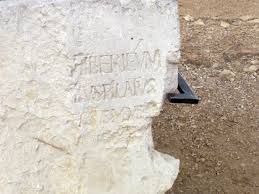
Christianity has always been a faith that is rooted in a specific, verifiable, historical time. Pontius Pilate is mentioned outside of the Bible in documents that still exist. He was a real person who had imperial responsibilities in a region that included Jerusalem during the years in and around 30 CE.

This is archaeological evidence of the existence of Pontius Pilate

Of course the Apostles’ Creed doesn’t say why Jesus was crucified. The creed is not an evangelism tool, it’s function is not to convince someone of the faith, but rather to be an acknowledgement of the faith by a believer.

This blog has been a project that has taken far too long to work through the Gospel of Mark. It is also been primarily aimed at someone who already knows about Jesus and who he is. For better or worse that is how it has played itself out.

The title of this post is a shorthand. “God Doesn’t Care…” That ellipsis is your clue. The rest of the sentiment is as much as we do about the things that we care about.

Why did Jesus have to die? Because people care way too much about the wrong things. Here are a list of the wrong things that Jesus did during his public ministry that led him to being arrested, beaten, and turned over to the Roman authorities for capital punishment.

  1. He healed people on the Sabbath, in other words he felt it was more important to do good on the day of rest than to blindly honor the day of rest.
  2. He ate with outcasts and people whom the “good” people of society deemed to be on the outside. He cared more about a community that ever expanded with mercy and grace at its center than the lines and boundaries that were drawn between people.
  3. He was willing to be in contact with lepers, blind people, children, and women who were menstruating. Not one person was ever unclean in his eyes.
  4. He called out religious leaders and people who came up with narrow interpretations of God’s law to make it ever harder and harder for people to feel a part of good society as the real vipers and sinners.
  5. He openly questioned whether station in society mattered, whether wealth and success equaled the blessing of God, and if making money off of poor people through burdensome taxes, bad exchange rates at the temple, and other forms of organized corruption were just.
  6. He suggested that the religious authorities of his day might value their positions of honor more than their piety.

That list can go on and on. Interestingly enough he did not openly question the authority of the Roman Empire to rule over the traditional land of Israel. In fact, he told people that they should do whatever a roman soldier asked and more. Jesus was even quoted as suggesting that the taxes paid were to be paid because they were Caesar’s due. To get Rome to put him to death the local authorities of Jerusalem had to convince Pilate that Jesus was seditious and claimed to be the King of the Jews.

So why does he have to die? As I mentioned above the Apostle’s Creed leaves the stuff of Jesus life out and focuses on the fact that he “was crucified dead and was buried.” Now to be clear all of the things that Jesus did in that list of 6 were good things and worthy of our attention and response. Those 6 things are simply not reason enough for the only begotten Son of God to die.

Many Christians think that they are reason enough. I suspect that they have a view of Jesus that makes him like Ghandi or Rev. Martin Luther King Jr. namely a peace-loving person who speaks truth to power and becomes a threat to the powers that be and therefore must be stopped. That is often the fate of the person who bucks the system; crushed by the machinations of power to maintain the status quo. I suggest that is also too little a reason for Jesus death.

Later in Apostles Creed after the section on Jesus there is a brief litany of doctrines that the Christian believes in: “I believe in the holy, catholic church (little C), the forgiveness of sins, the resurrection of the body and the life everlasting.”

This is the part that the other Christians emphasize. Jesus is not just some worthy do-gooder who runs afoul of the authorities. That’s no savior for the world. For these Christians, the death of Jesus is about the forgiveness of sins. It is safe to say that for them the death of Jesus is ONLY about the forgiveness of sins.

That forgiveness would include the things I mentioned above in that list of 6 things that Jesus did to cause trouble; however, they tend to focus on the things that people do individually that violate the 10 commandments. So, under that formulation, Jesus’ death pays the penalty for all who believe in Jesus for their murders, lies, adulteries, stealing, idolatry, and coveting. They say that Jesus dies to free each of us from the penalty of our sin which is death. His death provides a means to be right with God because his blood is shed for us vicariously and becomes our substitute in judgment.

Apologies for oversimplifying some really important theological concepts. Truth be told though, this idea of why Jesus had to die is also too small. In some ways it is arrogance to suggest that the reason that the Son of God has to die is because I got in trouble in the second grade for bringing a toy car to school, had it taken up by the teacher, months later took it back from her desk, and lied when she asked if I had taken it out of her desk. (It was a Hot Wheels of the Speed Racer Mark V so as the kids say if you know you know!)

Fun fact: I started this post 4 years ago! Apparently, then I wasn’t ready to say why Jesus had to die. In the interim, I have led some fairly comprehensive in-person Bible Studies on Luke, Hebrews, Philippians, and Romans. Through that process and my own study, prayer, pondering and angst I have wrestled with this seemingly simple question: why did Jesus have to die?

Again, I point out that the Apostle’s Creed does not list any details of Jesus life apart from his virgin birth, his crucifixion under Pontius Pilate, and his resurrection. Forgiveness of individual sins is a corollary at best in the Creed and grouped in with a litany that includes belief in the Holy Spirit, the Church and baptism. (Note: it is true that in the Nicene Creed we have a purpose for Jesus: “for us and for our salvation he came down from heaven”, but none of that is explicitly in the Gospel of Mark. Particularly not in Chapters 14 and 15.)

Stay with me. I have wrestled with this question a long time and I am going to sum up with answers that may or may not satisfy. I am prepared to be wrong, and I will admit that while I can show my work like any good math student, I am not going to make this post even longer by going through it all here. I am simply going to go to the two conclusions I have drawn (so far) and humbly say that I am still working out all the details.

“Eloi, Eloi, lema sabachthani?” (The only words of Jesus on the cross mentioned by Mark and translated: My God, My God why have you forsaken me?)

“Bartender you see, the wine that is drinking me, came from the vine that hung Judas from the devil’s tree, its roots deep, deep in the ground.”

These are lyrics from a song by Dave Matthews (who while not a professing Christian is often a pretty solid theologian) about a person who is bargaining with the bartender because of his fear of death. Roots deep, deep in the ground. The sin problem. It has some very deep roots that go well beyond both our everyday individual sins to encompass the extraordinary depths of our collective evil (racism, war crimes, genocide, child abuse, corruption to name only a sampling) and the ultimate penalty of those sins great and small and cumulative. Death.

Not only that, if that weren’t enough, but the sin problem is also the reason for the tortured natural world. What the Bible calls futility. Futility is why there are weeds in the garden and why there are virus that make us sick. Futility is why we have to work so hard to grow food (or a houseplant) and why dogs and cats so often fail to live in harmony. And all over that futility is the shroud of death.

The sin problem encompasses so much more than the foibles and excesses of you and I.

Roots deep, deep in the ground.

I have come to the conclusion that when Jesus is crucified, he became sin itself. Not simply that he took on all of our individual sins (as the atonement crowd likes to trumpet), but that he literally became the embodiment of sin. This is why he is forsaken by God. Like apathy to love and hate, the absence of feeling to strong feeling; sin is the absence of God. When Christ cries out these words from the cross it is because he is feeling for the only time in his life what it is to exist in a vacuum where God is not present.

Why did Christ have to die? So that sin could be destroyed. He dies to begin the unravelling of the eons old sin problem. To allow sin itself to stand in judgment before a righteous God. So that all the evil (sin) that ever was and ever shall be is dealt with in its entirety. Jesus became sin and took on the judgment that sin merited so that it could be dealt with once and forever. That is why he has to die, and in accepting the cold fingers of death (that we all experience and fear as the separation from all that love is) he puts himself in the position to defeat that enemy as well.

If that conclusion doesn’t make sense to you then I apologize because I have yet to fully comprehend how to express the thoughts in words. I fear it is a conclusion that goes beyond a rational explanation.

But I am thoroughly convinced that something that can best be described as cosmic is happening on the cross.

I mentioned two conclusions. The second one is much easier to express. At the end of the day the cross is not about judgment but about mercy. While judgment is being rendered (on sin through the death of Christ) what is being pronounced is the exceptional, never-ending mercy of God.

Not mercy limited to pardon extended to those who ask for it. But mercy flowing like a never-ending stream that overwhelms all who wade into it. For the One who is the rightful Judge is also the One who embodies the sin.

And that feels more like the mysteries of grace to me.

Earlier I said that the title of this post was God Doesn’t Care… (as much as we do about the things that we care about) and that is still true. The better completion of the title would be:

God Doesn’t Care as Much as We Do About the Things that We Care About Because He Cares So Completely About the One Thing that Truly Mattered.

Now that is wordy and not at all pithy!

Feel free to use this Bible Study for your own groups or discussion.  It is freely given. If you do I merely ask that you acknowledge where you got it and if you find it useful that you encourage others to seek it out. It is freely given and written with fear, foreboding, and prayer by a fellow hypocrite who is simply trying to figure out the road ahead.

Website Powered by WordPress.com.

Up ↑