Search

The Hypocritical Christian

Tag

gospel of Mark

The Most Significant Day Ever

What is the most significant day in history?

For Americans, there are lots of contenders whether it be the day the towers fell or the day the Japanese attacked Pearl Harbor. Other Americans might choose the moon landing or the day the Beatles played on the Ed Sullivan show. July 4th,1776, makes a strong case for the most significant day in history.

Other countries and nationalities would have their own days of significance. Days of foundings, of significant battles fought, of independence from colonial powers, all special days awash with extra meaning for those peoples.

Then there are the individual days people might choose when asked the question. The day they were married. The day a loved one died. Maybe even the day that they won the lottery. The least humble among us might suggest their own birthday!

There is only one day in all of human history that is so significant that it is literally celebrated around the world on every continent not just annually but every single week. That is the day Jesus rose from the dead.

Read Mark 16: 1-8

We do not know the exact date with any certainty. We can do a little historical triangulation and narrow it down to a year within the range of 30-34 CE (the renamed A.D.) and we know that because it was around the celebration of Passover we are in the Springtime of year in Jerusalem.

Ancient burial practices being what they were it was common for a body to be buried in a cave in those days and for loved ones and family members to bring spices and anoint the body. This was done to help cover the smells associated with decomposition. Eventually, the bones of the person would be collected and stored in a stone box called an ossuary. This is precisely what Mark says the women were heading out to the tomb to do in the early hours of the morning.

This is one of the ways in which this story with an incredible ending rings true. First, the suggested task of the women is precisely what we would expect to be going on based on what we know about 1 century burial practices in Jerusalem. Secondly, it rings more than a bit true, that none of the men are there because they have left this important yet menial task to the women. No doubt this anointing would have been followed up by going to the well for the daily water supply, getting the “kitchen” fire started for the days cooking and all the other never-ending tasks that fell on their shoulders.

They must have been experiencing a swirl of emotions. Jesus was dead. They had followed him and hung on his words, wondered what it might all mean, worried that they or their husbands, brothers, and friends might also experience retribution at the hands of the Sanhedrin or the Romans. Maybe they felt some resentment that they were having to “fit” this task into the rest of an always busy day. The only thing we do know for certain is that they wondered about how they were going to get into the tomb because there was the matter of the large stone that sealed the entrance.

This is when the story turns to the unexpected.

The stone is already moved away from the entrance! Mark notes that it was extremely large. Now, the ladies are probably thinking that someone else has come to anoint the body. They may have reasoned that one of the disciples had come to pay respects. They may even have considered the possibility that someone was coming to take the body away.

They mustered up the courage to go into the cave without knowing who was in there ahead of them. They were unprepared for what they found.

In our day, the idea that the tomb is empty that Jesus rose is so ingrained in us that we are inoculated from the sense of fear, trembling, and awestruck wonder those women experienced.

Entering the tomb, they saw a young man sitting at the right wearing a white robe and they were amazed. He said to them ‘do not be amazed; you are looking for Jesus the Nazarene, who has been crucified. He has risen. He is not here; behold, the place where they laid him.’

The word translated as amazed gives the sense of awestruck wonder or befuddlement. It is like the time my son came home from school around the age of 8 to learn that we now had a Wii. His young brain could not wrap itself around what was happening at all. He had gone to school like any other day and when he came home it was now a home with a Wii. What was this new world he was in that something like this could happen.

That is the befuddlement of joy. I think you will agree with me that there was a not inconsiderable amount of fear wrapped up in the astonishment that the two Marys and Salome were experiencing. Angels have this effect on people. American culture pictures angels as beautiful, serene women, who are dressed in white and gold. Oh! and they have wings. Angels, based on scripture, may resemble humans but there must be something fearsome about them because everyone is either astonished or scared in their presence. It must be that they are obviously other-worldly at the sight. We know this because the Angel always has to remind the persons that they manifest before to not be afraid.

Angels do a great many things in the scripture, but when the Angel appears as a herald it is always to clarify that God is acting in the current event. The Angel is there to assure the witnesses that any other “rational” explanation will not do. The Lord God has raised Jesus the Nazarene who was crucified from the dead.

In Greek, like English, the verb to rise has many meanings and connotations. It is used for a person getting up in the morning or for the sun at dawn. It is used for the bringing forth of something new. Just as we might say a new generation is rising. Or in our culture we speak of rising freshman or rising seniors as the students of one year of school matriculate to the next year. Normally in the New Testament the verb is coupled with the word for dead body to indicate someone being raised from the dead, like the times Jesus brought a dead people back to life. The word for dead body is not present here. Not to get too far into the weeds the verb tense is Aorist Passive. That’s fancy talk for something was done to Jesus between the Crucifixion and the Empty Tomb. The one whom Jesus referred to as Father raised him from the dead.

In terms of the meanings of the word Jesus is risen and something new is afoot in the world. Later Christians would come to understand that a new Age was also rising with Jesus. An Age that included Jesus as Lord and Savior for all who would put their faith and trust in him. An Age where salvation is promised to all who profess with their mouth and believe in their hearts that Jesus Christ is Lord. This Age lasts until the God appointed time when Christ returns and the “Age of the World to come” begins. You can read all about the future glories of that Age in Revelation 21 and 22.

The women are told to go and tell Peter and the others to meet Jesus in Galilee. Mark records that they fled with fear and trembling and told no one because they were so afraid and astonished. An empty tomb will do that to you.

They eventually told someone. No doubt later the same day. Maybe it was the second person that asked them what was wrong, maybe the third. Most likely they talked it over amongst themselves and decided that they best do what the Angel told them to do!

The most significant day in the History of the world. Why you say? Two reasons really. One, it is the only day that is both significant for the entire world. If Jesus Christ walked out of the grave then everything that he said about himself is true. It means that when he says that “all power and authority on heaven and earth have been given to me” that that is true. It means that he is the only true Lord and Savior. It means he reigns as the true ruler of every nation and all peoples. It means that there is no other God besides the One.

Two, it means that the day is significant for every single person who hears the story. For if Jesus Christ walked out of the grave then you have a decision to make. Do you believe the story? If so, then there exists roadmap on how to live in the teachings of Jesus. It means you can experience the fruits of the Spirit and life in the Kingdom of God. You can live in the sure and certain hope of the life of the world to come. If you believe, you can trust in the promise of Jesus that he is “the resurrection and the life, those who believe in me though they die yet shall they live.”

But it is a truth that demands a choice. And that makes the day even more significant. Anyone can ponder the day that Battle of Hastings was fought and go on about their lives without making a decision. It matters not what I think about the day Julius Ceasar crossed the Rubicon. The day that Salk perfected is vaccine has no claim upon me to make a decision. The Resurrection does demand a decision.

There is no half-way here. Its either true or it is not. If it is true then time is short for you to decide if you will proclaim Christ as Lord and experience renewal in this life and everlasting life one day. If you choose not to then this life is all there is and to paraphrase the Apostle Paul you will be the most to be pitied.

There is no halfhearted believing either. You cannot simply rely on the historical record and go to Church on the regular and try and be a good person and hope for the best. It is not enough to understand the faith and its ways. It has to be believed. The faith must be lived.

The Christian life is not about knowledge it is about a relationship with a living savior. “He is going ahead of you to Galilee there you will see Him.” Christ is always and forever on the move. God is waiting for you to find him.

Just as there are 2 possible lives (the present one and the prooffered eternal one) there are 2 deaths. The one that ends this life and in the last day the one that is everlasting separation from God.

If you have never called upon the Name of the Lord, do it today. Do it now.

Feel free to use this Bible Study for your own groups or discussion.  It is freely given. If you do I merely ask that you acknowledge where you got it and if you find it useful that you encourage others to seek it out. It is freely given and written with fear, foreboding, and prayer by a fellow hypocrite who is simply trying to figure out the road ahead.

The Kingdom of God

camel-shutterstock-970

Read Mark 10:13-27

One of my lasting memories from seminary comes from the daily worship services.  On occasion, when communion was being offered we would follow a liturgy derived from John Chrysostom in the way back days of the christian church.  At some point the celebrant (that is the person offering up the prayers for the bread and cup) would say “Holy Things for Holy People.”  I remember this because I was very fond of my liturgics (study of worship) professor Dr. Stanley Hall; and– though he was suffering from a rare condition that deteriorated his lungs — Stan would fill the chapel with his sonorous voice from the back of the hall with the response of the people: ONE is HOLY, ONE is LORD, Jesus Christ, to the glory of God. 

The purpose of the response is to direct the attention of those in attendance to God alone.  Even though the communion is considered holy (because the bread is set apart) and the gathered church can be called holy (set apart from other communities of people), God and God alone IS the only, truly holy thing.

Jesus does somethign similar when approached by a wealthy man in this reading from Mark.  After being addressed as “good teacher” Jesus quickly sidesteps the complement saying that God alone is Good.  In a world conditioned to consider every little hang up and fetish a lifestyle choice demanding special recognition and community acceptance it can be jarring to hear that only God is good.  Before we rationalize that Jesus was either having a bad day or displaying false humility we should accept that maybe he really meant what he said.  Limiting actual goodness to God alone is consistent with what we heard Jesus saying about the human heart earlier in Mark.

This is not to say that people cannot do good things or exhibit good character.  The young man speaking with Jesus at least claims to be doing those things himself.  The initial question that the man asks is what he must do to inherit eternal life. Jesus directs him to the commandments to which the man says that he has studiously kept them.  “You only lack one thing then,” Jesus suggests, “go and sell all that you have and give to the poor. You will have treasure in heaven and come and follow me.”

We are told that the man walked away dejected because he had a lot of things.

dejection

Jesus laments “how hard it is for the rich to enter the Kingdom of God.”

Many times this episode is preached all by itself divorced from the rest of the Gospel of Mark.  Some folks point to it as proof that wealth is bad.  “See! the rich will get theirs in the end because rich people cannot inherit the kingdom of God.” Although Jesus doesn’t actually say that. Other preachers, perhaps apologetically for their wealthy members, will teach that the episode is absolutely limited to this particular  wealthy man.  This was the particular problem for this guy because he was just like Ebeneezer Scrooge and loved his possessions more than others. “Fear not generous members of (insert name of wealthy church) so long as you are here in this moment and tithing you can rest assured that you have a place in the house of the Lord.”

The truth is in neither of these interpretations although there is a particularity to Jesus’ charge to this young man.  As always reading and interpreting this passage by itself prevents us from considering what Mark is communicating to us.  In the verses right before this young man appears we see Jesus playing around with little kids. He seizes the moment to teach his disciples that only those that receive the Kingdom of God like a child will enter it at all. 

Do you see the connection now? The episode with the rich man is illustrating the point about entering the Kingdom of God like a child.  Mark is giving us a way to understand what Jesus meant by demonstrating how Jesus taught this one particular grown man what it would mean for him.

Apart from age, what was the difference between the young man and the children? What makes a child different from an adult?  Self-sufficiency.  Children are dependent on others to care for them and to protect them.  Whenever a child loses a parent at an early age we say that they had to grow up too fast meaning that they had to take on adult responsibilities.

The problem for the rich man was not that he had wealth.  Resources are just resources to God.  Abraham had wealth.  Jacob had wealth. David had wealth. Jeremiah, Elijah, and Paul not so much. The problem was not in the possession of the property.  The problem was that the availability of means left the rich young man deluded into thinking that he didn’t have to rely upon God for eternal life.  He was doing the right things and keeping the commandments. He wanted to know from Jesus what else he needed to do. Goodness for him was about merit and merit was about accomplishment. The path to the Kingdom of God must surely be marked with road signs indicating how close you were along the way he thought.  In this he demonstrated at least one child like quality:  “Jesus, am I there yet?”

When I was a child we had gold stars in school.  You got a gold star at the end of the day if you were well behaved and did your work. I have heard of some schools today using a color chart (red, yellow, green) in a similar fashion.  At week’s end we could get a little surprise or treasure if we had a sufficient number of gold stars.  As I recall, some teachers expected perfection while others gave a little more grace.  Some had treasure boxes with trinkets while others were sure good behavior was its own reward. Had I known then what I know now I could have psycho-analyzed my teachers based on these things.  The rich young man was using the wrong child like approach to the Kingdom of God.  He was trying to gold star his way in.

It cannot be done that way.

It is telling that Jesus instructs the young man to follow him. In the Letter to the Hebrews we are told that Jesus is the author and pioneer of our faith that he has provided a more perfect way to God through the veil of his own flesh, a reference to the veil in the tabernacle and temple that separated the people from the presence of Yahweh.  Following Jesus is not just following Him at the end to the presence of God but it is also following him along the path to the Kingdom of God.

God wants to be a part of all of our lives: our work, our parenting, our relationships, our inner selves. To live the most abundant form of this life and the life of the world to come, we have to recognize and live a dependence on God.  A daily dependence on Him.  If faith is an expression of trust then self-sufficiency is a debilitating condition.

first-15-minutes

This year I have taken up a charge from my pastor, Eric Waters, to practice “The First 15”,  beginning each day with 15 minutes that belong to God.  It is deceptively simple.  I read a few lines of scripture and offer a prayer.  My prayer in the first moments of my day tends to be very simple as well because I am not awake enough to flourish it with useless extra words.  So I tend to just thank God for the morning, for another day, offer up someone or something else for God to bless, ask Him to handle something in my life and end it with the Lord’s prayer.   It is certainly simple and once the habit forms it shapes the day, the week, the life in a different pattern than not starting each day with God.   I admit that I also sometimes forget.  If you try the “first 15” for yourself understand that you will achieve imperfectly as well. When I do miss my day is more frustrating.  While my days are not perfect when I do start with the “first 15”, I find that whatever the day brings I am more in tune with the peace that Jesus promised us.

The Kingdom of God is open to those who approach as a child, dependent on the Lord to provide, to teach, to protect, and to guide.

Ask yourself:

What is keeping me from trusting God more completely?

Now is the time to give it up. 

Where in my life am relying more on my own abilities or power than God’s help? 

Invite God into all of it through prayer and meditation today.

Are you seeking to earn God’s favor rather than respond to God’s acceptance?

All I can remind, gently, is that the first never works.  If you ask, God will show the second, more perfect way.

If you have been enjoying these reflections consider subscribing so that they appear in your email conveniently for you.  Also consider sharing the site or a reflection with just one friend.  Remember that if you wish to use one for a bible study or meditation at the start of a meeting or for any other purpose all I ask is that you let people know from where you got it in the first place.

Thank you for reading.

Fearing Trembling and Knowing

Read Mark 5: 21-43

If you have been waiting for nearly 3 years to find out what happened to Jesus after he healed the “crazy” man in chains by banishing his many demons into a herd of pigs, I have 2 things to say:   1) I am really sorry and I promise not to let such a long period of time pass between posts to this blog any more.  2) Seriously?!? Do you even remember what happened? If for some reason you want a refresher you may read it here.

So having been uninvited from the land of the Gerasenes, Jesus and his cohort head back to the other side of the Sea of Galilee.  Here, in contrast to the angry mob that they just left, is an expectant crowd gathered to greet them.  We aren’t entirely sure of what has drawn the crowd.  It could be that word is spreading about what Jesus is capable of in terms of healing, that they have heard about the destruction of the pigs, or they know what Jairus is about to ask of Jesus and they have come for the show.

Jairus is described to us as a leader in the synagogue.  This means he is a prominent person in the community.  Here in Texas, he might be compared to someone who was not only an elder / deacon / alderman in a local congregation but also like a local office holder.  Some thing like being a councilman or a constable.  The point is that Mark wants us to realize that he is significant.  We do not know yet if seeking out Jesus is akin to political suicide (remember Nicodemus met Jesus at night) but the circumstances demand that he find Jesus soon.  His twelve year-old daughter is dying.

So they set off.  Jesus, the disciples, Jairus, and the crowd.  There is jostling and bumping, elbowing and maneuvering.  Probably the group formed into some sort of line working their way through the crowd each member occasionally looking back to the person who should be behind them and ahead to the person they should be following.  You have been in crowds like that before haven’t you?  Maybe to make it to the entry point of a popular ride at Disney World?  I have been in lines like that to get to parking lot after a concert.  No doubt Jairus was moving as fast as possible up ahead looking back frantically to make sure Jesus was still coming and Jesus was probably trying to make sure that the disciples were still in the group.

Mark tells us about only one other person in the crowd that day; a woman who has been actively bleeding for twelve years!  Mark says that she has been to the doctor so many times and nothing has helped.  She has spent all of her resources and, according to the Greek, having benefited nothing but into worse having come she has decided to do the only thing that is left for her.  She has heard about the things Jesus has done and she is going to find him and she believes that if she can even just touch his robe she will be healed.

Let’s stop right there for a minute and consider a few things.  Why would she be convinced of something being magical about Jesus’ robes?  Obviously this is a pre-scientific mindset but there are plenty of people today that adopt some magical thinking even though our world is mostly steeped in scientific thought.  Whatever logic she is using is not important, I really only ask to point out that every one around her that day would be convinced that they could be made ceremoniously unclean simply by touching her robes because she was bleeding. In a world where people can become unclean by touching someone’s clothes then certainly they might be healed by the clothes of a righteous person, right?

This would be the every day for this woman.  In fact so long as she was bleeding she probably had to announce to people that she was unclean as to warn them.  For more than a decade she has had to let people know that being near her is a threat.  What sort of fellowship did she have? what sort of community?  Did she always eat alone?  Did she have to go to the well for water at odd times?  She may have been a person of means and didn’t have those issues, but did her servants look at her with judgment instead of pity.  She wasn’t allowed in the synagogue; couldn’t go to the temple during Passover.  Was she married, did she have children?  Were her family members treated differently because of their connection to her? There hasn’t been anything that can fix it for her and nothing can change the pain that she has already endured.

Have you ever felt that sort of isolating pain before?

As I write this the world is in the midst of the Corona Virus outbreak.  Most of the United States is in some sort of imposed isolation.  In our efforts to “flatten the curve” of infection, a good thing, we are dealing with tremendous economic hardship and isolation.  For families this has been a time when they can grab some rare togetherness and connection and that has been a blessing.  For the single people it has been the opposite because it is hard to make connection from 6 feet away with a stranger.  I think many people, like myself,  eventually go out for either a walk or to get something from the store. It is surreal to see so few people out and about but also because of the looks that you receive when you encounter someone.  There is this moment where heads turn away or a glance signifies the unspoken question “are you safe?”.  Most of us have used more soap and hand cleansers in the past month than we did in the previous year.

It gives us a little insight into this Biblical woman’s life.  We do not know her name, but we do know her faith.  If she can just touch the robe she knows that something good will happen– that she will be healed.

Somewhere in the crowd she sees Jesus trying to keep up with Jairus making his way through the throng.  She herself presses and elbows and pushes and finally gets close enough that she can just touch his robe.  It happens.  Her flow stops.  She has lived with it so long she knows.  She knows!

Jesus knows too.  Mark relates that he felt power go out from him.  Someone in this crowd has experienced the healing touch of God.  He immediately stops to figure out who.  Salvation has been received Jesus would like to meet the recipient.  I don’t believe that Jesus is angry, I believe that he wants to affirm an act of faith, I believe he wants the relationship that comes from the grace granted.

Jesus asks who it was that touched him.  The disciples do not know.  Jairus doesn’t know and is frustrated by the delay.  No one knows except the woman.  She ventures forth Mark says “fearing, trembling, having known” falls at Jesus feet and tells him everything.

Jesus replies with grace and love, commends her faith, and sends her out with a declaration of peace and the assurance that she is forever healed of that affliction. I submit to you that it is not just her belief that touching Jesus robe would heal her that did heal her, but it was also her response to what Jesus had done for her.

fearing, trembling, having known

Having known what?  That she was healed, certainly.  That she had been healed despite having reached a point in her life where she was convinced that she would never find release from this sickness that gripped her perpetually?  Was she fearful and trembling because she had felt unworthy for so long that she believed the lie that she was fundamentally unclean and in that one moment experienced not only healing but that unbelieveable cleansing that comes from realizing that God does love you despite how unloveable you have felt or how unloveable you have allowed others to make you feel? Was she fearful and trembling because she now knew what Jesus could do and as a result who Jesus must be?  Recall the function of Mark’s gospel is to share with us the beginning of the gospel of Jesus Christ, the Son of God.

Many years after this, the Apostle Paul would write to the Christians in Phillipi one of the most significant passages in all of the Bible.  After  reminding them of who Christ Jesus is he implores them to work out their salvation with fear and trembling.  WOW.

I always wondered what Paul meant and I never realized the parallel language with this story.  So what did the woman do?  She sought out God. She found salvation and healing.  She recognized what God had done and she responded with appropriate awe and respect.  Her knowledge of God expanded by recognizing what he had done for her and she responded with the appropriate fear of the Lord and confession.  She entered into a deeper relationship by telling God everything.

What has God done for you? How has He made you whole? When have you experienced His power and might? What prayers has He answered? What hope has He sustained in you?

Whatever the answer keep telling God everything;  deepen the relationship. The One who has created everything that is is The One who has done this for you.  A little fearing and trembling at the truth of who God is appropriate; a lot of sharing is more so.

The story of chapter 5 isn’t over though.  No sooner does this encounter finish, then someone comes to Jairus and informs them that his daughter has died. There is no longer any need to trouble Jesus to help. Mark tells us that Jesus gives a call to deeper faith.  Do not be afraid but believe.

At this point a lot happens.  Jesus presses on with Jairus and only 3 of the disciples.  When they arrive the professional mourners are already at work playing the appropriate sad music and weeping.  When Jesus suggests that the girl is merely still asleep they laugh at him.  Not just a mild laughter but based on the Greek mocking laughter, derision.  Nothing to this point is helping Jairus with his trusting faith.

Jesus enters the room where the daughter is with just the 3 disciples and her mother and father.  Taking her hand and with a word (literally little girl get up) she opens her eyes and gets up.  Jesus tells her to feed their daughter and asks that no one say anything about what transpired.

This is the God that we worship, follow, serve, seek to know.  Sometimes He works in the pubic throng.  Some times he works in private and seeks no publicity.  But He is bigger than anything in this world, even death.

So get to fearing and trembling and knowing all that has happened to you and tell God everything.


A Healing, Demons, and Fear Abound

Read Mark 5: 1-20


22.4.2010: Sant'Apollinare Nuovo, Ravenna

Way back in my very first post about Mark, themes were laid out and one of those themes was “Jesus has authority.”

The end of Mark Chapter 4 and the beginning of Mark Chapter 5 is about demonstrating the breadth and power of that authority.  If you have read the Gospel of Mark before or even just the first few posts on Mark in this blog then you are aware that Jesus has the authority to cast out demons.   We have seen this already.

A quick word about demons.  Some times modern readers of the Bible are put off by the appearance of the supernatural.  Being scientifically minded they cannot find the wisdom in the account because they are too busy worrying about the validity of the concept of demons. I personally do not know if demons exist.  I do know that the world is full of many strange and wondrous things and I am not willing to say that the supernatural doesn’t exist.  If you want to chalk demons in the Bible up to primitive understandings of mental illness and the like that is your choice.  It is one of those things that cannot be proven beyond all doubt.  The choice you make will change the story some and will limit the range and power of God but it is at the end of the day your choice to make.

Jesus and the disciples arrive in the land of the Gentiles on the other side of the Sea of Galilee some time in the morning.  We are told that they encounter a man who lives in the caves that serve as tombs; a man who is crazed and who cannot be bound or controlled by anyone or even held by chains.  Wow!  We are told that he spends his days and his nights crying out and cutting himself with stones.

I do think it is useful to spend a moment empathizing with the man.  Have you ever felt outcast from the group?  Have you ever seen fear in the eyes of other people when they encounter you? I do not suspect that he chose to live in the tombs but rather had to because that is where the people allowed him to be.  Children were probably warned to stay away from him.  Older brothers probably threatened to turn their younger siblings over to him.  He probably had a host of unflattering nicknames.  Clearly, he has no community.  He has no positive interaction with others.  They fear him and shun him.  He lives in the ancient equivalent of the cemetery.  The community has left him for dead.

We soon learn the reason for this man’s isolation.  He is tormented by something greater than himself that seeks to destroy him completely.  When he sees Jesus in the distance he immediately closes the gap and falls at his feet.  Some translations say worshiped but the context means that he likely just went prostrate before Jesus; it is the same word in Greek for both.  The man speaks “What is it that you want from me, Jesus, Son of the Most High God? I beg you by God leave me alone.”

Again we learn from context that this wasn’t the man speaking but rather the demonic entity that has possessed him.  In the beginning of Mark the only ones who know who Jesus is are the demons, they address him by the title Son of God.  They also seem to know that the purpose of Jesus is counter to their own purposes because their response is always one of fear.  As the letter of James says, the demons believe and they tremble.

There is an irony here that the demon seems to pray to God that Jesus would be gracious unto them.  Jesus will not answer that prayer because they are at cross purposes.  The demonic, in so far as it is real (remember, you get to choose), has a singular purpose to destroy that which God has created.  More specifically to destroy the image of God present in this human being.  This is the purpose of the torment and the cutting and the driving the man out of the community.  God is love.  As such, God is relational.  In effecting the isolation of the host the demon has been working on destroying him physically as well as mentally through self-inflicted wounds.  The presence of Jesus introduces the purpose of the Holy One to effect salvation and redemption, not just for individuals but for all of creation.

And so the battle is enjoined.  Christ demands that the spirit comes out and that the demon reveal his name.  Legion is the name because they are many and they make a request of Jesus that they not be sent out of the country but rather be allowed to infest a neighboring herd of pigs.  Jesus allows it and immediately the demons leave the man, enter the pigs, and drive them all headlong into the ocean drowning them some 2000 in total!

The pig herders report to their bosses what has happened and people from the neighboring town come out to see for themselves.  They find Jesus and with him the man that had been crazy seated beside him.  He is right-minded, calm, and clothed even! For emphasis, Mark says the very same man that had been possessed by Legion just so there is no mistake for us. And a curious thing has happened the people are afraid.  So afraid in fact that they demand that Jesus and his friends leave at once.

Here is another good place to camp out and reflect.  Fear?  Anger would be the more likely response.  2000 pigs killed is a lot of money and the people may not have seen that as a good trade, one crazy man made well at the cost of 2000 pigs.  By modern standards the loss of that many pigs could have been a price tag of half a million dollars or more! Even at the cheapest level you would be looking at a hundred grand for a herd that size.  Is the peace of mind of one person worth the economic output of the community?  Praise the Lord in the eyes of Jesus the answer is yes.  Perhaps the fear is related to the power of Jesus to compel the demon in the first place.  Forget the pigs, let’s be afraid of the exorcist!  It makes sense to a point although you would like for someone to be happy for the formerly demon-possessed man.

I think the fear is reflective of something deeper within us as sinners.

The people were comfortable with the way things were.  Sure there was the demon possessed guy, but he lived away in the tombs where the evil people belong. He was avoidable and that meant no one had to deal with the reality that they were powerless to help him. They didn’t have to admit to themselves that they didn’t care about him.  they didn’t have to wrestle with the truth that they were too much like him and could have easily been him had the demons chosen differently.  He had his place and so long as he was out there they didn’t have to wrestle with what it meant.  He was darkness personified, but a darkness contained, and that is what people want is the darkness contained — categorized and prioritized; this sin unacceptable and outside the community but these other sins normalized and accepted.  People fear the devil but the devil can be avoided or explained away.  Recall that the demons were afraid because they knew they were at cross purpose with God.  The power of God invokes a greater fear and far too many of us want nothing to do with it because it exposes us as those who also are at cross purposes with the Lord.

Jesus knows when he isn’t wanted and leaves.  Before he goes however, the man who had been possessed, who now has been healed and restored to fullness of life, wishes to come along.  In fact the language that is used is the language of discipleship.  He wishes to follow Jesus.  Who can blame him for wanting to get way from the place that is filled with such ugly memories. Why wouldn’t you want to rid yourselves of the community that is more concerned about the loss of pigs than they are about what has happened to you?

Jesus refuses.  Not the offer of discipleship, but rather the change of venue; instead of allowing him to leave Jesus tells him that he is to stay and share with others what the Lord has done for him.  And we are told that he does this.

When you think about all that has befallen this man it can seem cruel that Jesus makes him stay amidst a people who must have mistreated him and labelled him.  I think the lesson to all of us that follow Jesus is that sometimes Jesus bids us stay in the very place that caused us pain, albeit pain that we were rescued from because that is where we will make the most difference.  It is a difficult place to be.  It couldn’t have been easy for this man but I cannot help but think that a few years later in the aftermath of Resurrection and Pentecost that his seed-sowing bore much fruit.

  • Where do you find yourself in this story?
  • Have you ever wanted to run when you felt the urge of Jesus to remain?
  • Are you afraid of the power of God to bring light into your heart? your community? your church? your world?
  • Are you afraid to admit that you are at cross purposes with the Holy One of God?
  • What sins are you too comfortable with and which sins do you ignore because they are over there?
  • Is there someone you have left for dead amidst the tombs?

As always this reflection is freely given. Use this Bible Study for your own groups or discussion.  If you do share it with a group I merely ask that you acknowledge where you got it and if you find it useful that you encourage others to seek it out. It is written with fear, foreboding, and prayer by a fellow hypocrite who is simply trying to figure out the road ahead.

The Fear of the Disciples

the-freak-liquid-mountains-of-lake-erie_880

Read Mark 4:35-41

Jesus has just finished a long day of teaching near the shores of the Sea of Galilee. The time has come for them to head to the opposite side of the lake and begin healing and teaching in the communities there.  We are told a couple of pertinent details about the journey.  A significant storm began as they were making there way across the 7 mile span and Jesus was taking a well deserved nap.

I grew up around lakes in Texas and I can tell you that storms on a lake are no small thing.  Apparently, this is particularly true of the Sea of Galilee because of the unique topography around it.  All of Isarel, west to east, is a series of radical changes in elevations in a comparatively short distance.  As a result the Sea of Galilee is in a basin of sorts that channels the wind across the water when a storm rages through the region.  A similar dynamic can be experienced when the wind is channeled through office buildings in a modern city or even apartment complexes in a smaller town.  The point is that the storms on the Sea of Galilee can be nasty and we need to remember that these guys are not in some modern style watercraft, but a homemade boat designed for fishing and not much else.

Have you ever napped on a boat?  It’s glorious! The boat rocks back and forth and if you are sleeping directly on centerline it is the closest thing to being in a cradle that you can experience.  When you consider the crazy compacted schedule that Jesus has been keeping and the incredible amounts of physical and mental energy he has exerted it is no wonder that he is “dead to the world” in the back of the boat.

We are told that when the disciples, all of whom are experienced fishermen, decide to wake Jesus. They are worried about dying because the boat was already taking on water.  I think it is important to pause here and really put yourself in the moment.  The storm is wicked, perhaps there was rain and perhaps there was just wind and waves.  Even without rain the waves alone could be devastating and frightening.  The image above is described as one of the “mountains of water” that form on Lake Erie during a storm.  A fishing boat in those days would have had a very low side to make it easier to haul a net of fish onto the boat.  It wouldn’t take much for a series of significant waves to begin filling the hull up.  Water is coming into the vessel, each wave striking the boat would have begun to feel like invisible fists pounding the side threatening to capsize her or worse break her apart. If the worst happens it is several miles to shore in storm driven waters.  Every one of these men grew up around these waters and every one of them likely has known someone who has drowned there. No wonder they were afraid!

That last point about the deadliness of the sea is pretty crucial for really understanding this story.  In the ancient Jewish tradition, the sea represents evil and chaos.  The sea is unpredictable and kills.  You see this in the very first verses of the scriptures.  God’s spirit hovers over the waters of the void and begins to bring order out of chaos.  The sea is given its limits but is always there as a symbol of the forces that are opposed to God.  You see it in the final pages of scripture when the beast rises up from the sea in Revelation and when the new creation is finalized, we are told that the sea is no more.  So, while the story is about the day that the disciples nearly died on a boat trip across the Sea of Galilee it metaphorically means so much more.

The disciples rouse Jesus from his deep sleep and level an accusation against him, “Do you not care that we are perishing!

Jesus stood and rebuked the wind and commanded the sea, ” Be silent” and the lake became calm.

calm lake

Take a moment and meditate on the two images.

How would you feel?

Try to imagine the feelings of fear and dread of the waves and the storm replaced with the feelings of relief and dread at what just happened.  The fellow next to you in the boat just told the weather to stop and it did.  Not impressed? Try it yourself sometime.  You won’t get very far.   As I write this it is 80 degrees Fahrenheit before 10 AM in Texas.  You don’t think I want to make it cooler with the sheer power of my will?  How many brides would kill to be able to control the weather before their outdoor wedding?  Each of us is powerless against the forces of heat, cold, wind and rain.  Each of us except Jesus.  That is by the way I think Mark’s point in his retelling.  Recall that Mark is a gospel bent on guiding every reader / hearer into making a decision about who Jesus is and in this moment he wants you to realize that Jesus commands the forces of nature and they obey.

In verse 41, the disciples ask “who is this that even the wind and the sea obey him?”  They would have had the benefit of growing up hearing the dozens of references in the psalms, proverbs, Job and prophets that YHWH does this very thing.  They would have grown up being told to remember how YHWH had delivered their people from Egypt by commanding the sea to part and allowing them to cross over on dry land.  This is what they were dealing with and why we are told a great fear (literally a mega phobia) gripped them in the wake of Jesus action.

“Who is this guy?”

That is the question with which we must wrestle.

Now some of you will respond to this with a ho-hum.  Maybe you are a life-long Christian and you settled on the answer “who is this guy?” a long time ago.  You may ask, what about the storms of my life?  My boat is floundering.  Where is the word for me, the reassurance that Jesus will calm my storms?  I have come to this post wanting to know that Jesus can stop the storms in my life.  I have job trouble.  I have debts.  I have addictions.  I have marital strife.  I have cancer.  What about me?  Doesn’t Jesus care that I am perishing?

The very same accusation that the disciples leveled against Jesus is on our own lips many times.

And Jesus said to them, “Why are you so cowardly; do you still have no faith?”

It is not two questions as most translations put it but a single question.  The nature of Jesus question, condemnation really, is to link the fear with the faith.  In other words, if you had faith, you would not fear but rather trust.  I know this because the Greek word used is particular.  It is not, phobos, from which we get the word phobia.  Phobos is the word used in verse 41 to describe the awe-struck fear that has overcome them.  Phobos is the word used throughout the New Testament (Phillipians 2 for example) to render the “fear of the Lord” that is the beginning of wisdom as the Old Testament (proverbs 1) so succinctly summarized the journey of faith in YHWH.  Here though, in verse 40, the word is deilos, a word that used in ancient Greek to describe the cowardice of soldiers who desert in battle and the inaction of the farmer who is paralyzed by fear of the future.  Deilos is always used negatively and connotes a paralyzing fear.  This seems backwards for English speakers because the word phobia was picked up in psychology to describe the rational and irrational fears that affect us.

We are also used to thinking of faith as a matter of the mind alone.  To many of us, having faith is having the correct belief.  In linking faith and cowardice Jesus is linking faith with action.  The person who has faith is the person who trusts.  The person who does not have faith is the person who is paralyzed by fear.  It is not simply understanding (mind) who Jesus is but knowing (heart and mind) who he is and allowing that deeper knowledge to guide our actions and our responses.  Jesus is surprised that after watching him cast out demons and healing people that the disciples are still so timid when the storm comes.

Think back on your life and recall the times that God has provided for you what you needed: the doors that have opened, the healings that have occurred, the resources that were given. The life of faith is not simply understanding who God is but allowing that understanding to put you in a place of trust where you can live in a relationship towards God that is a life marked by the expectation that God will provide.

The accusation was “Do you not care that we are perishing?”  The answer is if you trust me then you know that I care and that you matter.

I do not think that the life of faith means that there is never a reason to fear.  There are scary things out there: violence, war, famine, disease, divorce, unemployment, snakes… it is a long list.  There is nothing wrong with the instinct to fear but faith calls us to get past the fear to trust that the Lord will carry us through all things, even death, when that day comes.

So how do we live it?

Be assured.  Fear not.  The Lord knows your circumstance and your need before you ever vocalize it.  Use the Lord’s prayer as your guide and pray that pattern daily: Praise God, ask for your needs, seek forgiveness and grant forgiveness, ask for deliverance from the evil that is out there, expect and look for the will of God to be done more than your own solutions, and finish reminding yourself that all glory and honor will forever belong to God.  Doing so will train your heart and mind to trust in God’s provision and in God’s timing. When in doubt recall what God has done and know that God will do what is necessary.

Amen.

Questions:

  • What makes you afraid?
  • Are there areas of your life where you are not acting because of fear?
  • When was the last time you prayed the Lord’s prayer?
  • What is one thing you could do today to trust God more?

Are you enjoying the Hypocritical Christian? If you are then share the website with someone else and encourage them to try it out. If you receive it through email and choose to share it with some else let them know where they can find new posts for themselves. Also note that you are welcome to ask questions or even “argue” back through the comments.  Dialogue is always encouraged.  I ask that you suggest the website to others because knowing that people are going to the website encourages me to keep posting.

As always, the above reflection is given freely. If you choose to share it in a group bible study of your own or as a devotional before a small group meeting, etc. please let folks know where you got it.  It is written with fear, foreboding, and prayer by a fellow hypocrite who is just trying to figure out the road ahead.

Be Patient for the Kingdom Comes

Read Mark 4:26-34

Christians are always concerned about the Kingdom of God and how long it seems to be taking to arrive. Do you suppose it has always been this way?  Could it be that Christians in the West have become so conditioned for instant gratification that they more impatient for the Kingdom of God than their predecessors?  The anecdotal evidence is that every generation of Christian from the beginning have been anxious for the ultimate fulfillment of the Kingdom just read Acts 1:6-7.

In North America, denominations are very focused on the Kingdom of God albeit in very separate ways.  The more conservative a Church / Christian the more focused they seem to be on teasing out the signs of the imminent return of Christ. Like “Preppers” storing up for the downfall of civilization, their bug-out-bag is their zippered, handle-covered Bible and instead of a sign indicating they reserve the right to shoot trespassers they warn the trespassers they will be “left behind” that their cars will be driver-less in the event of the rapture through a thoughtfully placed bumper sticker.  Their counterparts in the more liberal arms of the Church have seemed to have forgotten that Jesus promised to return at all, focused instead on doing all this hard kingdom work themselves through political rallies for the justice issue du jour. In case your curious they often decorate their car with bumper stickers encouraging coexisting religious faiths / sects as though the true arrival of the Kingdom of God will look like a joint summit meeting.

These two short parables in Mark suggest where the Kingdom of God is concerned patience is required.

Jesus told them that the Kingdom of God was like a man who cast seed on the ground.  At first, we may naturally think of the parable of the sower we recently looked at but here the emphasis is not on the action of the sower but rather on the seed itself.  Jesus says the Kingdom of God is like the person who casts seed on the ground and while they sleep the seed sprouts and grows “– HOW; he himself does not know“.

Maybe this parable has lost some of its strength in a world where so many people have looked at pictures of a bean sprout plant growing in schoolbooks.  There are even a select few people who really do understand how it all works.  But it seems the point Jesus is trying to make in his pre-scientific method world is that it just happens over time, and it seems almost magical.

Coupled with the Parable of the Sower, we have been given some simple instructions. We are to scatter the Word of God and then let the Word do its thing.   Apparently even while we are sleeping the Word of God is at working sprouting and developing into a great big crop ready for harvest.  When the harvest comes there is more work to be done.

This parable although short works on two levels.  On the one hand it is a reminder to Christians that their efforts do not end with the sharing of the gospel but that they also need to be ready when the harvest is evident.  So, if you have been demonstrating the truth of Christ through words and actions you need to be ready when the one with whom you share is ready for the next step be it accepting Christ, attending worship, or being baptized.  The parable also works on the cosmic level.  Jesus will return when the harvest is ripe some day in the future.  Patience fellow Christ-followers, the Ancient of Days, like a seasoned farmer, will know the right time.

The second parable is another call to patience.  Jesus says that the Kingdom of God is like a Mustard Seed though it is small it grows into a tremendous plant.  There are some critics out there that mock Jesus because as they point out the mustard seed is neither the smallest seed nor is the mature plant the largest on Earth.  C. S. Lewis once commented that it was incumbent upon us to read the scriptures like adults. I suspect this is the sort of ill-conceived criticism he was referencing.

Allow me to update the parable imagery so that anyone can understand Jesus’ point.

Sequoia-Seed-on-Fingertip

Then Jesus said, “How can we picture the Kingdom of God or to what can we compare it to? The Kingdom of God is like this seed on my finger that breaks off from the seed pod on the ground and although it is so tiny and insignificant grows to become an awesome and amazing tree like this: 

sequoia

a tree so large that it can’t be captured on film in its entirety, and it would take more than a classroom of children to encircle its trunk. 

The point of the parable isn’t about the literalness of the seed or the plant, but the fact that the Kingdom is growing all the time, slowly, unseen into something massive and beautiful and only God knows when the harvest will be complete.

The mustard seed, or Sequoia seed, is Jesus.  A poor builder, a crucified criminal, in the furthest reaches of the Roman Empire two millennia ago couldn’t be more small and insignificant; yet, the 2.2 billion Christians alive today all trace their lineage back to this one man and his Resurrection around 34 C.E. (AD).  Not only that, but the estimated 13 billion confessing Christians of the past 2000 years — a Giant Sequoia indeed!

And the Kingdom of God is still growing at its own divinely ordained pace until that promised day when every knee will bow and every tongue confesses that Jesus Christ is the LORD to the glory of God.

What to do between now and then?  Well, one don’t smugly look for signs of THE RETURN and forget to do the work of sowing the gospel.  To do so is to risk a self-righteousness that awaits the judgment of the neighbor without practicing the love of neighbor God requires.  Two, don’t go about trying to rework the whole world into the Kingdom of God as you think it should look because the outcome is guaranteed to be a vision of justice viewed through sinful eyes.  Third, focus on living out Romans 12:9- 13:11  as best you can individually and collectively seeking guidance always first and foremost through scripture, prayer, and confession.

And be patient for the Kingdom is both growing and coming.

Questions:

  • Do you pray regularly for the return of Christ? If so, why? If not, why?
  • When you pray for THE RETURN are you secretly hoping that it come so others will face their comeuppance? 
  • What is the kingdom working balance in your life between prayer and study and good works? 
  • Do you read the Bible regularly? Pray daily? Are you looking for the chance to spread the gospel? 
  • How are you harvesting the growth that is ready until THE RETURN?
  • What are you or your faith community doing to serve God by serving others?

As always the above reflection is given freely. If you choose to share it in a group bible study of your own or as a devotional before a small group meeting, etc. please let folks know where you got it.  It is written with fear, foreboding, and prayer by a fellow hypocrite who is just trying to figure out the road ahead.

Are you enjoying the Hypocritical Christian? If you are please share the website with someone else and encourage them to try it out. If you receive it through email and choose to share it with some else let them know where they can find new posts for themselves. Also note that you are welcome to ask questions or even “argue” back through the comments.  Dialogue is always encouraged.  I ask that you suggest the website to others because knowing that people are going to the website encourages me to keep posting.

The Parable of the Sower

Read Mark 4:1-20

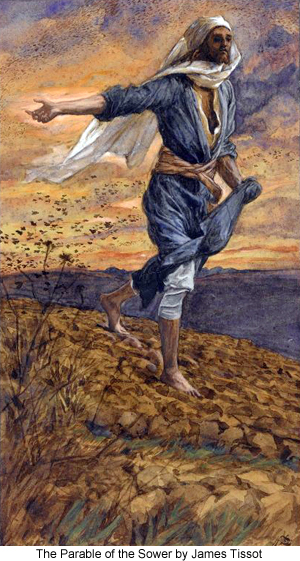
James_Tissot_The_Parable_of_the_Sower_300

“Behold a Sower went out to sow…”  thus begins one of the more famous parables of Jesus and the only one that is given a full explanation by the man himself.  Ironically, this parable is often interpreted by theologians and preachers independently of the explanation Jesus gives when the most complete explanation that we can give someone is read verses 13-20 if you have any questions.

Instead we are given sermons where people are asked “what kind of soil are you?”  We get messages about not worrying about those who are yet to believe because they are just not as fertile a soil as you the faithful listener here this Sunday morning. I almost fell back into that trap myself by very nearly writing a blog post where I intended to ask myself and you how our actions and decisions were impacting the soil of other people’s hearts.

Why are we so quick to try and add to or change the meaning Jesus gives this parable? The cynic in me says that some people want to avoid the fact that Jesus flat out mentions Satan in the explanation.  While I do think that the notion of Satan is disturbing to a great many “modern-minded” Christians, I suspect that the real reason efforts are made to come up with clever extensions of the parable or outright changes in the meaning is because we want the parable to be about us.

The parable is not about us.

The sower sows the word.  The word is the gospel and the gospel is thus: in the person of Jesus, God has initiated the Kingdom of God.  If you are still struggling with that being the fundamental truth of the gospel please reread the first three chapters of Mark, or review this blog post.

In this point in Mark, Jesus is sharing this parable to explain to those who believe in him (presumably the disciples) why some folks, like the pharisees, are so unbelieving that they wish to have him eliminated and other folks, like his immediate family, think that he is bonkers.  “Bonkers” is a technical term in this instance that theologians use so we don’t have to conjure up a confusing word like egotheistical.

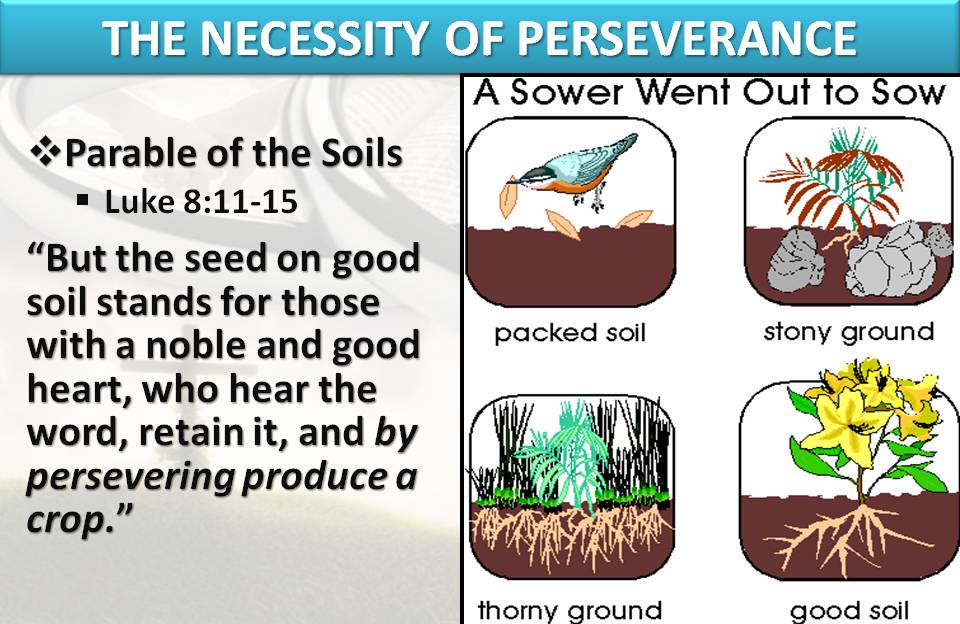
There are a lot of reasons why people fail to believe in Jesus. Some are hard soil and there is no way for the truth to take root before the birds and such eat it. Some are rocky and there is an initial taking hold but the plant doesn’t survive the heat and the wind, like the flowers that I put on my west facing apartment balcony. Others get choked out by the weeds. Finally there are those who are the good soil and the gospel takes root in the heart and grows strong and true and yields fruit.

That’s the meaning plain and simple.

sower images

I am not going to try and change that interpretation, but I am going to try and draw a couple of interpretative lessons out of that explanation.  Personally, I come from a family of farmers although I admit I know more or less nothing about farming.  I only know a little about gardening.  When I was a kid I wanted to help my mother plant a garden so she showed me how. We bought some seeds and we created a pretty good sized garden in the land next to our house. It had several rows that we had created with a tiller that mom borrowed for the purpose.  By the time we were done it was that classic Norman Rockwell style garden with little posts on the end to mark the rows and the seed packet stapled to them so we could remember whether that row was radishes or corn.  What I learned over that weekend was that gardening is hard work.

The first lesson that I would point out to from this sower story is this: the Word is not an annual. This gospel is not a one time yield sort of crop here today and gone tomorrow.  You will note that most of the times that Jesus gets all horticultural on us it is about vineyards or trees.  The Gospel when it takes root is going to be a perennial plant.  This is important because whenever we try to make the parable about us (focusing on the soil rather than the sower /seed) we can become fixated on whether or not we are good soil.  If we are good soil, then the yield can become a way for us to qualify ourselves among the other good soil out there i.e. am I yielding 30 times or 60 times? We can either compare ourselves this way to make ourselves feel like we are better Christians or we can get down on ourselves because we aren’t bearing as much fruit as someone else.

Stop it.

Sometimes the vineyard has a bumper crop.  Some years are lean.  Some years a fruit tree will produce more fruit than you know what to do with and some years there aren’t any fruits at all.  When I lived in Corpus there was a grapefruit tree in the backyard that produced far more grapefruit than I could have ever consumed.  Truth be told, even one grapefruit is generally more than I want to consume. Right across the fence in the neighbors yard, not even 10 feet away there was a grapefruit tree that was a perennial disappointment.  So much so that the neighbor always made sure I knew that he didn’t want me to prune the limbs that stretched over the fence from the superstar tree because he wanted to harvest those grapefruits.

It is like that with Christians.  We have seasons when we produce much fruit in our own lives or in the lives of others and there are seasons when the pickings are slim.  Both are OK.  Both bring glory to the Father because throughout it all we are good soil.   Jesus says, “they are the ones that hear the word and accept it” meaning that the good soil are those who have begun to orient themselves around the truth of Jesus Christ.  What does that mean?  Read Romans 12.  Most people think that the gospel is doing all those things, but those things flow out of understanding the truth about Jesus (Romans 1-11) not the other way around.

In short, if you want to be bear more fruit, then double down on your understanding of who Christ is and the fruit will follow.

Why is that? Because the word is being sown haphazardly all the time.  I mentioned earlier that when it came time to plant the garden my mother and I prepped the plot of land.  We tilled and readied the soil for the seed.  Not this sower named Jesus, this guy is chunking that seed all over the place. I once thought that this was really silly and not the most effective way to plant anything but I recently learned that this was common practice in his day.  A sower would sow the seed and then go back and till the ground turning over the dirt, rocks, weeds, etc whatever with the seed.  They did this for two reasons.  One, they didn’t always have the best soil to work with in the first place.  Let’s face it, Israel ain’t Kansas.  Two, there wasn’t a place down the road to buy potting soil and fertilizer and Weed-B-Gone.  You turned over the dirt and everything in it good and bad to have whatever nutrients you could get in the soil for the plant and you hoped that the Lord would bless you with rain and the right combination of stuff to find out where the good soil was and grow you some produce.

And therein lies the second take away from the parable for the believer: you WILL BE tilled.

Far too many Christians think that the after accepting Christ into their hearts life is going to be a long period of perfect.  When the tough stuff happens they ask themselves “Why is the Lord doing this to me?”  They ask themselves why God is punishing them.

“We rejoice in our suffering because we know that suffering produces perseverance and perseverance produces character and character produces hope and hope does not disappoint because God has poured out His love for us through the Holy Spirit.” (Romans 5:4)   


parable-of-soils

Ignore every preacher you hear (most of them are on TV) that try to sell you this Pollyana notion that the life of the Christian is smooth sailing.  Do your best to ignore your well-meaning Christian friends who try to tell you the same.  As my good buddy Sam used to say “It is hard to be a Christian”.  But when the stuff happens keep in mind that you are being tilled, the Sower is working His soil to make you produce fruit.

I will speak for myself.  Too often I have asked myself what does God want me to learn from this experience.  Too often I have listened to other people ask me that same question to which I have had very little in the way of answer.  What if our question became “God, how do I bear fruit in this moment?”   Don’t hear what I am not saying.  I am not suggesting that there is never a lesson or a pruning of the vine where we need to get ourselves aligned with God more closely.  What I am saying is that always asking the the first questions is putting the focus on us and our experience, pain, and hurt rather than putting the focus on God and asking how we can grow and bloom.

Questions:

  1. Have you found yourself focused more on the soils (you) in the story than on the seed (word)?
  2. Have you ever judged yourself for the amount of fruit your life is yielding for the Lord?
  3. Have you asked yourself recently “Why me Lord?”
  4. How would your walk of faith be different if you asked God to help you bear fruit in times of trial and suffering?
  5. What can you do to focus more on the word during this season of your life?

Are you enjoying the Hypocritical Christian? If you are please share the website with someone else and encourage them to try it out. If you receive it through email and choose to share it with some else let them know where they can find new posts for themselves. Also note that you are welcome to ask questions or even “argue” back through the comments.  Dialogue is always encouraged.  I ask that you suggest the website to others because knowing that people are going to the website encourages me to keep posting.

As always this is given freely and if you choose to use it in a bible study of your own or as a devotional before a small group meeting, etc. please let folks know where you got it.  It is written with fear, foreboding, and prayer by a fellow hypocrite who is just trying to figure out the road ahead.


To the Moon and Back Again… Why The Believer Shouldn’t Fear Blasphemy of the Holy Spirit

Read Mark 3:20-30


to the moon and back

I Love You to the Moon and Back is a popular book for little children.  My guess is that it was written by someone inspired during a reading of Do You Know How Much I Love You? given that the latter ends with this very phrase.  It is a fitting sentiment of parental love and has inspired a cottage industry of wall art like the image above and posters and wedding invitations and coffee mugs and who knows what else.

The moon is officially 238900 miles away from the Earth.  Imagine how large the moon must be to be so visible in the night sky? Interesting fact, at apogee, the moon is over 250000 miles away from the earth. So when someone says they love you to the moon and back they are saying a lot. In fact you would circle the earth’s equator 7.5 times to equal the distance to the moon and a total of 15 times to go there and back.  So, I guess when a person says that they love you to the moon and back they are saying that they would chase a you around the world 15 times to woo or save you.  Most parents have felt like they have chased their children that far at one time or another.  No one ever says I love you to the Sun and back (186 million miles) probably because the Sun is not out when you are trying to get a child to go to bed; except in Texas where the sun is seemingly always out!

we_are_so_tiny-100047037-large

This image is from the Jet Propulsion Laboratory at CalTech.  The larger dot is the Earth and the smaller dot is the moon seen from 900 million miles away! In case you are wondering that is a picture taken from a spacecraft near Saturn. Brief conspiracy note: I have no way of proving that this is a picture from 900 million miles away. It could be zoomed out capture of a light bright with a pinprick in the paper for all I know.  Still if Saturn which I have seen through a telescope is 900 million miles away then why don’t we start saying “I love you to Saturn and back”?

Since we are going for hyperbole of the highest order here, the furthest known visible distant “object” from earth is a galaxy, MACS0647-JD, that is 13.3 billion light years away. If you are curious how many miles that is it is 13.3 billion multiplied by 5.87 trillion or 7.81 e+22 miles.

“I love you to MACS0647-JD and back” just doesn’t have the same appeal as the Moon or Saturn; nor does it lend itself easily to wall art you can find at Hobby Lobby.  Truth be told 7.81 e+22 miles only makes sense to like 2% of the population.

Thus far in Mark’s gospel, Jesus has been healing folks, casting out demons, preaching and sharing the truth about the arrival of the hour of the Kingdom of God.  Demons have recognized him.  People have begun following him.  The powers that be in Jerusalem have taken notice and especially since he has healed people on the Sabbath.  Now, in these verses, we learn the smear campaign that has begun.

Jesus is possessed of some sort of unholy spirit or is using the power of Beelzebub to perform magic and seduce the people.  In fact, the presence of the Scribes may very well be a sign that the Sanhedrin are conducting an official investigation into whether or not Capernaum has been seduced by evil.  This was a very real thing in first century Palestine.  We also know from documents in the second century that the idea of Jesus as sorcerer and seducer of minds was still a charge leveled against him by Jewish authorities and pagans in their arguments with Christians.

Jesus answers the charge here with a simple parable: a house divided against itself can not stand.  If I am empowered by Satan then how can Satan succeed if the things you see me do are actively working against the demonic powers in the world? This is the question that Jesus asks.  It is sound logic.  After all, an army never turns its guns on itself and shoots half the troops before engaging in battle.  There are lots of places we can look for examples of this wisdom.  If a husband and wife are struggling we sometimes see the symptoms in the children. If the offense unit and defense unit of a football team do not respect each other or the coaching staff the team is seldom successful.  Abraham Lincoln famously applied this saying to the competing sides of the War Between the States. Even today, we see it in the struggles of the Democratic and Republican parties not to mention the Congress as a whole. Indeed, when a house struggles against itself it cannot stand. Thus, it was ridiculous to consider that Jesus might be invoking the power of Satan to attack the demonic forces in the world.

Jesus goes on to talk about the inability to plunder the strong man’s house without first binding the strong man. For years I could not follow this notion because I did not know who the strong man was.  I always supposed that the strong man was God and that no one would be able to enter into his kingdom and bind him up and pillage.  Sometimes I even wondered how to apply it to the life of a believer.  How can we be the strong man and avoid the binding and the robbing?  Now I am older and hopefully a little wiser and I have come to realize that the strong man is Satan.  Jesus is not describing what Satan is trying to do to God or us, as I always thought; rather, Jesus is describing what he is doing while on Earth.  He is the one who is entering into the realm of the strong man where he will bind him up and loot the house.

Recall way back in chapter 1, specifically verses 7 and 8 where John the Baptizer says that one is coming who is greater than he who baptizes with the Holy Spirit. Jesus is this greater than.  Not only is the bringer of the Holy Spirit greater than John the Baptizer, he is greater than  the strong man, Beelzebub.  The mission of Jesus includes His entering into the house of the devil, binding him up, and spoiling his house.

What are the spoils of Jesus work of binding Satan?   Read his next statement, the beautiful sublime truth about what Christ does in his spoiling of the Devil’s domain.

“Truly,  ALL sins shall be forgiven the sons of men, and whatever blasphemies they utter…”  I realize that this is half the verse but it is so crucial that we linger here for bit.  Three little letters (only 5 in Greek) but so complete and full.  ALL.  Think of the ways that word is used in our own language:  All expenses paid.  All-inclusive. Open all the windows. Deal all the cards.  The team won all of their games.   It means every.  It means completely.  It means in-totality. ALL means ALL and it never means less than every last thing that it references.

ALL SINS shall be forgiven (sons of men is a colloquialism for people) and whatever blasphemies they utter.  What does Jesus plunder from the strong man’s house?  Our guiltiness.  Satan is the accuser.  He is the district attorney who brings the charges against people before God. Jesus enters into the house and takes from him the power of sin over us by providing for the forgiveness of ALL our sins.  As the great hymn puts it “my sin not in part but in whole.” ALL.

Whatever you are doing right now, stop.  Stop and let that truth sink in and devastate your heart.  Give the Holy Spirit the silence to work and reveal and wash.


Every single sin you can think of from your past or present is forgiven.  

The sins you are yet to commit, for the believer they too are forgiven. 

ALL

This is what Christ has done.  Here in this moment he is foreshadowing, but when he utters “it is finished” on the cross, the work is done. His death the atoning sacrifice for your sins. The only sacrifice that you will ever need.  The only work that will ever suffice for your sin.  Done!

Praise God for his love for you.  Confess with your mouth that Jesus Christ is Lord and believe in your heart that He has completed this mighty work for you and for all who put their faith and trust in Him. This is the gospel.  This and nothing else.

but whoever blasphemes against the Holy Spirit never has forgiveness, but is guilty of an eternal sin!”

This is why I asked you to stop and ponder the beauty of all your sins being forgiven, because if you read too quickly you will become afraid of this half of the verse.  There is but one unpardonable sin and that is blasphemy of the Holy Spirit.  Unpardonable means that it cannot be forgiven.  The inability to forgive it is what makes it an eternal sin.

The gospel of John tells us that the work of the Holy Spirit is straightforward.  The Holy Spirit is tasked with convicting the hearts of people about sin and with the truth about who Christ is.  To make it simpler, it is to reveal your guilt before a just and Almighty God and then reveal the pardon that is available to ALL who believe that Christ has died and risen to secure that pardon.

This is why blaspheming the Holy Spirit is unpardonable because it literally means denying the truth of who Christ is and what he has done.  When a person rejects this truth, that person has placed themselves at complete antagonism to God’s will.  So, if you are a believer in Christ, be encouraged for you have already avoided the one eternal sin.

The scribes with their claims that Jesus was an operative of Satan were treading very dangerous ground.  They were at risk of the ultimate blasphemy.  For rejecting Jesus is to reject God himself.

If you are reading this then you are most likely a believer in Jesus Christ; therefore, fear not blasphemy of the Holy Spirit.  Embrace the profound love of Christ that would forgive you ALL of your sins.

  • What are you holding onto that is sinful?
  • What guilt from past action or inaction do you still feel?
  • What sins of other believers are you still holding against them?
  • If God has forgive you much shouldn’t you forgive others?

ALL

The universe is suspected to be 46 billion light years across or around 2.6 sextillion miles, with the visible expanse of space a mere 13.3 billion light years.  I sometimes like to ponder the expansion of the universe from the Big Bang as the creation of the universe rocketing way from its source, God.  My head cannot completely picture that and I have absolutely no reference for the exceptional distance the universe is from one side to the other.  What I know (and I use know in the sense of deepest truth not just in my mind) is that the Divine Author of all that is exists outside of the limitations of time and space.  What I know is that before all was created Jesus was meant to happen.  I mean, Jesus knew when the creation began that there would be a cross and a death. God chose to create all that is from love.  Jesus chose to love by agreeing to create and therefore to die. The Holy Spirit chose to love by binding the hearts of people and the glories of creation to the Creator.  So, Jesus traveled those sextillion miles that all of your sins might be forgiven.

Or in other words, “God loves you to MACS0647-JD and back!”

And then some.


Feel free to use this Bible study for your own groups or discussion.  It is freely given. If you do I merely ask that you acknowledge where you got it and if you find it useful that you encourage others to seek it out. It is written with fear, foreboding, and prayer by a fellow hypocrite who is simply trying to figure out the road ahead.
Dig Deeper

Read Mark 3:1-6

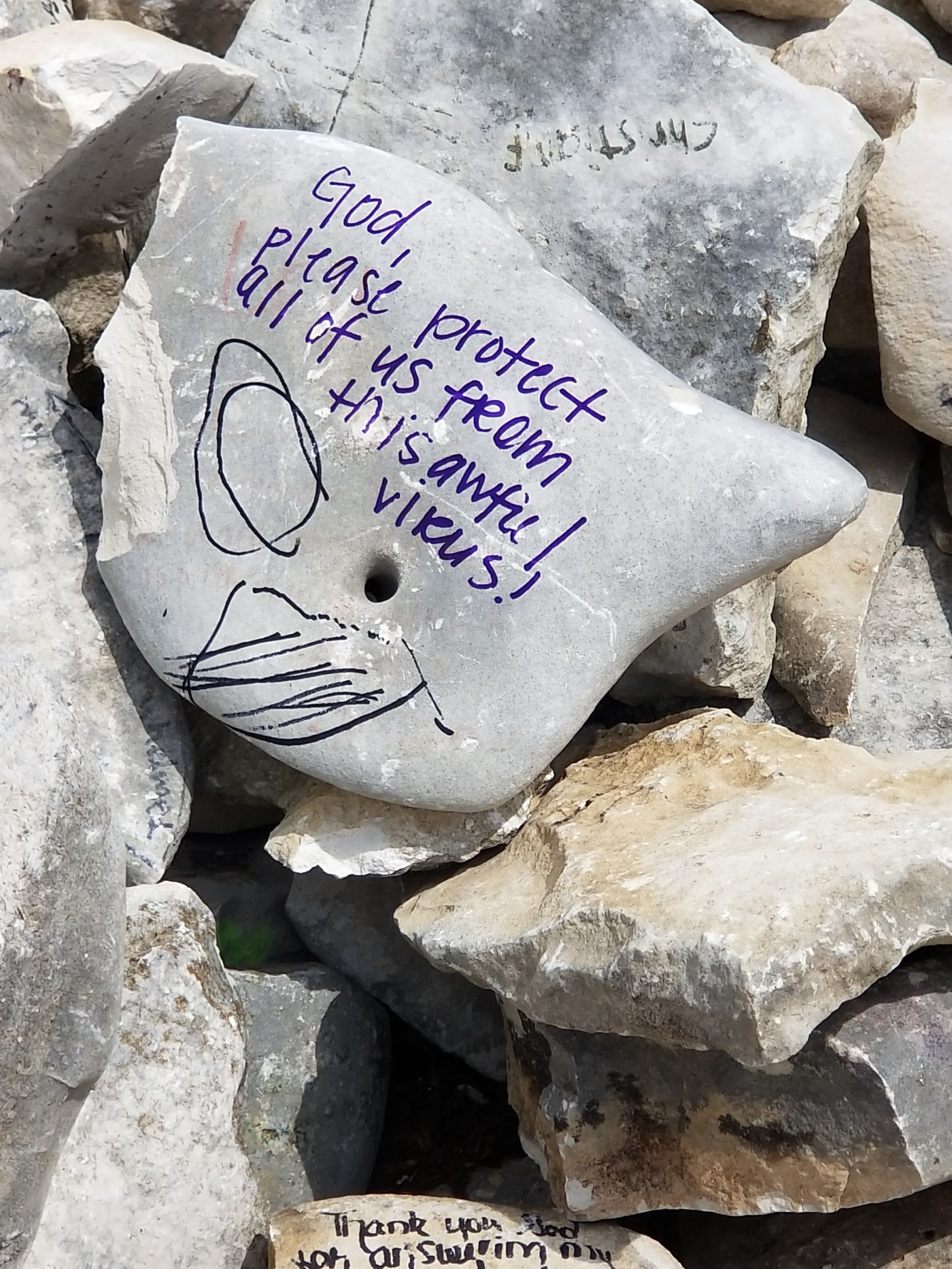
a_boulder

I don’t know if this is true of all kids but it certainly was true of me.  Some times I dug up rocks in the ground.  Whether I was looking for “skipping stones” or just goofing around I sometimes went looking for rocks. More than once, I started digging out a rock and soon realized that the rock was actually much bigger than the part that I had seen at ground level.  Now I live in the Texas Hill Country and if you dig at all in this area you soon learn there can be all sorts of rocks beneath the surface and even the seemingly smallest rock can suddenly be huge!

If you never start digging though the rock always just seems small and small rocks are manageable. Scripture can be the same way. You read a passage from the Bible and it seems simple and straightforward and small.  After doing a little more digging you figure out there is a lot more to it and it is heavy!

In the first three verses of Mark 3, we read a straightforward story. Jesus goes into a synagogue on the Sabbath and ‘yawn’ he is going to heal someone.  Simple, straightforward, nothing complicated: a man needs healing, it is the Sabbath, Jesus is going to do it, and its going to upset those pesky Pharisees all over again.  Really, Mark? we think, can’t you move on we have seen all this before already.  Blah, blah, blah Jesus heals on the Sabbath.  Jesus is Lord of the Sabbath.  We get it.  This story is a pebble.

That impulse isn’t limited to everyday readers of the gospel.  It happens to well-educated trained readers of scripture too.  In fact, you can probably already hear the sermons written from this passage in your head:

“Jesus was a radical who upset the political and religious authorities of his day by disregarding the rules in favor of caring for people in their time of need.  What rules do we need to flaunt today to continue the good work of our political revolutionary Jesus?”

“How are we like the Pharisees allowing our traditions to keep us from doing good or making worship a more inviting place for the weak, the weary, and the downtrodden.  Is not our emphases on music and liturgy a modern expression of the legalism of Pharisees?  How must we change to ensure that the grace of Christ is first and foremost?”  

“The Pharisees felt there power slipping away at the hands of this Jesus who did what was right in a moment when everyone else would not.  This is why they sought to kill him.  Fortunately, we would never make that mistake today as we would welcome Jesus and his miracles into our midst.”

O.K.  That last one is less likely to be preached, but you know you have heard the others.  And they come from a superficial reading of this passage.  Some Christians, mostly progressive, never get farther than considering Jesus to be a better Caesar Chavez.  Other Christians, mostly conservative, never get any deeper in these scriptures than judging the Pharisees for there legalism and failure to recognize the Messiah when he showed up.

Dig a little deeper, sweep away some dirt, find the bigger rock buried in the ground.

Jesus follows his habits, he is in worship on the Sabbath. (For modern Christians there is a whole sermon in the first sentence!) Mark tells us that there was a man with a withered hand present and that “they” were watching Jesus to see if he would heal him on the Sabbath. Jesus asks the man to come forward to the middle of the synagogue, the center of attention.  Here is where we get confused, because the man has been brought front and center we assume that the healing is the big deal.  But this man will remain anonymous throughout and Jesus is never going to comment on his faith.  This latter point is how we know Mark is telling us something different from the previous arguments about the Sabbath or healing events.  So much for the meaning of the text to be about the poor and needy.

Similarly Jesus begins addressing his detractors and he does so using the common parlance of the rabbis of his day: “Is it lawful on the Sabbath to do good or to do harm, to save a life or to kill?”  The first clause was a common interpretive argument of Rabbis predating Jesus and after.  It is a rhetorical question the answer to which must be: “Of course it is lawful to do good the Sabbath.”  Many rabbis had debated these things and it was determined that saving a life must take precedence over inaction in the law of God.  If we are to love our neighbors first and foremost then doing good is part and parcel of the Sabbath.  To put a modern spin on it, you naturally would have surgeons and EMTs work on the Sabbath.  It couldn’t be unlawful to aid an accident victim.  It would be appropriate to defend a lamb from a wolf on the Sabbath.

Christ-heals-the-man-with-a-paralyzed-hand-610x353

Back to the text: the Pharisees do not say anything.  Their silence upsets Jesus greatly.  Of course they don’t argue with Jesus because the question is rhetorical.  Naturally the Sabbath allows for life saving and other acts of good.  Of course, Jesus doesn’t stop with the basic question.  He has brought the man forward.  Between his question and the presence of the man he is implying that healing the withered hand is the equivalent of “saving a life” and failure to heal the withered hand is the equivalent of killing.  What?

Let’s be clear, Jesus is nobody’s fool.  He knows as well as anyone that the withered hand could wait a day or even 12 hours.  This is the key to understanding that the story is not simply about the perils of legalism or about the way that people become so rigid interpreting right from wrong that they fail to see the effect of such legalism on others.

Here is where the buried rock is revealed.

If you have been following this blog you know that I feel that scriptures are best understood in the broader context of the chapter / book that they are found in.  The Reformers (Luther, Calvin, Zwingli, etc) promoted the notion that scripture should be used to interpret scripture.  That is a great principle and scripture should be used to interpret other scriptures.  That said, it is also important that a reader of scripture first looks to the rest of the current book before jumping to other books in the Bible.  If you have been reading Mark (or this blog) then you know that Jesus is making a claim about the arrival of the Kingdom of God.  According to Jesus, the hour is now that God is acting.  In the healing of the paralytic there was the tacit claim that Jesus (as the Son of Man) has the authority to forgive sins (something that is YHWH’s purview) and in the conversations about Sabbath-keeping the implication is that Jesus is the Lord of the Sabbath (also the purview of YHWH). Throughout Mark, Jesus is saying look at this; see by what I do that what I say is true.

So many people describe the Gospel of John as Christocentric, but how can you miss the fact that in Mark the center of every story thus far and the focus of every point has been Jesus and who he is.  This gospel is extremely Christocentric.

Back to the paradox that healing the withered hand is not a matter of life and death. Robert Guelich, NT scholar, writes, “‘To do good’ and ‘to save a life’ takes on an eschatological ring of the coming of the day of salvation, the fulfillment of God’s promised activity in history.” God is acting, breaking into the world with the arrival of the Kingdom.  The kingdom is present wherever Jesus is present. I think that Jesus before the man in the synagogue is a moment where Mark wants us to recognize ourselves present in the presence of God. For Jesus to do good  / heal meant to give life and to refrain from good / not heal was to kill, meaning depriving another of the benefits of the redemptive / restorative power of God.  Failing to act would be cheating the man and all the gathered community of the right now benefits of the Kingdom of God even as they would have to wait for the ultimate fulfillment of the Kingdom. But the key is that the presence of Jesus brings life and changes things.

This is what we have seen throughout the Gospel of Mark.  A demon possessed man comes before Jesus and is made whole–saved–and Jesus demonstrates power over the forces of evil.  A paralyzed man is brought before him and made whole and Jesus demonstrates the power to forgive sin. A tax-collector is called into his retinue and redeemed from a sinful life and Jesus demonstrates the need for God’s Anointed to be amidst the sinners. Hyper-religious folk judge the followers of Jesus for not following the law more closely and Jesus proclaims an authority over the law itself.  Every aspect of Mark so far has been an effort to nudge the reader to make a decision about the true nature of Jesus. Is he the embodiment of the rule of God among us or not?

Every encounter from the demon possessed to the disciple; from the physically deformed to the self-righteous has been at its core a question of life and death because this is the moment that they have encountered Jesus. How each responded to that encounter is what has mattered most.

So how have you responded?  Have you acknowledged the truth of who Christ is?

How has your limited idea of Jesus prevented another from encountering Christ? If Jesus is just a great teacher why should anyone care? If he is a social radical then why should anyone make a decision for him rather than just see him as another Ghandi or Malcolm X?

Maybe you have chosen for Jesus and welcomed the encounter for yourself and your salvation.  Have your actions and your efforts encouraged others to know who He is?  Have you expressed forgiveness and grace to those whom you see as sinners? Or are you silent in the face of this life and death moment for others?

Maybe you have called out to God in your hours of need, a cancer diagnosis, a child who is sick, or a loss of  job. Upon restoration have you turned your heart over to the Lord or just thanked God glibly for granting your wishes?

Let’s be clear, Jesus is not just healing a man with a withered hand, rather, he is restoring a life.  Just as Jesus does when he brings the alcoholic to sobriety, the addict to wholeness, or reunites estranged family. Jesus acts and the proper response is deeper faith, deeper trust, and deeper praise of who God is for each of us.

Jesus never touches the man.  He tells him to reach out his hand and the as the man does so his hand is restored.  We are not told how the man responded to this act.  We are told that the Pharisees in seeing this incredible moment of life-giving miracle went from that place conspiring to end a life.

A final thought: if Mark wants us to see ourselves as the man with the withered hand, in the presence of God with nothing to account for but our limitations then Mark also wants us to ask ourselves how often are we like the Pharisees.  How often do we see the restorative work of God (an addict finding sobriety, a tax cheat attending worship, a murderer released from a prison sentence, the list is exhaustive) and question the wisdom and grace of God perhaps even to the point of considering the need to stop this radical love rather than celebrating that someone has experienced the overwhelming healing power of Christ?  There are really only two places to be in those moments.  One of them deepens our own salvation and the other leads to rejection of Jesus.

Feel free to use this Bible study for your own groups or discussion.  It is freely given. If you do I merely ask that you acknowledge where you got it and if you find it useful that you encourage others to seek it out. It is written with fear, foreboding, and prayer by a fellow hypocrite who is simply trying to figure out the road ahead.


Website Powered by WordPress.com.

Up ↑