Search

The Hypocritical Christian

Tag

healing the paralytic

Faith that Heals

faith

Take a moment to reread Mark Chapter 2, 1-12.

In the very first post on the Hypocritical Christian, I suggested the following themes for the gospel of Mark:

  • Origin of the Good News of Jesus Christ
  • Christ is the messiah for the purpose of salvation
  • Christ has authority
  • Repentance is about believing whom Christ is
  • The specific work of Christ is dealing with the sin problem.

Now in the first 12 verse of Mark 2, we see all of this playing out.  In fact at least one commentator has suggested that the entire Gospel of Mark is found in these 12 verses.  Of course that is a little bit of hyperbole, but the point is that in this one story the broadest themes and the major point that Mark is communicating is present in action.

You may recall that the paralytic has been lowered into the presence of Jesus and even though the friends clearly want a healing miracle for their pal what Jesus actually says is pretty astonishing.  “Son, your sins are forgiven.”

So astonishing in fact that there were present some professional religious folk (scribes) who were thinking to themselves, “Wait, what?!?  You can’t do that!”   They knew their Old Testament scriptures quite well and that told them that only YHWH can forgive sins. If you are not familiar with YHWH it is the four consonants of the sacred name of God.  The name given to Moses from the burning bush.  If you have ever heard the phrase “the God of Abraham, Jacob, and Issac” then you know what we mean when we say YHWH.  So the scribes know that only God can forgive sins.  Exodus 34:6-7; Isaiah 43:25 and 44:22 are just a few of the places that make this clear.

Mark tells us that the scribes believe Jesus to be blaspheming.  Blasphemy is a technical term and in Jesus day a religious crime.  Anything that discredited THE NAME (YHWH) was punishable by death through stoning. In the scribes’ minds claiming the ability to do something that only the ONE GOD can do was a serious act of discrediting God. It is hard to think of something that we have in our culture that is the equivalent of this.  Maybe using the parking space of the CEO or drinking from the Admiral’s private liquor cabinet, but these infractions are minor compared to the way they viewed blasphemy.  The closest thing I can think of is identity theft, but identity theft of someone enormously powerful like the President or the Queen of England or OPRAH!

Here is where it gets interesting. Jesus knows what they are thinking and calls them out on it. He issues a challenge for himself to them.  He starts by asking them a question: “Which is easier to say ‘Your sins are forgiven’; or to say ‘Get up.  Take your pallet and walk’?”

Note what is going on here in the question.  Sins are an intangible thing while paralysis is not. If I say to a person who can not walk get up and they do then I have clearly healed them of their paralysis.  If I say to a person that your sins are forgiven there is no way that anyone can prove it just by looking.  On the one hand, it is easier to say the first because no one can disprove you with empirical evidence unlike saying stand up because in the second case the person either gets up or they do not; on the other hand, the latter is the easier of the two because it is not something that only God can claim authority over.  Everyone had seen a faith healer work this sort of miracle before. Even if we only thought in terms of modern science the latter would still be easier because it is both prove-able and there are medical procedures for healing some forms of paralysis. Try and get a prescription for your sins filled at Walgreens!

But Jesus is not stopping with the rhetorical question, he is actually cleverly setting up the scribes because he follows the question up with the following statement: “but in order that you may know that the Son of Man has authority on earth to forgive sins — he said to the paralyzed one ‘I say to you, Rise, take up your pallet and go home.'”

See both the challenge and the set up?  If the paralytic stands up then the Son of Man has the authority (power) to forgive sins on earth. If the paralytic stands up the scribes will have to admit that the sins were forgiven and that no blasphemy took place.

(Note: “Son of Man” is a term that Mark uses about 2 dozen times in his gospel. Another time we can discuss what this title means, but please make note from the bold type above there can be zero question that Jesus means for it to refer to himself.)

Mark makes it crystal clear what happens next.  The paralytic, to the absolute astonishment of the crowd, stands up, picks up his pallet and left this time out the door and not the hole in the roof. Jesus proved his point spectacularly and everyone gave praise to God.

So what does this mean that Jesus claims an authority that the Old Testament scriptures clearly indicate is the sole purview of YHWH? What is the implication? It is pretty inescapable, if Jesus makes the man walk in the way he structured the challenge then he also forgave the paralytic’s sins.  Don’t get caught up in the tortured discussions about how they viewed sin and illness as interconnected in those days and this is Jesus giving them some good old post-enlightenment sensibility about these matters of illness and the separation of the physical from the spiritual.  That is smoke and mirrors and clearly not the intent that Mark has here.  Mark wants to demonstrate here the key points that his Gospel is seeking to share: Jesus is the Christ (Messiah) and uniquely appointed by God to be God’s agent, the presence of the Kingdom on Earth. Jesus has authority.  Jesus is going to correct the sin problem.

Mark is sharing this story to persuade everyone who reads / hears it of the truth of who Christ is.  Remember the demon in the first chapter: “you are the Holy One of God.” Mark is asking all of us to ponder what it means that this Jesus can do something that only God can do.

Consider this.  When the the four bring the paralyzed one to Jesus we are told that when Jesus saw their faith he spoke to the paralytic.  I said in a previous post that what they did in action was demonstrate their faith that Jesus could do what they desired.  In New Testament Greek faith is the word pistis (this is the transliteration of the Greek letters) and it means assurance, conviction, etc. all those synonyms in English that you would expect.  What is interesting is that it is derived from the Greek word peitho which is strictly speaking “to win over; persuade.” With this information we can come to understand that faith is a demonstration of having been persuaded.  It is a confiding belief in the truth, veracity, reality of any person or thing.  In the case of the four, their actions demonstrated a belief in the truth of whom Jesus was and the authority that he possessed.

I think that Mark is trying to persuade us. In the last post I wrote: “faith that heals is faith that trusts.” A careful reader will note that the only difference in the title of the last post and this post is punctuation. Faith that heals is faith that trusts; faith that heals comes from having been persuaded about who Christ is.

I encourage you to spend a little time this week asking yourself what it truly meant that the paralytic got up and walked.  Is it not more than a miracle? Is it not more than the forgiveness of sins?

Mark seems to think so.

Feel free to use this Bible study for your own groups or discussion.  It is freely given. If you do I merely ask that you acknowledge where you got it and if you find it useful that you encourage others to seek it out. It is freely given and written with fear, foreboding, and prayer by a fellow hypocrite who is simply trying to figure out the road ahead.
Faith That Heals?

Years ago I purchased my first house.  It was a 75 year old bungalow made from stone. Over the course of 7 years, the interior of the house was restored to something like what it would have looked in the 1920s.  The work included reinstalling a wall so that one very large room was once again two bedrooms.  When the wall was rebuilt, closets were included to increase the storage. Not only was the wall build, but the trim work around the doors, the crown molding, and the toe moldings all had to be milled by me to make it look like the millwork from 7 decades before.  Some years later I had the opportunity to stop by and ask the current owner if my children could see where they used to live. The host was gracious. The house looked great and it was nice to bring back memories, but one thing was a little irritating.  The wall and closets had been removed again.  Ugh!

I mention this because I have often thought that the first miracle of Mark Chapter 2 is not the healing of the paralytic, but rather that Jesus does not get mad.  Many, many people have heard this tale of four men bringing a paralyzed man on a gurney of some sort to be healed. Kids like the story because the tearing a hole in the roof (literally digging up the roof) is a vivid image.  If you are not careful you will miss a little trivia fact in the start of the story.  This is Jesus’ home. This is Jesus’ roof!

So, just take a moment and ponder that. Imagine what it would be like to be at home, with…um… the whole town over.  They are piling in through the door -some of them are hacking and coughing; some of them have weeping pustules. Some of the people are probably just watching you work and wondering if there is more to drink or something to eat. You are teaching and healing, healing and teaching. You are trapped behind the couch because there is no room left. And then after all of this, four grown men climb up on your roof, dig a hole large enough for a man- a prostrate man- to pass through and they lower him down to you.

And miraculously, Jesus’ reaction is to be impressed with their faith to the point that he does what they ask.

Well, sort of.

What Mark actually tells us is “And Jesus seeing their faith said to the paralytic, “my son, your sins are forgiven.”

This the first of two posts on these 12 verses of Mark.  When I started the Hypocritical Christian blog I expected to write a post a week on a single chapter of a book in the Bible.  I was probably foolish to think that was possible because there is so much in every passage of scripture that it is impossible to skip over stuff. Not only that, but the Holy Spirit keeps telling me to post more often.  I mention this simply to say in this post you may determine that I left out some stuff and you will be right to note I am not covering everything. This post is going to focus on the action of the four men and the revelation that Jesus is “cardiognostes”, the “heart-knower.” The subsequent post will look more directly at the controversy with the scribes with a emphasis on what faith means.

The story is really straightforward.  Four friends carry a man to Jesus.  They cannot reach him.  They go to exceptional lengths to overcome the crowd.  Jesus is impressed and pronounces forgiveness. The scribes think to themselves that Jesus is making a claim to do what only God can do. Jesus reads their minds.

Just these 8 verses force me to ask some questions. Can a person experience healing and salvation because of the faith of someone else? Gosh I hope so because Christians do a lot of praying for health.

  • When was the last time that you prayed extra hard for some oneelse’s healing?
  • When did you last pray for someone whose situation seemed helpless (paralysis is a big deal) with the total conviction that Jesus can make the change happen?
  • When was the last time you went the extra mile to bring someone else into the presence of Jesus?

It seems to me that what Jesus sees in the actions of the four men is their resolve not only to help their stricken friend, but that Jesus is the one who can make the difference. It is that latter part that labels what they do as faith versus just desperation. This conviction they have is what makes the difference for their friend.

I have a friend, Paul Burns, who wrote a book called Prayer Encounters. The book grew in part out of his own experience of leading people in life-changing prayers.  Paul would say to people that the key to effective prayer is the belief that God can do what is asked. Mark doesn’t record the conversation if any between the four and Jesus. All we get are the actions, but those actions demonstrate that these four believe that Jesus can do something.

Too many Christians pay lip-service to prayer.  Too many Christians spend too little time helping those in need get into the presence of the Lord.

In the next post, we will unpack the meaning of faith more fully. For now, consider that Jesus knows what the scribes are thinking in their hearts. We don’t know if that is simply because he sees something in their faces and he intuits their thoughts; or, if he is just straight up reading their minds. The trouble with Jesus is he may be a super-intuitive, smart person and he may just be God and therefore a mind reader.  Mark has an answer in mind that we will get to next time. Somehow Jesus knows. What if he knows what you are thinking as well?

Scared?

We all should be.

  • Have you been hiding some ill-will towards someone you work with? a spouse? a sibling? the President? the neighbor whose political affiliation is different? the person from a different race? The person poorer or richer than you?
  • Do you say one thing to people but “secretly” think another?
  • Do you judge others? do you judge self? do you lust? do you rage?

We could make that list go for a long time. I do not write these things to make any of us feel guilty.  I write them to say that when we read Mark Chapter 2, we should take seriously the reminder that Jesus knows our hearts.  It should remind us that as much as we need God’s healing for the physical things that ail us and as much as we need God’s blessing for the material needs that befall us; we need God’s forgiveness for the sins that plague us.

Ignatius Loyola, the founder of the Jesuits, encouraged his students to spend a few minutes daily doing a personal inventory.  The idea was to contemplate the effectiveness of our thoughts and actions with the intent of improving consistently. I invite you in light of the faith demonstrated by the four who carried the paralytic to do some personal inventory.  I urge you in light of Jesus’ knack for reading minds to take a moment to consider what is most often on your mind. Perhaps these questions can help:

  • When you pray for yourself or others are you convinced that Jesus can answer the prayer?  If not, what would it take for you to change your viewpoint (repent) and pray with more conviction?
  • Is there someone who needs your help? Is there someone who needs the witness of your faith or actions? If Jesus was watching your actions would he see your faith?
  • What secret thought do wish God couldn’t see?  When was the last time you confessed to God your sins? Just as importantly, what past sins do you keep apologizing to God because you doubt that He forgave you?
  • What is one thing that can be different in your life tomorrow that will move you closer to Jesus?

Just as we all need to pray to Christ with the belief that God can do what we ask, we need to pray to Christ to renew our minds and thoughts because our actions will follow. Faith that heals is faith that trusts.

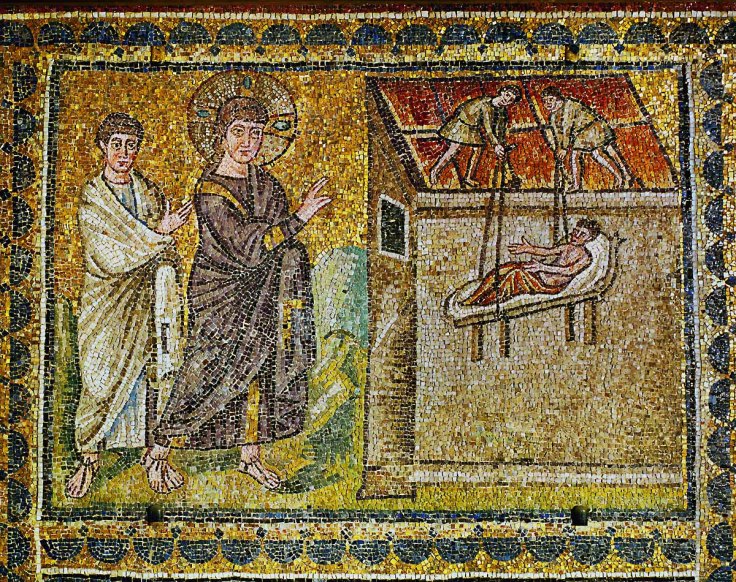
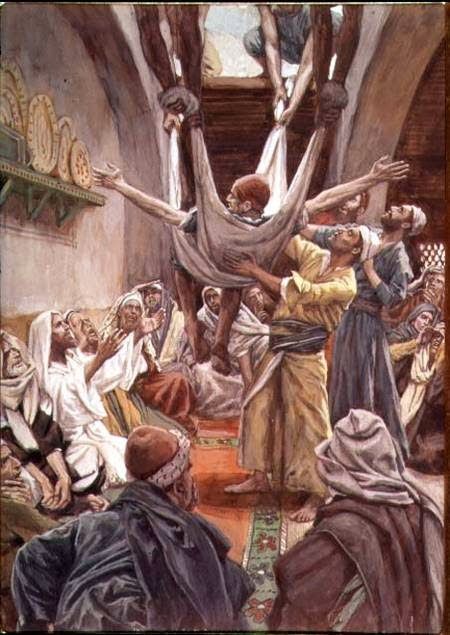
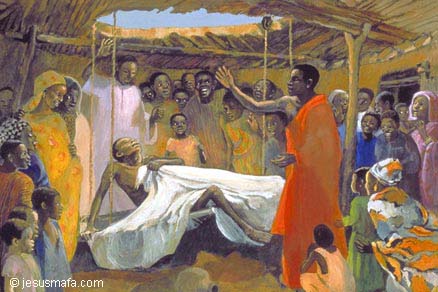
Images of Healing the Paralytic

Below are three separate images depicting the healing of a paralytic man as told in Mark Chapter 2. The images come from different times.  This first one looks like one that I might have seen in school when I was a kid.  I went to Catholic school and they didn’t have child friendly pictures back then. While at first glance the image looks middle eastern, closer examination shows that all the folks in the image have European features regardless of how swarthy their skin is.

paralytic

This second image is from the Jesusmafa images.  My understanding is that these images came out of a partnership between indigenous Mafa Christians and French missionaries in Cameroon. It is a great example of how the stories of the gospel can be inculturated, or put into a localized context, where ever they told.

jesusmafa_healing_paralyzed_man

Finally there is this apparently even older image of the story. I am not sure where it came from but it is in a mosaic style that was fairly prominent in the first 500 years of Christianity.

The paralytic lowered from the roof, Jesus and an apostle. Mosaic (6th)

Website Powered by WordPress.com.

Up ↑