Search

The Hypocritical Christian

Tag

HypocriticalChristian

Mercy, Mercy Me

The previous post began our journey through Romans. You can read it here. If you are up to date, you know that we ended that post by saying that “it all begins with mercy.”

“Therefore, I urge all of you because of the mercies of God” Paul writes in Romans 12:1. The therefore at the start of 12 is the culmination of all that Paul has written to the church in Rome up to that point; so, if this is the culmination of his argument, then mercy is a key thing to understand.

Mercy is everywhere in the scriptures. These posts on Romans are an effort to synthesize a three-year bible study that I led. The first year we walked through the Gospel of Luke. We encountered mercy over and over again. For Example: when Mary begins to prophesize after the angel Gabriel has come, she recites Psalm 103: “His mercy is upon generation after generation toward those who fear Him.” Likewise, Zacharias says “because of the tender mercy of our God with which the Sunrise from on high will visit us” referring to the promised messiah. Perhaps most importantly though Jesus himself highlights mercy to his followers.

Jesus in the midst of the beatitudes and preaching in Luke says “Be merciful, just as your Father is merciful.” This is not just a suggestion; it is something that is to be true of those who follow God. We are to be merciful. The parallel passage in Matthew expresses the same point differently. There the word is perfect. “Study to be perfect as your father in heaven is perfect.” Now that can cause a lot of grief for a person, because I don’t know about you, but I fail at perfection usually in the first hour of my day. Perfection is an ideal. But Luke helps us to understand that being perfect like God means being merciful!

We will come back to that thought in a minute but first we need to consider another place where Jesus highlights mercy. One day, a lawyer challenges Jesus to explain what it means to love your neighbor by asking “who is my neighbor?”. Jesus replies with a parable (the story of the good Samaritan) that culminates in this question, “Whom do you suppose was the neighbor to the man who was left for dead?”; the answer given “the one who showed mercy to him” is met with the response “go and do the same.”

The underlying Greek word for mercy is eleos. It is a word with a rich and deep meaning. In the New Testament the word means more than forgiveness, although it does mean forgiving a debt or providing pardon. Eleos also means compassion, generosity, and provision. The Samaritan did all of this in the story. In that manner he acted like his Father, God.

In Exodus 34, God offers a self-description to Moses: “The LORD, the LORD God, merciful and gracious, slow to anger and abounding in lovingkindness (hesed) and truth…“. Mercy is so important to the character of YHWH that it is the first adjective used in his self-description!

Hebrew scholars note that the word for mercy and the word for womb have the same trilateral root. In Biblical Hebrew, all words are built outward from three core consonants. These “roots” provide insight into the meaning behind the word. We do something similar in English. You can understand the English word enlightenment if you know the meaning of light as to illumine or make something easier to see. The womb is a place of love, safety, and provision for the baby. It is in the womb that the strong bonds of love are first formed between mother and child. The womb is a place where the growing child is kept safe and where all that is needed is provided.

Saying God is merciful is to say that he loves unconditionally, that God forms us, and we grow when connected to him. Saying God is merciful means that he provides everything that we need. We see aspects of this mercy throughout Luke, not only with the Samaritan, but also when Jesus feeds the 5000, heals the demoniacs, and when he promises the thief on the cross that that very day, he would join him in Paradise. Mercy all around!

The writer of Hebrews shares “we have a great high priest who has passed through the heavens, Jesus the Son of God… therefore lets us draw near with confidence to the throne of grace, so that we may receive mercy and find grace to help in time of need.

What does this have to do with Paul and his Letter to the Romans?

Paul grew up learning all that we know as the Old Testament. Early in his life, he felt that he understood all of who God was, what it meant that he was merciful and gracious; righteous and just. Paul was so certain of his understanding he persecuted the Christians in Jerusalem and other places because he was certain that they were heretics sharing falsehoods about God. Then it all changed. After encountering Jesus in a vision, he rededicated his understanding of those scriptures to comprehend what it meant for someone to have risen from the dead. By the time Paul is writing to Rome, and by the grace of God to us as well, he is able to say because of the mercies of God (his provision, his protection, his transforming spirit, and his salvation) we are to provide ourselves as living sacrifices.

Our forgiveness and justification in Christ Jesus are just the starting point. Now we are to live out mercy-filled lives in response to what God has done for us. This is our “rightful worship”. The path of your transformation follows opportunities of mercy, and it means so much more than just being more forgiving.

Some will recognize a Marvin Gaye song from the title of this post. Not particularly theological, but the song begins “oh mercy, mercy me, things aren’t what they seem to be, no.” In our next post we will start at the beginning of Romans and start seeing that the world isn’t what it seems. Until then the title of this post is a prayer you can live this week.

In Exodus when God describes himself it is written that he descended from the cloud and proclaimed the Name of the Lord. “YHWH, YHWH ELOHIM, a god of Mercy…” mercy is not just what God does but it is who God is! So, the title is a prayer best read this way: “MERCY, mercy me.”

Thank you for reading. If this post blessed you, please share it with someone else. As always it is freely given. You are welcome to use it although it would be nice if you credited where it came from.

Peace to you on your own journey, Vaya con Dios!
The Most Significant Day Ever

What is the most significant day in history?

For Americans, there are lots of contenders whether it be the day the towers fell or the day the Japanese attacked Pearl Harbor. Other Americans might choose the moon landing or the day the Beatles played on the Ed Sullivan show. July 4th,1776, makes a strong case for the most significant day in history.

Other countries and nationalities would have their own days of significance. Days of foundings, of significant battles fought, of independence from colonial powers, all special days awash with extra meaning for those peoples.

Then there are the individual days people might choose when asked the question. The day they were married. The day a loved one died. Maybe even the day that they won the lottery. The least humble among us might suggest their own birthday!

There is only one day in all of human history that is so significant that it is literally celebrated around the world on every continent not just annually but every single week. That is the day Jesus rose from the dead.

Read Mark 16: 1-8

We do not know the exact date with any certainty. We can do a little historical triangulation and narrow it down to a year within the range of 30-34 CE (the renamed A.D.) and we know that because it was around the celebration of Passover we are in the Springtime of year in Jerusalem.

Ancient burial practices being what they were it was common for a body to be buried in a cave in those days and for loved ones and family members to bring spices and anoint the body. This was done to help cover the smells associated with decomposition. Eventually, the bones of the person would be collected and stored in a stone box called an ossuary. This is precisely what Mark says the women were heading out to the tomb to do in the early hours of the morning.

This is one of the ways in which this story with an incredible ending rings true. First, the suggested task of the women is precisely what we would expect to be going on based on what we know about 1 century burial practices in Jerusalem. Secondly, it rings more than a bit true, that none of the men are there because they have left this important yet menial task to the women. No doubt this anointing would have been followed up by going to the well for the daily water supply, getting the “kitchen” fire started for the days cooking and all the other never-ending tasks that fell on their shoulders.

They must have been experiencing a swirl of emotions. Jesus was dead. They had followed him and hung on his words, wondered what it might all mean, worried that they or their husbands, brothers, and friends might also experience retribution at the hands of the Sanhedrin or the Romans. Maybe they felt some resentment that they were having to “fit” this task into the rest of an always busy day. The only thing we do know for certain is that they wondered about how they were going to get into the tomb because there was the matter of the large stone that sealed the entrance.

This is when the story turns to the unexpected.

The stone is already moved away from the entrance! Mark notes that it was extremely large. Now, the ladies are probably thinking that someone else has come to anoint the body. They may have reasoned that one of the disciples had come to pay respects. They may even have considered the possibility that someone was coming to take the body away.

They mustered up the courage to go into the cave without knowing who was in there ahead of them. They were unprepared for what they found.

In our day, the idea that the tomb is empty that Jesus rose is so ingrained in us that we are inoculated from the sense of fear, trembling, and awestruck wonder those women experienced.

Entering the tomb, they saw a young man sitting at the right wearing a white robe and they were amazed. He said to them ‘do not be amazed; you are looking for Jesus the Nazarene, who has been crucified. He has risen. He is not here; behold, the place where they laid him.’

The word translated as amazed gives the sense of awestruck wonder or befuddlement. It is like the time my son came home from school around the age of 8 to learn that we now had a Wii. His young brain could not wrap itself around what was happening at all. He had gone to school like any other day and when he came home it was now a home with a Wii. What was this new world he was in that something like this could happen.

That is the befuddlement of joy. I think you will agree with me that there was a not inconsiderable amount of fear wrapped up in the astonishment that the two Marys and Salome were experiencing. Angels have this effect on people. American culture pictures angels as beautiful, serene women, who are dressed in white and gold. Oh! and they have wings. Angels, based on scripture, may resemble humans but there must be something fearsome about them because everyone is either astonished or scared in their presence. It must be that they are obviously other-worldly at the sight. We know this because the Angel always has to remind the persons that they manifest before to not be afraid.

Angels do a great many things in the scripture, but when the Angel appears as a herald it is always to clarify that God is acting in the current event. The Angel is there to assure the witnesses that any other “rational” explanation will not do. The Lord God has raised Jesus the Nazarene who was crucified from the dead.

In Greek, like English, the verb to rise has many meanings and connotations. It is used for a person getting up in the morning or for the sun at dawn. It is used for the bringing forth of something new. Just as we might say a new generation is rising. Or in our culture we speak of rising freshman or rising seniors as the students of one year of school matriculate to the next year. Normally in the New Testament the verb is coupled with the word for dead body to indicate someone being raised from the dead, like the times Jesus brought a dead people back to life. The word for dead body is not present here. Not to get too far into the weeds the verb tense is Aorist Passive. That’s fancy talk for something was done to Jesus between the Crucifixion and the Empty Tomb. The one whom Jesus referred to as Father raised him from the dead.

In terms of the meanings of the word Jesus is risen and something new is afoot in the world. Later Christians would come to understand that a new Age was also rising with Jesus. An Age that included Jesus as Lord and Savior for all who would put their faith and trust in him. An Age where salvation is promised to all who profess with their mouth and believe in their hearts that Jesus Christ is Lord. This Age lasts until the God appointed time when Christ returns and the “Age of the World to come” begins. You can read all about the future glories of that Age in Revelation 21 and 22.

The women are told to go and tell Peter and the others to meet Jesus in Galilee. Mark records that they fled with fear and trembling and told no one because they were so afraid and astonished. An empty tomb will do that to you.

They eventually told someone. No doubt later the same day. Maybe it was the second person that asked them what was wrong, maybe the third. Most likely they talked it over amongst themselves and decided that they best do what the Angel told them to do!

The most significant day in the History of the world. Why you say? Two reasons really. One, it is the only day that is both significant for the entire world. If Jesus Christ walked out of the grave then everything that he said about himself is true. It means that when he says that “all power and authority on heaven and earth have been given to me” that that is true. It means that he is the only true Lord and Savior. It means he reigns as the true ruler of every nation and all peoples. It means that there is no other God besides the One.

Two, it means that the day is significant for every single person who hears the story. For if Jesus Christ walked out of the grave then you have a decision to make. Do you believe the story? If so, then there exists roadmap on how to live in the teachings of Jesus. It means you can experience the fruits of the Spirit and life in the Kingdom of God. You can live in the sure and certain hope of the life of the world to come. If you believe, you can trust in the promise of Jesus that he is “the resurrection and the life, those who believe in me though they die yet shall they live.”

But it is a truth that demands a choice. And that makes the day even more significant. Anyone can ponder the day that Battle of Hastings was fought and go on about their lives without making a decision. It matters not what I think about the day Julius Ceasar crossed the Rubicon. The day that Salk perfected is vaccine has no claim upon me to make a decision. The Resurrection does demand a decision.

There is no half-way here. Its either true or it is not. If it is true then time is short for you to decide if you will proclaim Christ as Lord and experience renewal in this life and everlasting life one day. If you choose not to then this life is all there is and to paraphrase the Apostle Paul you will be the most to be pitied.

There is no halfhearted believing either. You cannot simply rely on the historical record and go to Church on the regular and try and be a good person and hope for the best. It is not enough to understand the faith and its ways. It has to be believed. The faith must be lived.

The Christian life is not about knowledge it is about a relationship with a living savior. “He is going ahead of you to Galilee there you will see Him.” Christ is always and forever on the move. God is waiting for you to find him.

Just as there are 2 possible lives (the present one and the prooffered eternal one) there are 2 deaths. The one that ends this life and in the last day the one that is everlasting separation from God.

If you have never called upon the Name of the Lord, do it today. Do it now.

Feel free to use this Bible Study for your own groups or discussion.  It is freely given. If you do I merely ask that you acknowledge where you got it and if you find it useful that you encourage others to seek it out. It is freely given and written with fear, foreboding, and prayer by a fellow hypocrite who is simply trying to figure out the road ahead.

The Parable of the Sower

Read Mark 4:1-20

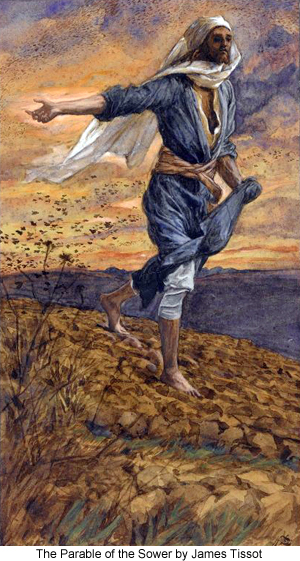
James_Tissot_The_Parable_of_the_Sower_300

“Behold a Sower went out to sow…”  thus begins one of the more famous parables of Jesus and the only one that is given a full explanation by the man himself.  Ironically, this parable is often interpreted by theologians and preachers independently of the explanation Jesus gives when the most complete explanation that we can give someone is read verses 13-20 if you have any questions.

Instead we are given sermons where people are asked “what kind of soil are you?”  We get messages about not worrying about those who are yet to believe because they are just not as fertile a soil as you the faithful listener here this Sunday morning. I almost fell back into that trap myself by very nearly writing a blog post where I intended to ask myself and you how our actions and decisions were impacting the soil of other people’s hearts.

Why are we so quick to try and add to or change the meaning Jesus gives this parable? The cynic in me says that some people want to avoid the fact that Jesus flat out mentions Satan in the explanation.  While I do think that the notion of Satan is disturbing to a great many “modern-minded” Christians, I suspect that the real reason efforts are made to come up with clever extensions of the parable or outright changes in the meaning is because we want the parable to be about us.

The parable is not about us.

The sower sows the word.  The word is the gospel and the gospel is thus: in the person of Jesus, God has initiated the Kingdom of God.  If you are still struggling with that being the fundamental truth of the gospel please reread the first three chapters of Mark, or review this blog post.

In this point in Mark, Jesus is sharing this parable to explain to those who believe in him (presumably the disciples) why some folks, like the pharisees, are so unbelieving that they wish to have him eliminated and other folks, like his immediate family, think that he is bonkers.  “Bonkers” is a technical term in this instance that theologians use so we don’t have to conjure up a confusing word like egotheistical.

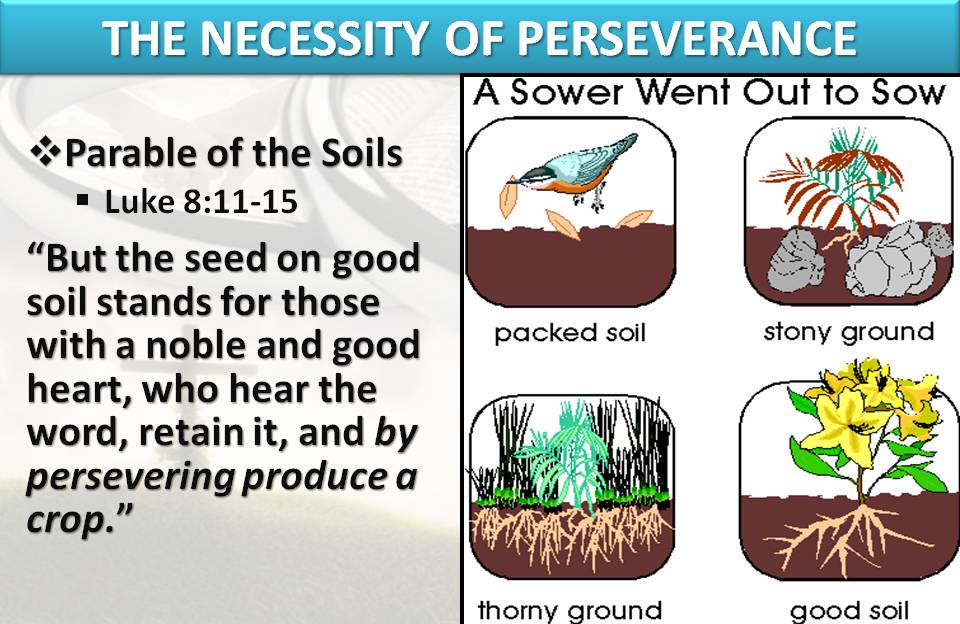
There are a lot of reasons why people fail to believe in Jesus. Some are hard soil and there is no way for the truth to take root before the birds and such eat it. Some are rocky and there is an initial taking hold but the plant doesn’t survive the heat and the wind, like the flowers that I put on my west facing apartment balcony. Others get choked out by the weeds. Finally there are those who are the good soil and the gospel takes root in the heart and grows strong and true and yields fruit.

That’s the meaning plain and simple.

sower images

I am not going to try and change that interpretation, but I am going to try and draw a couple of interpretative lessons out of that explanation.  Personally, I come from a family of farmers although I admit I know more or less nothing about farming.  I only know a little about gardening.  When I was a kid I wanted to help my mother plant a garden so she showed me how. We bought some seeds and we created a pretty good sized garden in the land next to our house. It had several rows that we had created with a tiller that mom borrowed for the purpose.  By the time we were done it was that classic Norman Rockwell style garden with little posts on the end to mark the rows and the seed packet stapled to them so we could remember whether that row was radishes or corn.  What I learned over that weekend was that gardening is hard work.

The first lesson that I would point out to from this sower story is this: the Word is not an annual. This gospel is not a one time yield sort of crop here today and gone tomorrow.  You will note that most of the times that Jesus gets all horticultural on us it is about vineyards or trees.  The Gospel when it takes root is going to be a perennial plant.  This is important because whenever we try to make the parable about us (focusing on the soil rather than the sower /seed) we can become fixated on whether or not we are good soil.  If we are good soil, then the yield can become a way for us to qualify ourselves among the other good soil out there i.e. am I yielding 30 times or 60 times? We can either compare ourselves this way to make ourselves feel like we are better Christians or we can get down on ourselves because we aren’t bearing as much fruit as someone else.

Stop it.

Sometimes the vineyard has a bumper crop.  Some years are lean.  Some years a fruit tree will produce more fruit than you know what to do with and some years there aren’t any fruits at all.  When I lived in Corpus there was a grapefruit tree in the backyard that produced far more grapefruit than I could have ever consumed.  Truth be told, even one grapefruit is generally more than I want to consume. Right across the fence in the neighbors yard, not even 10 feet away there was a grapefruit tree that was a perennial disappointment.  So much so that the neighbor always made sure I knew that he didn’t want me to prune the limbs that stretched over the fence from the superstar tree because he wanted to harvest those grapefruits.

It is like that with Christians.  We have seasons when we produce much fruit in our own lives or in the lives of others and there are seasons when the pickings are slim.  Both are OK.  Both bring glory to the Father because throughout it all we are good soil.   Jesus says, “they are the ones that hear the word and accept it” meaning that the good soil are those who have begun to orient themselves around the truth of Jesus Christ.  What does that mean?  Read Romans 12.  Most people think that the gospel is doing all those things, but those things flow out of understanding the truth about Jesus (Romans 1-11) not the other way around.

In short, if you want to be bear more fruit, then double down on your understanding of who Christ is and the fruit will follow.

Why is that? Because the word is being sown haphazardly all the time.  I mentioned earlier that when it came time to plant the garden my mother and I prepped the plot of land.  We tilled and readied the soil for the seed.  Not this sower named Jesus, this guy is chunking that seed all over the place. I once thought that this was really silly and not the most effective way to plant anything but I recently learned that this was common practice in his day.  A sower would sow the seed and then go back and till the ground turning over the dirt, rocks, weeds, etc whatever with the seed.  They did this for two reasons.  One, they didn’t always have the best soil to work with in the first place.  Let’s face it, Israel ain’t Kansas.  Two, there wasn’t a place down the road to buy potting soil and fertilizer and Weed-B-Gone.  You turned over the dirt and everything in it good and bad to have whatever nutrients you could get in the soil for the plant and you hoped that the Lord would bless you with rain and the right combination of stuff to find out where the good soil was and grow you some produce.

And therein lies the second take away from the parable for the believer: you WILL BE tilled.

Far too many Christians think that the after accepting Christ into their hearts life is going to be a long period of perfect.  When the tough stuff happens they ask themselves “Why is the Lord doing this to me?”  They ask themselves why God is punishing them.

“We rejoice in our suffering because we know that suffering produces perseverance and perseverance produces character and character produces hope and hope does not disappoint because God has poured out His love for us through the Holy Spirit.” (Romans 5:4)   


parable-of-soils

Ignore every preacher you hear (most of them are on TV) that try to sell you this Pollyana notion that the life of the Christian is smooth sailing.  Do your best to ignore your well-meaning Christian friends who try to tell you the same.  As my good buddy Sam used to say “It is hard to be a Christian”.  But when the stuff happens keep in mind that you are being tilled, the Sower is working His soil to make you produce fruit.

I will speak for myself.  Too often I have asked myself what does God want me to learn from this experience.  Too often I have listened to other people ask me that same question to which I have had very little in the way of answer.  What if our question became “God, how do I bear fruit in this moment?”   Don’t hear what I am not saying.  I am not suggesting that there is never a lesson or a pruning of the vine where we need to get ourselves aligned with God more closely.  What I am saying is that always asking the the first questions is putting the focus on us and our experience, pain, and hurt rather than putting the focus on God and asking how we can grow and bloom.

Questions:

  1. Have you found yourself focused more on the soils (you) in the story than on the seed (word)?
  2. Have you ever judged yourself for the amount of fruit your life is yielding for the Lord?
  3. Have you asked yourself recently “Why me Lord?”
  4. How would your walk of faith be different if you asked God to help you bear fruit in times of trial and suffering?
  5. What can you do to focus more on the word during this season of your life?

Are you enjoying the Hypocritical Christian? If you are please share the website with someone else and encourage them to try it out. If you receive it through email and choose to share it with some else let them know where they can find new posts for themselves. Also note that you are welcome to ask questions or even “argue” back through the comments.  Dialogue is always encouraged.  I ask that you suggest the website to others because knowing that people are going to the website encourages me to keep posting.

As always this is given freely and if you choose to use it in a bible study of your own or as a devotional before a small group meeting, etc. please let folks know where you got it.  It is written with fear, foreboding, and prayer by a fellow hypocrite who is just trying to figure out the road ahead.


What the Church /Christians Get Wrong

Read Mark 2:15-22

There are a couple of ambiguities in these few verses in Mark.  One, is whose house is this meal taking place in? Two, when Mark writes “there were many of them, and they were following him” who is Mark referring to?  The house in question might be the house of Levi whom Jesus has just called to follow Him.  The house could also be the same house that “the four” tore the roof off of to lower down the paralytic; in other words, we could be at Jesus’ house again.  The many either refers to the number of tax collectors and sinner present or it refers to the number of disciples that were following Jesus.  Neither of these ambiguities has any significant bearing on the story but I think that it is appropriate to point out these things because the decision is often made for you in the Bible translation that you read. For myself, I like to think of it as Jesus’ house and I like to think that Mark is saying that there were a lot of tax collectors and sinners following Jesus. The latter is particularly important to me because I am a SINNER and I am trying to follow Jesus.

Of course all Christians are sinners; trouble is too many Christians forget that they are sinners.

Let’s be clear that in the New Testament when you see that word “sinners” scholars agree that it means people with a bad reputation in the community.  In a lot of church settings people will say ooh I am a sinner, but often times they mean things like:

  • “I’m so bad, I had chocolate cake for breakfast.”
  • “Oh no, I cut some one off in traffic today and I broke the speed limit.”
  • “Woe is me I said a naughty word today when my boss gave me extra work.”

But New Testament scholars are pretty convinced that the sinners Jesus was eating with were people who had jobs that folks didn’t agree with (like the tax collector) and people who were known to have done horrible things (like assault, theft, adultery, or murder)! You know the people that other people judge.

Let that sink in for a minute.

Jesus is eating with bad people.

wanted2-289x300

Now, let me be clear, I am a card carrying SINNER. I’m not talking about the things that we consider to be little sins.  I have done the stuff on the big-boy list, you know the stuff on THE LIST: the ten commandments.  In fact, I have blown through way more of the list than I care to remember.

Funny thing is that most everyone I know has too. Go ahead, refresh your memory here.

Jesus is eating with bad people.

People like you and me.

The ambiguities end when we look at the next portion of the text. Mark is very clear about who is also present at this meal and how those people feel about the company that Jesus keeps. “When the scribes of the Pharisees saw that He was eating with the sinners and tax collectors, they said to His disciples, “Why is He eating and drinking with tax collectors and sinners?”

Sitting down to eat with someone is a big deal.  Most of us do not eat with just anyone.  We eat with the people we like.  We break bread with the people we want to be around.  When was the last time you hosted a dinner party and just invited the entire town? Do you ask everyone at work to join you for drinks after work? Do you have people in your home that you really don’t like?  For most people the answer will be at best not very often.  This is another reason I like to think of this as being at Jesus house because it prevents our easy escape from the implication of Jesus having those sorts of people over.  You see if it is Levi’s house well then Jesus can’t help it that Levi’s friends are a group of ne’er-do-wells. What would you expect he is a tax collector after all? But, if it is Jesus house and Jesus is the host than these “undesireables” are his guests!

This is the first mention of Pharisees in the gospel of Mark.  Pharisees were a popular religious group in first century Judea and Galilee. They believed that the common folk could experience the joy of living the disciplined life of faith.  They expected themselves and others to follow the teachings of God, to keep the Law of Moses, and be blessed and righteous.  Because of their understanding of the faith they find Jesus’ dinner habits distressing.  Eating with these people who are in clear disregard of God’s righteousness because of their jobs and lifestyles puts Jesus at risk spiritually because he is in fellowship with them.  God apparently judges folks guilty by association.

Christians like to think of the Pharisees as a group of hypocrites.  Trouble is that they are not being hypocrites.  The Pharisee reaction is totally in keeping with their understanding of how to please God.  The Pharisees are not being hypocrites; they are being totally consistent!

When Christians and the Church act like the Pharisees we are the ones being hypocrites.

Here are just a few examples that spring to mind:

  • most of the people who get invited to worship are folks who look like the people already there
  • Youth who have hard time staying still, use vulgarities, or wear inappropriate clothes don’t stick around long because of the subtle ways that they are made to feel judged
  • Families with ill-behaved children are made to feel unwelcome
  • Little children are welcome at Vacation Bible School but their working-class parents are judged for not making it to worship on their one day off a week
  • People are judged for only coming to worship at Christmas and Easter

Oh but you know what that’s the collective equivalent of the list of sins from above.  How about this list:

  • A woman at a small group admits that she is Christian and gay and someone else at the table gets up and walks out
  • The church learns that a woman has committed adultery and a Church Elder sends a letter to her saying the elder hopes that she and her children will not be coming back to church
  • A group of men at a Bible Study discuss the lifestyle of one of the Bible Study members when he is not present and all agree that he isn’t really a very good Christian man
  • A family decides to leave a congregation and its members stop talking to them at the grocery store
  • A church member is judged because their teen is in trouble with the law or struggling at school

And neither of these lists speak to how we Christians handle the persons in our midst that we know are sober alcoholics, struggling with addiction, sexual sins, xenophobes, gossipers, tax-cheats, following political idols, or unbelievers.


It is Christians and the Church,  not the Pharisees, who are the hypocrites when it comes to how we treat tax collectors and sinners.

We are good at making excuses: We do not want to be seen as condoning the sin.  We do not want our children and teenagers to have bad influences around. We worry about what people will say if they knew _______?

What we are not good at is hanging around sinners

At the end of the day we are all too likely to be guilty of judging our neighbor or fearing the judgment of our neighbors more than the judgment of God.

sinners judge sinners

Jesus responds to the question that was asked of his followers: “It is not those who are healthy who need a physician, but those who are sick; I did not come to call the righteous, but sinners.”

This is a pretty famous Jesus quote and it would be a good idea for us to unpack it a little since this is his answer to the charge of being a friend of sinners.  Grammar time: note that the English translation links the two sayings with a semi-colon.  This is not two separate thoughts but two sentences that will function as clauses that will interpret the other.  This is crucial because people like to separate them a little more than that and that leads to a misunderstanding.  The correct reading would render the following logical conclusion:  healthy= righteous; sick = sinners.

When you separate them out and make each sentence stand alone you get the following conclusion.  Sick people are the ones that need a doctor; so, if you are well you have no need of a doctor.  Read this way there are people who do not need Jesus just as there are those who do not need a doctor.  If you think that that is true, go back up and click on the link to the Ten Commandments and read it for real this time!  People like to read this saying in this manner because it allows them to dodge Jesus the same way the person with 101 degree fever blowing snot on everything that moves can deny that they need to make a doctor’s appointment and get drugs.  Even better, they can make the entire comment from Jesus a statement against the self-righteous pharisees and by extension about how Jesus doesn’t like self-righteousness.  Naturally, when read this way the self-righteousness can be whatever you want that makes you feel righteous for not being like those sorts of people.

But when you read the two statements together, there is no escaping the meaning of Jesus. Recall that part of what Mark is trying to teach us about Jesus is that he has come to deal with the sin problem.  Sick people need a doctor and Jesus came to call the sinner.  If we are all sinners then Jesus has come for us all.  This is what makes Jesus inclusive.  It is not that Jesus welcomes those on the outskirts and the margins of society, although this is true; Jesus is inclusive because he welcomes ALL.  When we only emphasize Jesus reaching out to those the society cast off in our own sense of justice what we do is minimize the impact of the sin problem, minimize the scope of Jesus work, and we set ourselves up to be on a different insider vs outsider dichotomy that coincidentally allows us to judge those who are not as “Jesus-y”as we are.  Jesus is inclusive because he is come to call the sinner. Jesus wants the tax-collector to know him.  Jesus wants the sinner to know him.  Yet, the beauty of Jesus is that he wants the pharisee to know him, too.

This is what the Church /Christians gets wrong time and time again.  Jesus welcomes everyone.  Jesus eats with everyone.  Not so the Church.  No so the Christian. Every generation of Christian in every context has sins that are beyond the pale, and people that are not welcome. Denominations split and form out of these outsiders vs insiders distinctions. The Church globally and the church locally fails to be a welcoming place for everyone.  Individual Christians gossip and judge their neighbors, believers and unbelievers, but seldom seem consistent in judging themselves. Christians individually and collectively confuse loving someone through their sin struggle with condoning sinful behaviors. Grace, true grace, as exhibited by a God that will sit down and eat and drink with those who disappoint is in short supply. Grace, true grace, that is exhibited by a God that will enter fully into humanity in order to redeem all of humanity and is experienced in the forgiveness of sin is forgotten rather than shared.

In the movie Excalibur, which has nothing to do with Jesus or the Church, there is a moment when Arthur has united all the various clans and become the true and rightful King of England. Everyone is celebrating and Merlin, the magician, is asked to say something on this great occasion.  In a deep, mellifluous voice, Merlin enjoins those present to remember well the feelings they have, their camaraderie, their shared sense of purpose, the things that bind them altogether because he adds menacingly “it is the doom of man that he forgets.” And so it is.

Jesus eats with bad people.

People like you and me.


The Call of Levi

cvggo_calling

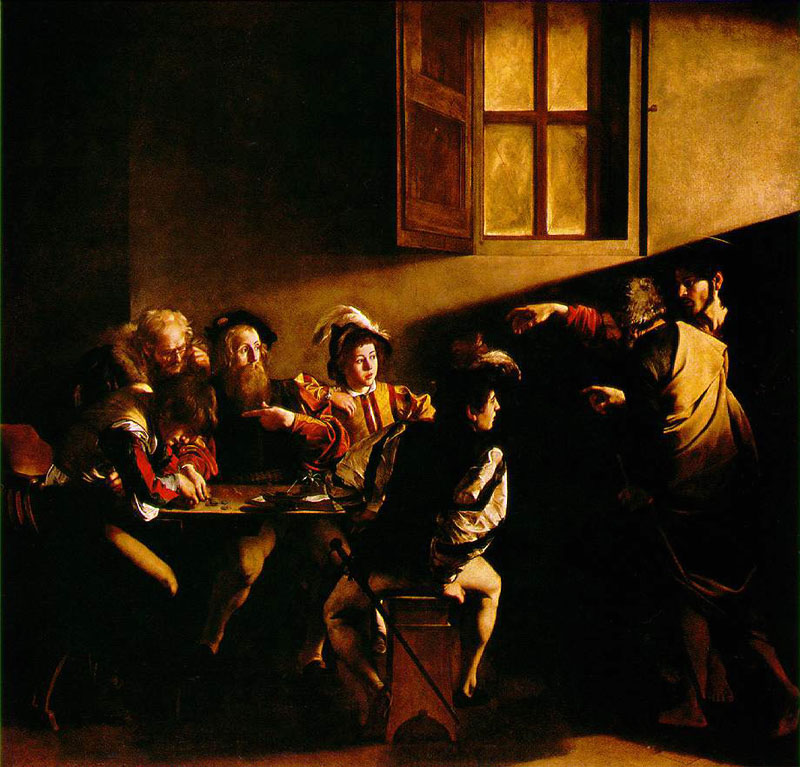
This is Carravagio’s painting depicting the Call of Matthew / Levi.

Caravaggio was a Baroque period painter who lived a relatively short life, even in his day, of 38 years.  He was a renowned belligerent drunkard.  He was not the first choice of the church officials to paint a three painting series of St Matthew on the walls of  Contarelli Chapel in the church of San Luigi dei Francesi in Rome.

In the painting, forget for a moment that Caravaggio contemporized the clothing and the setting to be more like 16th century Italy, we see a man showing Jesus where to find Levi (Matthew) amidst the rest of the tax collectors. It is not clear if the man who is seated and pointing is pointing at the fellow next to him or at himself.  This was probably by design by Caravaggio, the ambiguity suggesting that Jesus could call almost anyone at any time. But, like a lot of people, I prefer to think of the fellow pointing as being Levi, who is pointing towards himself as if to say “Wait! you mean me?”

Calling is an interesting thing. Because the Bible includes so many dramatic stories of calling we sometimes get trapped into thinking that we have to experience a burning bush or a whale story to be called.  We forget that Samuel was asleep and a boy.  We forget that Levi was hanging out at work.  Steven the Cyprian was just travelling through Jerusalem and was asked to carry a cross. The four whom we saw rip up the roof and lower their paralyzed friend down were just doing that.

Yes, all too often, we get caught up thinking that calling always entails: “When Christ calls a man he bids the man to come and die.”  That’s a quote from The Cost of Discipleship by Bonhoeffer.  Bonhoeffer is not wrong, there is a systematic death to self that must take place in the following of Christ; but, Bonhoeffer, is a tad over-dramatic. Sure, Peter, whom Bonhoeffer uses as his example ultimately was called to be martyred as was Levi/Matthew and therefore were both metaphorically and literally called to die. The truth is that the vast majority of followers of Jesus are never asked to do such things.  We should never forget that many are and it is the potential cost of all our discipleship; however, we should also never forget that many more are not called in that way. Bonhoeffer was writing at a very dangerous time in a very particular context.  If we aren’t careful we misjudge our own time and the sinfulness of pride can lead us to look for the “good fight” every where and in all times. But I digress.

Verse 15 says that after Levi responded to the call  (You know, after he said “who me” and Jesus likely responded with “well, yeah” or “and why not you?”) that he and Jesus were at a meal together where lots of sinners and tax-collectors were present with Jesus disciples. The sentence is a little ambiguous.  The verses ends with this clause “for there were many of them and they were following Jesus.”  It is unclear if the many refers to the sinners and tax-collectors or if it refers to the disciples.  Either way there were many of them and they were following Jesus and the concepts of many and following are more important than the identities. This is precisely what I think Mark is intending for us to hear.  Sure we all know about famous followers like Levi or St Paul or Bonhoffer or C.S. Lewis or Mother Theresa or Beth Moore but there are always many more anonymous followers of Jesus. Hordes of them in fact.

Sure there are those of us who are called by God to follow Jesus into big jobs and life changing / life threatening work.  Most of us though are called to the other kind of discipleship: quiet, consistent witness every day exactly where we are.

  • Have you delayed your own urging to follow Jesus because you are afraid of where he will send you?
  • Perhaps you have fallen into the pride trap of wanting to be picked for something big for the Lord?
  • Maybe you have forgotten how important just being a witness in the everyday is to the work of the Kingdom of God?

Stop waiting to follow.  Be like Levi: arise and follow.  Be like the unnamed many and spend some time around the table in fellowship with Jesus. Go to worship.  Pray each morning; you always have something to give to God in prayer. Be kind.  Don’t judge. Find some ways to give back to the community.  Even the quiet disciples are welcomed with “well done good and faithful servant” when it is time to cross the Jordan.

Feel free to use this Bible study for your own groups or discussion.  It is freely given. If you do I merely ask that you acknowledge where you got it and if you find it useful that you encourage others to seek it out. It is freely given and written with fear, foreboding, and prayer by a fellow hypocrite who is simply trying to figure out the road ahead.


What Does it Mean to Repent

The gospel of Mark is generally considered to be the very first of the four gospels written.  It starts without much introduction; in fact, the very first sentence is not a sentence at all but rather a concept.  The beginning of the Good News (gospel) of Jesus Christ.

In whichever translation or copy of the Bible you read, Mark chapter 1 will seem to be a collection of vignettes that are distinct from one another. Do not be fooled.  While you may have been taught each of them individually, Mark was written as one long book and the themes of the entire book are all centered around that opening “sentence” and laid out in those first sections that are deceptively separate.  This is the discussion of the Gospel, the good news, of Jesus the Christ.

The themes of Mark as laid out in the first chapter are:

  • The origin of the Good News
  • Christ is the anointed one of God (Messiah) for the purpose of salvation
  • Christ has authority
  • Repentance is about believing who Christ is
  • The specific work of Christ is dealing with the sin problem

For this first post, I want to focus specifically on the second and fourth of these themes.

We see that Mark starts by saying this is the beginning of the Good News of Jesus the Christ, the Son of God. Beginning implies that you are seeing the start of something that is ongoing; or, that you are seeing the start of something that has an ending. Either way, the beginning is the start.  When we get to the end of Mark, you will see that there is no ending to this Good News, but that is for a much later post.

John the Baptist arrives on the scene (1:4) preaching a baptism of repentance for the forgiveness of sins.  

What does it mean to repent? For most people and many Christians it means “stop it”. What is to be stopped is whatever thing you are doing that is against the will of God. Sin is the word we Christians like to use for everything that we do that is outside of God’s will. I know a thing or two about sinning.  Truth is that I have many years experience in sinning.  Some of my sins are public and spectacular and some are private and mundane.  Most of us can look no further than the 10 commandments to realize that we got plenty of sin in our lives.  Christians are always hypocrites because we are always sinning.  And let me tell you that we do ourselves no favors with our very limited concept of repenting.

More than once when I was a pastor I had a people approach me about some person in the church that we were letting be a part of the fellowship of the congregation whom they knew were sinners. They wondered if we had asked these people to repent before they were allowed to join. Ironically, they never saw this admonishing of the church leadership for our poor standards as being judgmental or gossipy; after all, their motives were always pure – they wanted to keep the Church community clean from these sinners.  the problem of course is that if we did that then no one would ever be in the community, because, honestly, every single one of us is sinning in some way every single day.

Take a look at Mark 1:15.  Jesus begins his ministry by saying “the time is fulfilled and the kingdom of God is at hand; repent and believe in the gospel.  This statement is LOADED with meaning.  Depending on how you read it, “the time is fulfilled” seems like either hyperbole or simply a statement that the hour as come.  Nope!  Ancient Greek, the language of the New Testament, has two words for time: Kairos and Chronos.  The latter is the word from which we get the English words chronological  and chronometer.  This is measured time like minutes and hours and days and years.   Kairos is used in the New Testament as a short hand for God’s timing.  I like to think of it as the “right time”.  An illustration may help with the difference:  when a woman is pregnant the baby is said to be due in 9 months. That 9 months is “chronos” or the measured out time of gestation for a baby.  Now, any woman will tell you that the doctor’s prediction of the day a child will be born is as about as useful as the weatherman telling you when it will rain.  The actual birth is “kairos”, the time of the fulfilling, when the baby is ready. Don’t spend a lot of time saying but wait don’t babies  sometimes come too early? Yes, but they come when they come and that is the aspect of kairos I want you to understand.  What Jesus is saying is that the moment of the kingdom of God has come and the appropriate response is to repent and believe. 

Repent means to change direction.  Repent means to think differently.  And the way that Jesus meant it was to say, “Hey! God is acting now and you best believe that something wonderful is unfolding, RIGHT NOW”.

This isn’t different from John the Baptist.  John was saying “Hey, God is about to act and you better stop what you are doing and get ready for the arrival of what God is doing.”  You could even say that John was trying to tell every one that they need to change their way of thinking to believing that God was about to do what God promised.

I know that a lot of people will say that I am crazy to suggest that the principle meaning of repentance is to believe rather than to stop your sinning. Let me be clear: repenting is not not about stopping sin, but it is more so about trusting what God is doing and in this passage it is first and foremost about believing in who Christ is.

Case in point.  Mark starts by telling us that this is the good news of Jesus the Christ, the Son of God. Then in 1:11, the baptism of Jesus occurs where God says to the gathered that this is my beloved SON. Jesus says the time is now and the Kingdom of God (the very presence of God on earth if you will ) is happening in front of them.  Next, Jesus calls people to this repentance in action by saying “follow me” and then we have this curious moment in 1:21-28 where Jesus encounters a demon possessed person and the demon says “I know who you are- the Holy One of God”.

See the pattern? Everything is driving toward this one central point that Jesus is the Christ, the Holy One, the Anointed One, the Son of God.  Something special and unique (in the truest sense of this word) is happening right before their eyes and their belief in the same is of the utmost importance!

Questions

  1. Where are you in believing that Jesus is the Christ?
  2. Many Christians like to downplay or even deny the uniqueness of Christ?  If this a sin; is it hypocritical?
  3. Is Jesus of Nazareth just a great teacher or is Jesus of Nazareth something more?
  4. Is it more important to stop sinning or is it more important to start believing in the truth about Jesus?

Feel free to use this Bible Study for your own groups or discussion.  It is freely given. If you do I merely ask that you acknowledge where you got it and if you find it useful that you encourage others to seek it out. It is freely given and written with fear, foreboding, and prayer by a fellow hypocrite who is simply trying to figure out the road ahead.


Website Powered by WordPress.com.

Up ↑