Search

The Hypocritical Christian

Tag

idolatry

Enough Idol Chatter

Take a close look at the image above. It comes from an article I saw regarding the development of new towns in England. The diagram reflects the way in which new developments would be laid out. Not limited to the United Kingdom, I saw a similar design for a community being built here in Texas. Do you notice what is missing from the area that we Americans would call the town square? There is no house of worship whatsoever in the drawing.

When I was a boy, we learned about how the Spanish had designed settlements as they colonized the southwest. In the center of town around the livestock pens and the taverns and the government building there would be a church. You can still see examples in Sante Fe, New Mexico and Jackson Square in New Orleans, today. It was literally more likely that there would be a church or abbey or mission at the center of town than there would be a schoolhouse.

The prevalence of the local parish has been replaced with the GP Surgery (the local doctor’s office in England) in the plotting of new towns. The exact same health clinic was present in the model town I saw here in Texas. Why am I bringing this innocuous detail to your attention? Because idolatry is pernicious and omnipresent.

What can be idolatrous about a doctor’s office? In modern western culture, the health care system is the center of worship! Recall the ways that we can determine an idol: where we spend our time, where we commit our money, and the outcomes of the idol. I will add a fourth determining factor: the size of the buildings dedicated to the idol. We already discussed politics and sports both of which have major structures dedicated to them. Now consider that some of the largest buildings in any US city or town are hospitals. There are pharmacies, emergency clinics, and doctor’s offices on every other corner.

Every year, the pharmaceutical industry spends hundreds of millions of dollars on advertising for various medications encouraging the viewer to ask their physician about “drug X”. In 2020, the United States collectively made 1 billion visits to the doctor! That was nearly double the number of visits that we made as a nation in 1988. The population only grew by 30% during that same 30-year period meaning we go to the doctor a lot more. Let me be clear that in and of itself is not a bad thing. I merely mean to point out that given the amount spent ($4.8 TRILLION in 2023) along with the time committed there is the potential for an idol to be at work.

Everyone wishes to be healthy and being mindful of your health is a good thing, but just like the manner in which politics and sports can misalign the focus, so can our obsession with health. When I was a pastor, it was much more likely that when asked for prayer requests folks offered up concerns about upcoming surgeries and current maladies than to pray for the salvation of their neighbor or the hastening of Christ’s return. Admittedly I was a presbyterian minister, but I suspect that many clergy from other denominations would report a similar trend.

Many, if not most, of the hospitals and hospital systems in America were originally funded by churches. We have Methodist, Presbyterian, and Baptist health systems all over our nation; although, the roots that those systems have sprung from are largely forgotten, the only remnants being the name on the sign and a small benign chapel tucked away somewhere deep within the complex. As a culture we have gone so far from the church being involved in the health systems as to looking to the government to provide for our health needs. The pendulum has swung from churches and denominations loving their neighbor by funding hospitals and research institutions to the government being seen as a source for universal health care. One might be excused for thinking there was a malevolent force at work in the world to drive allegiance and fealty away from God and towards the government.

Allow me to suggest two other outcomes that indicate that an obsession with health has become an idol in the West. First, as the government takes on more of the expense of health care, the rationing of care becomes increasingly likely. Ultimately this leads to decisions about withholding treatments from the elderly and other members of society (those with special needs, for example) perceived to be a waste of expenditures. People become line items in a budget rather than patients in need of help. Second, there has been a breakthrough medication in recent years that allows diabetics to regulate their blood sugars effectively. The drug also happens to spark weight loss in non-diabetic users. The result is predictable. So many prescriptions have been written for people looking to lose weight that there has been a shortage of this life-saving medication for diabetics.

The first of these outcomes represents the dehumanizing of life. The elderly become expendable to save a dollar or two. Not exactly the stuff of honoring our fathers and mothers that. The second outcome reflects a potential selfishness that runs up against love of neighbor. To be sure there are some people who are not diabetic for whom a weight loss drug can be a significant blessing; however, last year the FDA reported 80 million prescriptions for these medications in a nation where less than 40 million people are diabetic.

Again, none of this is to say that health care and pharmaceuticals are inherently evil. Nor am I making political statements about how tax dollars are spent on health care. What I am suggesting is that for many people the modern health care system (like politics and sports) has become an idol complete with its own temples, priests, and sacraments.

I could continue to expose potential idols over and over again and never get on to the rest of the letter of Romans. I have hit on 3 of the biggies in modern America and I already feel like a curmudgeon hollering for the kids to get off of the lawn. I leave it to you to determine your own potential idols. They can be politics, sports, pleasure, food, healthcare, shopping, victimhood, just to name a few. The list is endless. John Calvin is right; people are idol factories.

Why is that?

Because we were made to worship. More specifically, we were created to respond to God; to glorify God as God and give thanks (Rom 1:21). If we choose to ignore the truth about God, that urge to worship will find an outlet and in the absence of God that outlet will be an idol, either physical or metaphysical, of our own creation. When we do this, we suppress the truth, and God gives us over to the freedom from God that we indicate that we want. It is a dark path that leads to increasing wickedness. Put another way, what we spend our time, talent, and treasure on begins to shape us and our way of thinking. The idol becomes increasingly important and determinative in our lives. Paul describes it as exchanging the truth about God for a lie and worshiping the created thing instead of the creator (1:25). What starts as sin becomes wickedness; idol worship begats immorality and injustice.

In his day, Paul looked around Roman culture and zeroed in on what he considered to be the most egregious example: homosexual activity. The truth about God that is revealed in creation is that there are two sexes (male and female) and that they procreate to “be fruitful and multiply” (in Genesis terms) and perpetuate the species (in evolutionary biology terms), but homosexual behavior does neither of these things.

Over the centuries many people have looked at this portion of the letter to the Romans and concluded that homosexuality is worse than any other possible wickedness. This is a misuse of the text in my estimation. Allow me to present two arguments against this interpretation. One, the fact that Paul zeroes in on homosexual behavior at the beginning of his list has more to do with the culture of Rome that he is addressing than any notion that this sin is greater than all the others. Rather than being the chief sin, homosexuality provided the most egregious example of Paul’s basic argument that when a people routinely deny the truth about God and begin worshipping idols of their own making, they live increasingly as a law unto themselves. Homosexual behavior illustrated how far from the intentionality of God’s creation humanity could fall.

If Paul were writing a letter to the American Church, it would look decidedly different than Romans 1. His principal example of humanity worshiping the creation rather than the creator might well be the embrace of transgenderism. If the truth revealed in creation is that there are two genders (male and female) then the notion that we should be altering the biological reality of an individual to suit their self-perception would be the ultimate example of the creation ignoring the creator. I find it interesting that the arguments about transgenderism beg responses from the 3 idols I have highlighted. The health industry designing the procedures and medications for transitioning a person’s gender begging for research dollars as they play creator all the while bristling at any attempt at restraint. People of conflicting politics demanding that the government either affirm multiple interpretations of gender or declare that there are only two options. Sports confronting the fairness of transitioned athletes competing in the alternatively gendered sports.

Perhaps another sign of idol is the expectation that the idol can declare truth.

The second proof I will offer that Paul is not mentioning homosexuality as the chief sin of humanity is scriptural. Take a moment to read the works of the flesh he relates to the believers in Galatia (Gal 5:19-21). Consider the two places in Corinthians where he lists out wicked behavior (1 Cor 5:9-11 and 6:9-10). Read his admonition to Timothy about the behavior of people in the last days (2 Tim 3:2-5). A careful reading of scripture indicates that there is plenty of sin to go around for everyone. Not convinced? Try on the words of Jesus: “out of men’s hearts, come evil thoughts, sexual immorality, theft, murder, adultery, greed, malice, deceit, lewdness, envy, slander, arrogance and folly. All these evils come from inside and make a person unclean. (Mk 7:21-23)”.

None of this is to say that homosexuality is not a sin; it is. Elevating it above any other sin is a form of judgmentalism and denies the truth that all sins are equal in the eyes of God. All have sinned and fallen short of the glory of God whether the sin is an obvious violation of God’s law or more subtle like self-righteousness and judgment of the neighbor.

It is important to remember that the end of Romans (1:21-32) is a description of what happens to all those who “do not honor God or give thanks.” These individuals profess “to be wise, they become fools.” In the Bible, the fool is the one who rejects God. Earlier I said that idolatry begats wickedness and injustice. Paul put it this way:

 And just as they did not see fit to acknowledge God any longer, God gave them over to a depraved mind, to do those things which are not proper, being filled with all unrighteousness, wickedness, greed, evil; full of envy, murder, strife, deceit, malice; they are gossips,  slanderers, haters of God, insolent, arrogant, boastful, inventors of evil, disobedient to parents, without understanding, untrustworthy, unloving, unmerciful;  and although they know the ordinance of God, that those who practice such things are worthy of death, they not only do the same, but also give hearty approval to those who practice them.

The truth is, though, all of us are somewhere in the list; no matter how difficult it is to stomach we are all in the list. We prefer to point the finger anywhere but ourselves. We try to ignore the subtle sway of our own idols on our souls. We deny the power of the idols in our culture and ignore the means by which the sphere of the flesh shapes our thinking and our actions.

The chapter culminates in that list because it is that list (and any other listing of wickedness found anywhere in the scriptures) that condemns us. Romans 1 ends this way because here Paul shares why “the wrath of God is revealed from heaven against all ungodliness and unrighteousness… (Romans 1:18)”.

As I am finishing this post it is Ash Wednesday. My pastor shared this thought tonight: “when we treat God trivially, we will treat sin trivially”. Not sure which ancient commentator said this first, but whomever it was must have been a careful student of Paul. Those ten words are an excellent summary of Romans 1:18-32.

The first reading for Ash Wednesday was Joel calling for a solemn assembly of the people to rend their hearts and not their garments because “the day of the Lord is coming; surely it is near…” and so it is. There will be time enough for the gospel in Romans, it will be delivered in spades! But make no mistake even for those who trust in the gospel, what Paul called the power of salvation (1:16), the day of the Lord comes.

For now, it is best to linger for a time in the depths of your own depravity. Consider the litany of wickedness that Paul provided us. If you know the gospel, really know it in the depths of your being, such lingering will produce a deeper repentance and a deeper thanksgiving for grace. If you do not know the gospel, the lingering can prepare your heart for the truth of Jesus Christ.

Blessings to you in your journey. Vaya con Dios!

As always, the above is freely given, and all are welcome to use it. If you do it would be nice if you mentioned where you got it. Finally, if you know someone who might benefit from reading these posts please share the URL or email with them.
More Idol Chatter

Romans 1:28-32: And just as they did not see fit to acknowledge God any longer, God gave them over to a depraved mind, to do those things which are not proper, being filled with all unrighteousness, wickedness, greed, evil; full of envy, murder, strife, deceit, malice; they are gossips,  slanderers, haters of God, insolent, arrogant, boastful, inventors of evil, disobedient to parents,  without understanding, untrustworthy, unloving, unmerciful; and although they know the ordinance of God, that those who practice such things are worthy of death, they not only do the same, but also give hearty approval to those who practice them.

These are the culminating words of the first chapter of Romans. In them, Paul shares with us the impact that idolatry has on the heart and soul of a person. He also lays out for us the outcomes of the sphere of the flesh that seeks to conform us.

Previously I suggested the following ways to determine an idol: “There are a few simple ways. One it is where we invest our time, energy, and talents. Two is where we spend our money. Three is the outcome that the idol produces.” With this in mind I am going to point to another of the great idols of American culture: SPORTS!

American culture is positively obsessed with sports, football, in particular. I am as guilty as anyone and often have to check in on myself with the Holy Spirit. Every Saturday of the College Football season I wear something with the Texas A&M logo on it and I pay close attention to the outcomes of those games. This year I had the opportunity to attend the first game between TAMU (my alma mater) and The University of Texas in over a decade. This was a huge deal in my home state. Such a big deal that I seriously considered whether I might quit my job if my boss had not approved my request for the day off!

Sports has not always been an idol in America. All of our professional sports leagues were once smaller and college sports more regional and of interest primarily to alumni. But idolatry corrupts slowly. The historian in me would say that what changed was the rise of television and income inequality. Television provided more exposure and profits through licensing agreements and media rights. As income inequality rose, the promise of wealth and scholarships through sports led thousands of parents to invest more time and money into helping their children develop into top-tier athletes.

Not all of this is a bad thing. Children being involved in youth sports teaches many good life lessons if done right. It also keeps them from mischief and danger. I know many parents that choose to program every moment of the day for their children to avoid the child ever being in danger or left with idle time for drugs and sex. There are many wonderful stories of young people from disadvantaged backgrounds who have achieved many great things through sports. Idols in modern culture can be quite tricky to recognize because they are not typically giant statues made from ivory and wood that people are worshipping.

Make no mistake, sports can become an idol. In my first pastorate, I had a conversation with a dad of three children. At the time, they would miss worship fairly regularly because they were in a travel baseball league for their son. They attended tournaments all over Texas and neighboring states. This was true for a lot of parents. The Dad asked me if I thought it was wrong that they were not in worship as often. As a pastor you learn that people often ask you questions about things they already feel guilty about in hopes that you will exonerate them. I said it was really about choices. I also asked if they ever attended worship in the town that the tournament was held in. He said they did not and asked me what I meant about choices. I said as parents where we put the emphasis and the energy communicates to our children what is valued and important. Whatever we choose it will be shaping ourselves and our children for good and for ill. Sports being emphasized will hopefully develop the tenets of sportsmanship, tenacity, and teamwork. What it will not do is teach them about a Creator for whom they should be grateful toward nor a savior that loves them. Choices.

Soccer was the first youth sport in America that invaded Sunday mornings for practices. This was a pragmatic decision because that was the day that practice fields were available to them. The parents and youth involved though were the ones who had to decide if Sunday morning worship was more important or not. When the NFL first began televising games the noon kick-off was deliberately scheduled to allow for those on the east coast to attend church before the game. Sixty years later the NFL broadcasts 3 games a year on Sunday mornings because they are played in Europe. Again, the airtime is pragmatic in nature for that is the time, in the USA, that the game is being played at the “normal time” in Europe. The decision as to skipping church to watch football is not pragmatic at all. It is a matter of devotion and allegiance.

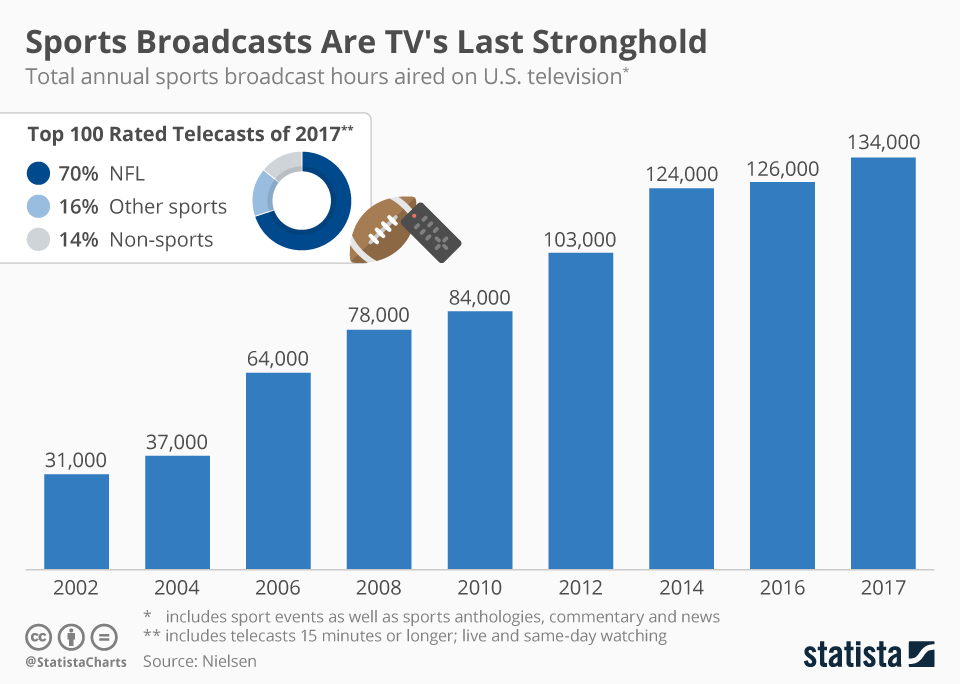
If how we use our time is a measure of a potential idol, then sports certainly qualifies. In 2017, there were 134000 hours devoted to broadcasting sports in the USA. The equivalent of 15.29 years!

70% of that time was devoted to NFL broadcasts. Full Disclosure there is an NFL game on my television as I type this. This is not to say that we shouldn’t watch sports, rather as Christians we should be mindful of the time we spent on watching sports versus the time we spend worshipping God, loving our neighbors, and devoting ourselves to prayer, etc.

Money spent is another measure. No matter how we look at it the money is huge. This week a professional baseball player signed the largest sports contract in history at $765 million over fifteen years. Pundits predict that the player, Soto, will be solely a designated hitter for the last 10 years of his 15-year agreement meaning he will be paid tens of millions to do nothing except hit a little white ball. Professional sports in the USA resulted in $14.3 billion dollars in salaries for all involved in 2023. Global professional sports revenue in 2028 is estimated to be $680 billion. New NFL stadiums are billion-dollar buildings. The most recently constructed one is SoFi Stadium in Los Angeles. It is the 4th most expensive building ever constructed. The list of the 30 most expensive buildings in the world is dominated by casinos, which brings us to gambling.

Professional sports leagues in the United States have all partnered in the past few years with sports betting. Broadcasts include tips on bets to make. Young people in the United States are learning about betting lines, over /under, and parlays. Gambling, when it becomes an addictive vice, is particularly pernicious. It is one of the few vices that can literally take everything a person has in a single day and now all of our professional sports outlets (not to mention their media partners) not only support gambling but actively encourage it.

While gambling is not specifically listed in Paul’s list of the vices that idolatry promotes (I have no idea if there was a Latin word for bookie in Ancient Rome) it certainly can be a vehicle for wickedness, greed, malice, and inventing evil.

Paul culminates that list with the damning phrase “not only do they do these things they give hearty approval to those who do.” Along with sports-betting, here is where we see examples of the outcomes the idol produces. In my lifetime the greatest NFL QB of all time is known to have cheated at the sport. We learned that one of the great College Football coaches of all time knowingly kept an assistant in his employ for years who molested young men. In both instances winning was more important than integrity. There are many other examples of wickedness across sports from gymnastics to basketball to soccer. When sport becomes an idol, it makes winning a virtue rather than an outcome.

What are we to do with all of this? Sports, like politics in the previous post about idols. can be a good thing. There are many virtues to sports and they play an important role in our lives. Politics, particularly, in democratic and republican (or democratic republics like the USA) forms of government provide a good means of distributing power and providing for the general welfare of their citizens. At the same time, politics and sports can become idolatrous and prevent the development of the fruit of the Spirit in the Christian. They can disfigure the individual Christian and produce in us attitudes and allegiances that run counter to our calling as Christ followers.

In modern culture, idols are not often foreign gods but forces in our cultures and societies that can corrupt believers. This is not really different from the idols we see in the Biblical times. The foreign gods that first the Israelites and early Christians faced were not actual gods rather they were representations of cultural forces that threaten fealty to the one true God. They demanded acquiescence to cultural norms that encouraged behavior inconsistent with the call to love YHWH with all your heart, soul, and strength; and, to love your neighbor as yourself. We have seen how sports can distract the believer from time spent in worship. Sports can also encourage an attitude that winning is the only thing that matters even to the point of accepting and encouraging the odious behavior of those who are the best at the sport. Sports increasingly encourages the vice of gambling as well with all of its potential destructive force on individuals and families.

The message of Romans is that there are forces at work in the world (the sphere of the flesh) that seek to conform us to their version of reality. These forces seek to train our souls to accept the supposed virtues of the world and divert us from depending on the Creator. Conversely, those who are alive in Christ are to be shaped by the ever-transformative work of the Spirit and the rule of Christ in our hearts (the sphere of the spirit). Therefore, it is incumbent on the Christian to constantly be checking on our beliefs and how we got them. We must ensure that we are spending adequate time to allow the practice of the faith to shape and mold us. We do this through the rhythms of prayer, worship, and scripture study. We do this through the willful and counter cultural striving to love our neighbor. We are to practice forgiveness and mercy. We are to care for the poor and the stranger in our midst. Later in Romans, we will look at the practical aspects of this Spirit life. The first step though is for us to be honest about the idolatrous forces at work in our world and through prayer discerning the hold they may have on our hearts and minds.

Blessings to you in your journey. Vaya con Dios!

As always, the above is freely given, and all are welcome to use it. If you do it would be nice if you mentioned where you got it. Finally, if you know someone who might benefit from reading these posts please share the URL or email with them.

The Forgotten Holiday

This post is a brief reflection and departure from the current project of working through Paul’s Letter to the Romans; although, there are some connections.

By law in the United States the fourth Thursday of every November is set aside for a day of Thanksgiving. While it became law in 1941, days of Thanksgiving designated by government proclamation were a regular part of American civic life. Abraham Lincoln is generally credited with the proclamation that it be celebrated regularly on the last Thursday of November. That was in 1863, the Civil War was still raging when the President suggested that the nation would benefit from a day of prayer and thanksgiving to God.

A brief excerpt from the President’s proclamation: “No human counsel hath devised nor hath any mortal hand worked out these great things. They are the gracious gifts of the Most High God, who, while dealing with us in anger for our sins, hath nevertheless remembered mercy. It has seemed to me fit and proper that they should be solemnly, reverently and gratefully acknowledged as with one heart and one voice by the whole American People.”

When I was a child, we were taught that Thanksgiving has its roots in the experience of the Pilgrims in Massachusetts celebrating the harvest that would ensure their survival for at least another year. We were also told that they had invited their Native American friends to join them in a peaceful gathering. As my own children are grown, I am not sure if students today are taught these things; nor, do I know if they make pilgrim hats from construction paper and decorate turkeys that they have created by tracing their own hand on a piece of paper.

I do know that Thanksgiving is the forgotten holiday in my country. It still happens but it is being cast adrift from its roots and may someday be replaced by some other seemingly useful national holiday. To be clear Thanksgiving is not openly maligned, it is simply ignored and pushed to the margins by seemingly more important considerations.

One, the current national narrative to explain who and what we are as Americans runs counter to peaceful interactions between English Settlers (re: Imperialists) and Native Americans (re: Victimized Indigenous People) over a feast giving praise to Divine Providence. The notion that a Federal Holiday would exist to encourage a time of feast and prayer offends those who misunderstand our Constitution’s first amendment.

Second, Thanksgiving is a selfless holiday. What do I mean? Consider the self-centeredness of Halloween and Christmas (ironically) that border it. Thanksgiving is not as Instagram-ready as Halloween. Halloween has become a holiday for young moms to show off their children’s cute costumes with pictures and reels of the trick or treating process. Adults without children in the United States have increasingly turned it into an excuse to party, the costumes providing a means of dressing provocatively or trying out a different persona. I do not mean to sound curmudgeonly. The children are cute, and they deserve the fun of getting free candy. Adults can party however they see fit. Still, seeking social media likes and a night of bacchanalia reflects a certain selfishness inherent in how we are celebrating Halloween. Christmas, at least amongst the secular minded people, a time of gift giving which also means gift receiving. Again, parties are emphasized. Many folks look forward to it as a time of the year when they can get a great deal on new electronics or clearance priced clothing in the last week of the year. Every major car maker runs commercials during the holidays encouraging the purchase of a new vehicle. Christmas is almost becoming Consumptionmas.

Thanksgiving by contrast is chock full of selfless behavior. Consider the gathering of a large family. The host member of the family is expected to facilitate a feast! This entails being up hours before the company to work on the meal all the while keeping the toilets running and the linens washed (selfless behavior). The guests have travelled, often cross country, leaving their own homes and using their limited time off from work to spend time with family many of whom they intentionally left behind at some point in their lives (selfless behavior). There are still other members of society who will be responsible for the early opening of retailers for Black Friday deals, grocery stores for those who didn’t plan well and forgot cranberries, keeping gas stations open for travelers, diners for divorced dads, and hospitals for the misfortunate. All selfless behavior in its own right.

Third, Thanksgiving is being ignored because many people in this country are appalled at the notion of being forced to sit down and break bread with a family member that may have voted differently than them. Back in 2016 I remember hearing on NPR a radio spot on how to be around your family that voted republican. The incidences of similar stories as been on the rise for the past 8 years. The prevalence of such advice presented as newsworthy on cable networks and in major publications, both for liberals and conservatives, says something about us as a culture. Perhaps this helps explain the rise of Friendsgiving celebrations where it is considered easier and better to gather with your like-minded fellows than with your diverse family.

When you put it altogether a Christian might begin to think there are forces at work that want to distract us from the task of taking just one day out of the year to remember blessings and returning thanks to God. It’s as if these idolatrous forces work to secularize the day and make it all about consumption and football. You could read all the above reasons for the maligning of Thanksgiving as the work of the principal idols in modern culture (Sports, Money, Politics, Self) to distract and deflect any attention whatsoever on the Almighty.

Something to think about.

Faithful readers of this blog have already been reminded that part of who we are called to be is people who give thanks to God. For even though they knew God, they did not honor Him as God or give thanks, but they became futile in their speculations, and their foolish heart was darkened (Rom 1:21) and Paul reminds the believers in Phillipi, Rejoice in the Lord always. I will say it again: Rejoice! Let your gentleness be evident to all. The Lord is near. Do not be anxious about anything, but in every situation, by prayer and petition, with thanksgiving, present your requests to God. And the peace of God, which transcends all understanding, will guard your hearts and your minds in Christ Jesus (Phil 4:4-7).

Jesus encourages us to be in the world and not of the world. So, enjoy the football, eat the turkey, reminisce with family and friends. If you have to work let your Christ light shine. Do these things but do them with a heart filled with gratitude to the Almighty One who makes all things possible and all things new.

Vaya Con Dios!

Idol Chatter

Read Romans 1:18-25

Trigger Warning: The next several posts may contain ideas that will offend some readers.

In the last post, we looked at the wrath of God and the call, since the beginning of creation, for us to honor God and give him thanks. Living this life of gratitude towards God is one part of how we can live out the calling to become “living and holy sacrifices acceptable to God” (Romans 12); and this life of grateful praise is also part of becoming transformed by the Spirit Sphere in our lives and not being conformed by the Flesh Sphere. (a description of the two spheres may be found in this post)

Professing to be wise, they become fools and exchanged the glory of the incorruptible God for an image of corruptible man and of birds and four-footed animals and crawling creatures.” The Roman world when Paul is writing this letter was a land overflowing with idols. Cities had temples to various Gods. Homes had idols for household gods. The Imperial government itself was beginning to take on cult-like status elevating Augustus Caesar to a posthumous divinity. Good Roman citizens were expected to pay homage to these gods to maintain the peace and stability of society.

The Old Testament is replete with idolatry. We read of the “pillars in high places” that were idols of gods foreign to Israel. The Israelites fashion a golden calf when they get tired of waiting on Moses’ return. Elijah confronts the prophets of Baal. All this in a land that was instructed (commanded even!) that “I am YHWH your God… you shall have no other god before Me. you shall not make for yourself an idol or any likeness… you shall not worship them or serve them…” (Deut 5)

Many people think that idolatry is a thing of the past. They are wrong. John Calvin called people “idol making factories”. He was spot on because, then and now, we are really good at constructing things to place our faith and trust in. Paul is very clear that we are to have our faith in and our obedience directed towards Christ. So, any of these other things that we place our hope and trust in are idols.

I live in the United States. The Fall in my country is the time of year when our modern idols are on full display. Not only is it football season, but it is also election season, and thanks to Black Friday it is shopping season. I started this post with a trigger warning because when you begin calling out the idols some people will become offended.

How do you determine an idol? There are a few simple ways. One it is where we invest our time, energy, and talents. Two is where we spend our money. Three is the outcome that the idol produces. Allow me to clarify. Psalm 1 instructs us that the blessed person loves the word of God and meditates on it day and night. It follows that those things that we spend more time on than God’s word are potential idols. In Luke 16, we are told that the pharisees were great lovers of money and that we cannot serve both God and mammon because people cannot serve two masters. We will always ultimately love and serve one master more than the other. So, where we spend our money can reveal a potential idol. Finally, the word of God is truth, and its outcome is love (agape) and the promotion of unity; therefore, idols promote the opposite of these: animosity and division.

Understand that idolatry is like gambling in that it what may be a problem for one person is not a problem for another. That being said, there are Idolatrous forces at work in the world that constitute the sphere of the flesh that seeks to separate people from their calling to know God and praise him. Over the next several posts we will break down the principal idols at work in my culture (Western Civilization /USA). I can only speak of my context; your results may vary. We begin with one of the most powerful and pervasive modern idols: politics. I invite you to read the rest of Romans 1.

Romans 1:18-32

The impact of an idol, according to Paul, is that the idol worshipper devolves into foolishness (v24). Fool is a technical term in the scriptures for it is the fool who has said in their heart that there is no God. The appeal of the idol is twofold. Idols are simultaneously a god that we have constructed in our own image and a god that we can control. But bowing down to the idol eventually leads to becoming a fool. Once someone enters into this foolishness, God decides to give them over to their own desires and unwise thoughts (v28-31).

Paul’s list of vices and sins in the last verses of Romans 1 provides us with a convenient guide to determining idolatry. If idol worship produces that fruit in the fool; then it follows that we can identify potential idols by how many of these vices the idol promotes.

Allow me a quick clarification. Politics in the sense I am referring is not the same as government. Government is the necessary ordering of people to allow for their peace, safety, and prosperity. Government is evident in the Bible and later in Romans we will learn that Christians are called to be good citizens in the communities that they inhabit. By contrast politics is the effort to wield the power of government and to influence the policy directives thereof.

I suggest to you that politics is the principal idol of America today. Americans increasingly look to government to solve all manner of problems large and small. Americans seek laws to legitimize behaviors and belief systems. Americans also are fond of labelling certain groups victims who deserve more of the attention and resources of government. Finally, any casual observer of the American political spectrum will recognize that much of it revolves around who will be allowed to wield the extensive power of the government; because, on every level (local, state, and federal) the right to wield such authority provides both the allure of making over society in one’s own image and to benefit financially as a result. Some of you will think that is all very true, but does that make it an idol?

Let’s look first at some of the criteria I listed above in determining idols. A quick google search reveals the following: Money? Experts estimate as a nation we will spend around $2 billion dollars on relief for Hurricane Helene. By contrast the total amount spend on the 2024 election will be $16 Billion. Time? CBS dedicated around 23 hours to coverage of Hurricane Helene; no doubt they surpassed that amount in election coverage on the day before, during, and after the recent election without considering all the hours spent on the campaign trail over the past 18 months. In terms of time there are now at least 5 television channels devoted to around the clock news reporting the vast majority of which is centered on politics. This tally doesn’t include the channels totally devoted to business news which also invariably covers a great deal of politics. There are also a multitude of national and local radio stations whose format is strictly devoted to politics. Americans spend a tremendous amount of time following and arguing politics on the airwaves. Finally, given the vitriolic responses recorded on Instagram, Tik Tok, and X (formerly known as Twitter) there is little doubt that the outcome of our political life is division rather than unity. If a space alien were to eavesdrop on us during an election year, they could not be faulted for thinking that we were dealing with life-or-death decisions constantly.

I could cite a myriad of examples of headlines that demonstrate the above but that would risk this post becoming pedantic. I want to be clear that none of this is to say that Christians shouldn’t be involved in politics. All I am suggesting is that all Christians should compare their commitment to politics to their commitment to scripture, prayer, and Christ. Again, I can only speak of the context in the USA. There are too many of us Americans who identify quickly as democrats or republicans rather than as Christians. We need to be involved but we would do well to remember these words of Jesus, “render unto Caesar what is Caesar’s, and unto God the things that are God” (Luke 20).

Finally, let’s look at the list of vices that God’s word says idolatry renders and ask ourselves if an over emphasis on politics doesn’t produce wickedness, strife, deceit, and lack of mercy (Romans 1:29-31). If we are honest politics far too often results in people not only doing the same; “but also giving hearty approval to those who practice them” (Romans 1:32).

The good news is that Christ’s sacrifice covers a multitude of sins. We are always able to break the hold of an idol through repentance and seeking God while he may be found. All who have placed their faith and trust in Christ are under the influence of the Spirit. We are to practice the fruit of the Spirit (love, joy, peace, patience, kindness, goodness, faithfulness, gentleness, and self-control) and utilize the full armor of God in our political life as we do in our personal lives remembering Paul’s admonition that our struggle is not against flesh and blood.

Politics has a way of infiltrating every aspect of our lives and causing us to filter everything through the worldview of the political ideology (or party platforms) with which we are aligned. I began pondering these things while I was in seminary. I had been very invested in the politics of America most of my life. While in seminary the 2004 presidential election happened. The responses that I saw and some of what I felt myself caused me to question the issues of allegiance to Christ and political allegiance. I began to think that if Jesus cared at all about politics that his own views would never reflect one party platform over another. It was much more likely that his thoughts on the matter would be a blend of positions from across the spectrum. Out of this, for a time, I led talks about how Christians should engage in political discourse.

Around 2008, some minister friends of mine and I gathered for a continuing education event. We spent the evening with a good meal and some drinks. My friend Paul, who often saw things the opposite of me, and I began to argue strongly about the virtues of universal health care. We both had had a little too much to drink and the argument turned ugly. Some mean things were said to one another. Our evening ended with anger and animosity. Our friendship took a body blow that evening.

The next day, I approached my friend with a penitent spirit and a desire for reconciliation. To Paul’s credit he was willing to accept my apologies and be merciful towards me. Eventually, we added a maxim to the rules I was developing for Christian political dialogue: “never get liquored up and talk politics!” We still speak weekly, and we still discuss the important matters of the day. We have been friends now for 20 years, but we almost ended that friendship 16 years too soon. That would have been a tragedy. I credit Christ with seeing us through that time and growing our friendship ever sense.

Regardless of where you live (there are some international readers of Hypocritical Christian!) I encourage you to take a moment to assess how often politics consumes your thoughts. Are you spending more time in conversations about the latest outcomes than you do asking your neighbor about their lives? Do you find yourself anxious and worried about the outcome of elections and judiciary decisions? Do you find it hard to love the neighbor who disagrees with you politically? Have you allowed your political leanings to give you the permission to lose friendships and family members?

Politics tries to draw your thoughts and energies to it. The more time you give to it the less time you give to both love of God and love of neighbor. If you found yourself on the wrong side of the questions above, I encourage you to spend some time in prayer and scripture. Jesus is waiting especially if you are weary or heavy laden. He will give you rest. He will forgive.

Peace to you and blessings on your journey. Vaya con Dios!

As always, the above is freely given, and all are welcome to use it. If you do it would be nice if you mentioned where you got it. Finally, if you know someone who might benefit from reading these posts please share the URL or email with them.

Website Powered by WordPress.com.

Up ↑