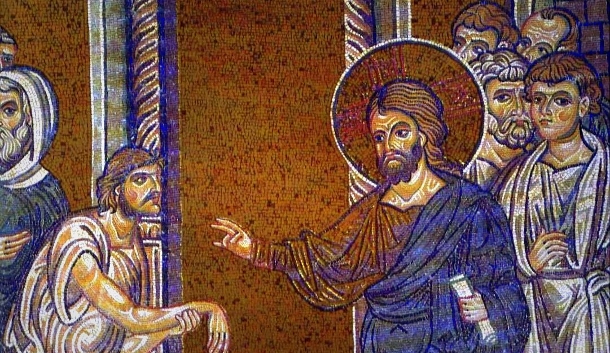
Search

The Hypocritical Christian

Tag

jesus heals

Fearing Trembling and Knowing

Read Mark 5: 21-43

If you have been waiting for nearly 3 years to find out what happened to Jesus after he healed the “crazy” man in chains by banishing his many demons into a herd of pigs, I have 2 things to say:   1) I am really sorry and I promise not to let such a long period of time pass between posts to this blog any more.  2) Seriously?!? Do you even remember what happened? If for some reason you want a refresher you may read it here.

So having been uninvited from the land of the Gerasenes, Jesus and his cohort head back to the other side of the Sea of Galilee.  Here, in contrast to the angry mob that they just left, is an expectant crowd gathered to greet them.  We aren’t entirely sure of what has drawn the crowd.  It could be that word is spreading about what Jesus is capable of in terms of healing, that they have heard about the destruction of the pigs, or they know what Jairus is about to ask of Jesus and they have come for the show.

Jairus is described to us as a leader in the synagogue.  This means he is a prominent person in the community.  Here in Texas, he might be compared to someone who was not only an elder / deacon / alderman in a local congregation but also like a local office holder.  Some thing like being a councilman or a constable.  The point is that Mark wants us to realize that he is significant.  We do not know yet if seeking out Jesus is akin to political suicide (remember Nicodemus met Jesus at night) but the circumstances demand that he find Jesus soon.  His twelve year-old daughter is dying.

So they set off.  Jesus, the disciples, Jairus, and the crowd.  There is jostling and bumping, elbowing and maneuvering.  Probably the group formed into some sort of line working their way through the crowd each member occasionally looking back to the person who should be behind them and ahead to the person they should be following.  You have been in crowds like that before haven’t you?  Maybe to make it to the entry point of a popular ride at Disney World?  I have been in lines like that to get to parking lot after a concert.  No doubt Jairus was moving as fast as possible up ahead looking back frantically to make sure Jesus was still coming and Jesus was probably trying to make sure that the disciples were still in the group.

Mark tells us about only one other person in the crowd that day; a woman who has been actively bleeding for twelve years!  Mark says that she has been to the doctor so many times and nothing has helped.  She has spent all of her resources and, according to the Greek, having benefited nothing but into worse having come she has decided to do the only thing that is left for her.  She has heard about the things Jesus has done and she is going to find him and she believes that if she can even just touch his robe she will be healed.

Let’s stop right there for a minute and consider a few things.  Why would she be convinced of something being magical about Jesus’ robes?  Obviously this is a pre-scientific mindset but there are plenty of people today that adopt some magical thinking even though our world is mostly steeped in scientific thought.  Whatever logic she is using is not important, I really only ask to point out that every one around her that day would be convinced that they could be made ceremoniously unclean simply by touching her robes because she was bleeding. In a world where people can become unclean by touching someone’s clothes then certainly they might be healed by the clothes of a righteous person, right?

This would be the every day for this woman.  In fact so long as she was bleeding she probably had to announce to people that she was unclean as to warn them.  For more than a decade she has had to let people know that being near her is a threat.  What sort of fellowship did she have? what sort of community?  Did she always eat alone?  Did she have to go to the well for water at odd times?  She may have been a person of means and didn’t have those issues, but did her servants look at her with judgment instead of pity.  She wasn’t allowed in the synagogue; couldn’t go to the temple during Passover.  Was she married, did she have children?  Were her family members treated differently because of their connection to her? There hasn’t been anything that can fix it for her and nothing can change the pain that she has already endured.

Have you ever felt that sort of isolating pain before?

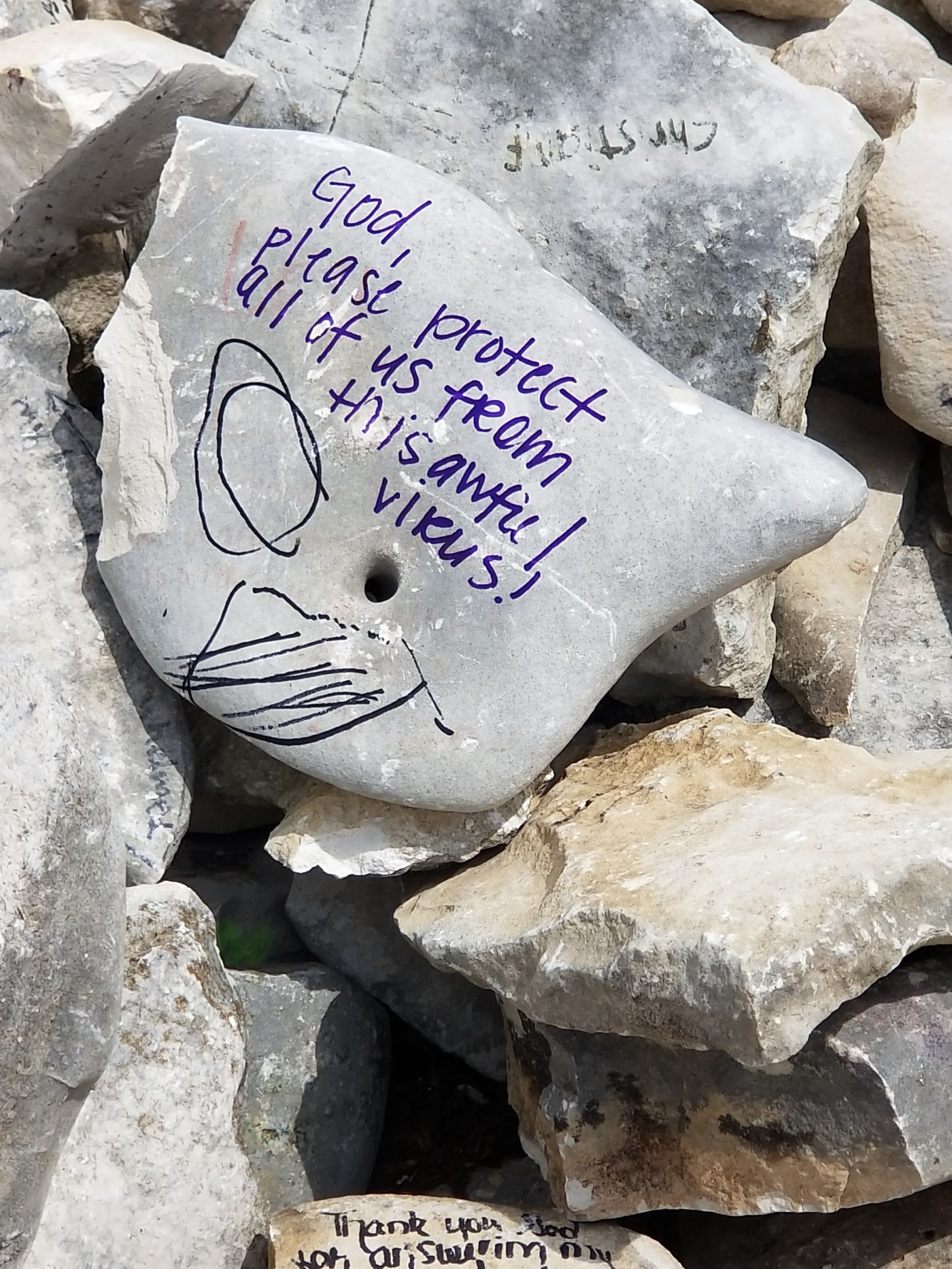
As I write this the world is in the midst of the Corona Virus outbreak.  Most of the United States is in some sort of imposed isolation.  In our efforts to “flatten the curve” of infection, a good thing, we are dealing with tremendous economic hardship and isolation.  For families this has been a time when they can grab some rare togetherness and connection and that has been a blessing.  For the single people it has been the opposite because it is hard to make connection from 6 feet away with a stranger.  I think many people, like myself,  eventually go out for either a walk or to get something from the store. It is surreal to see so few people out and about but also because of the looks that you receive when you encounter someone.  There is this moment where heads turn away or a glance signifies the unspoken question “are you safe?”.  Most of us have used more soap and hand cleansers in the past month than we did in the previous year.

It gives us a little insight into this Biblical woman’s life.  We do not know her name, but we do know her faith.  If she can just touch the robe she knows that something good will happen– that she will be healed.

Somewhere in the crowd she sees Jesus trying to keep up with Jairus making his way through the throng.  She herself presses and elbows and pushes and finally gets close enough that she can just touch his robe.  It happens.  Her flow stops.  She has lived with it so long she knows.  She knows!

Jesus knows too.  Mark relates that he felt power go out from him.  Someone in this crowd has experienced the healing touch of God.  He immediately stops to figure out who.  Salvation has been received Jesus would like to meet the recipient.  I don’t believe that Jesus is angry, I believe that he wants to affirm an act of faith, I believe he wants the relationship that comes from the grace granted.

Jesus asks who it was that touched him.  The disciples do not know.  Jairus doesn’t know and is frustrated by the delay.  No one knows except the woman.  She ventures forth Mark says “fearing, trembling, having known” falls at Jesus feet and tells him everything.

Jesus replies with grace and love, commends her faith, and sends her out with a declaration of peace and the assurance that she is forever healed of that affliction. I submit to you that it is not just her belief that touching Jesus robe would heal her that did heal her, but it was also her response to what Jesus had done for her.

fearing, trembling, having known

Having known what?  That she was healed, certainly.  That she had been healed despite having reached a point in her life where she was convinced that she would never find release from this sickness that gripped her perpetually?  Was she fearful and trembling because she had felt unworthy for so long that she believed the lie that she was fundamentally unclean and in that one moment experienced not only healing but that unbelieveable cleansing that comes from realizing that God does love you despite how unloveable you have felt or how unloveable you have allowed others to make you feel? Was she fearful and trembling because she now knew what Jesus could do and as a result who Jesus must be?  Recall the function of Mark’s gospel is to share with us the beginning of the gospel of Jesus Christ, the Son of God.

Many years after this, the Apostle Paul would write to the Christians in Phillipi one of the most significant passages in all of the Bible.  After  reminding them of who Christ Jesus is he implores them to work out their salvation with fear and trembling.  WOW.

I always wondered what Paul meant and I never realized the parallel language with this story.  So what did the woman do?  She sought out God. She found salvation and healing.  She recognized what God had done and she responded with appropriate awe and respect.  Her knowledge of God expanded by recognizing what he had done for her and she responded with the appropriate fear of the Lord and confession.  She entered into a deeper relationship by telling God everything.

What has God done for you? How has He made you whole? When have you experienced His power and might? What prayers has He answered? What hope has He sustained in you?

Whatever the answer keep telling God everything;  deepen the relationship. The One who has created everything that is is The One who has done this for you.  A little fearing and trembling at the truth of who God is appropriate; a lot of sharing is more so.

The story of chapter 5 isn’t over though.  No sooner does this encounter finish, then someone comes to Jairus and informs them that his daughter has died. There is no longer any need to trouble Jesus to help. Mark tells us that Jesus gives a call to deeper faith.  Do not be afraid but believe.

At this point a lot happens.  Jesus presses on with Jairus and only 3 of the disciples.  When they arrive the professional mourners are already at work playing the appropriate sad music and weeping.  When Jesus suggests that the girl is merely still asleep they laugh at him.  Not just a mild laughter but based on the Greek mocking laughter, derision.  Nothing to this point is helping Jairus with his trusting faith.

Jesus enters the room where the daughter is with just the 3 disciples and her mother and father.  Taking her hand and with a word (literally little girl get up) she opens her eyes and gets up.  Jesus tells her to feed their daughter and asks that no one say anything about what transpired.

This is the God that we worship, follow, serve, seek to know.  Sometimes He works in the pubic throng.  Some times he works in private and seeks no publicity.  But He is bigger than anything in this world, even death.

So get to fearing and trembling and knowing all that has happened to you and tell God everything.




A Healing, Demons, and Fear Abound

Read Mark 5: 1-20


22.4.2010: Sant'Apollinare Nuovo, Ravenna

Way back in my very first post about Mark, themes were laid out and one of those themes was “Jesus has authority.”

The end of Mark Chapter 4 and the beginning of Mark Chapter 5 is about demonstrating the breadth and power of that authority.  If you have read the Gospel of Mark before or even just the first few posts on Mark in this blog then you are aware that Jesus has the authority to cast out demons.   We have seen this already.

A quick word about demons.  Some times modern readers of the Bible are put off by the appearance of the supernatural.  Being scientifically minded they cannot find the wisdom in the account because they are too busy worrying about the validity of the concept of demons. I personally do not know if demons exist.  I do know that the world is full of many strange and wondrous things and I am not willing to say that the supernatural doesn’t exist.  If you want to chalk demons in the Bible up to primitive understandings of mental illness and the like that is your choice.  It is one of those things that cannot be proven beyond all doubt.  The choice you make will change the story some and will limit the range and power of God but it is at the end of the day your choice to make.

Jesus and the disciples arrive in the land of the Gentiles on the other side of the Sea of Galilee some time in the morning.  We are told that they encounter a man who lives in the caves that serve as tombs; a man who is crazed and who cannot be bound or controlled by anyone or even held by chains.  Wow!  We are told that he spends his days and his nights crying out and cutting himself with stones.

I do think it is useful to spend a moment empathizing with the man.  Have you ever felt outcast from the group?  Have you ever seen fear in the eyes of other people when they encounter you? I do not suspect that he chose to live in the tombs but rather had to because that is where the people allowed him to be.  Children were probably warned to stay away from him.  Older brothers probably threatened to turn their younger siblings over to him.  He probably had a host of unflattering nicknames.  Clearly, he has no community.  He has no positive interaction with others.  They fear him and shun him.  He lives in the ancient equivalent of the cemetery.  The community has left him for dead.

We soon learn the reason for this man’s isolation.  He is tormented by something greater than himself that seeks to destroy him completely.  When he sees Jesus in the distance he immediately closes the gap and falls at his feet.  Some translations say worshiped but the context means that he likely just went prostrate before Jesus; it is the same word in Greek for both.  The man speaks “What is it that you want from me, Jesus, Son of the Most High God? I beg you by God leave me alone.”

Again we learn from context that this wasn’t the man speaking but rather the demonic entity that has possessed him.  In the beginning of Mark the only ones who know who Jesus is are the demons, they address him by the title Son of God.  They also seem to know that the purpose of Jesus is counter to their own purposes because their response is always one of fear.  As the letter of James says, the demons believe and they tremble.

There is an irony here that the demon seems to pray to God that Jesus would be gracious unto them.  Jesus will not answer that prayer because they are at cross purposes.  The demonic, in so far as it is real (remember, you get to choose), has a singular purpose to destroy that which God has created.  More specifically to destroy the image of God present in this human being.  This is the purpose of the torment and the cutting and the driving the man out of the community.  God is love.  As such, God is relational.  In effecting the isolation of the host the demon has been working on destroying him physically as well as mentally through self-inflicted wounds.  The presence of Jesus introduces the purpose of the Holy One to effect salvation and redemption, not just for individuals but for all of creation.

And so the battle is enjoined.  Christ demands that the spirit comes out and that the demon reveal his name.  Legion is the name because they are many and they make a request of Jesus that they not be sent out of the country but rather be allowed to infest a neighboring herd of pigs.  Jesus allows it and immediately the demons leave the man, enter the pigs, and drive them all headlong into the ocean drowning them some 2000 in total!

The pig herders report to their bosses what has happened and people from the neighboring town come out to see for themselves.  They find Jesus and with him the man that had been crazy seated beside him.  He is right-minded, calm, and clothed even! For emphasis, Mark says the very same man that had been possessed by Legion just so there is no mistake for us. And a curious thing has happened the people are afraid.  So afraid in fact that they demand that Jesus and his friends leave at once.

Here is another good place to camp out and reflect.  Fear?  Anger would be the more likely response.  2000 pigs killed is a lot of money and the people may not have seen that as a good trade, one crazy man made well at the cost of 2000 pigs.  By modern standards the loss of that many pigs could have been a price tag of half a million dollars or more! Even at the cheapest level you would be looking at a hundred grand for a herd that size.  Is the peace of mind of one person worth the economic output of the community?  Praise the Lord in the eyes of Jesus the answer is yes.  Perhaps the fear is related to the power of Jesus to compel the demon in the first place.  Forget the pigs, let’s be afraid of the exorcist!  It makes sense to a point although you would like for someone to be happy for the formerly demon-possessed man.

I think the fear is reflective of something deeper within us as sinners.

The people were comfortable with the way things were.  Sure there was the demon possessed guy, but he lived away in the tombs where the evil people belong. He was avoidable and that meant no one had to deal with the reality that they were powerless to help him. They didn’t have to admit to themselves that they didn’t care about him.  they didn’t have to wrestle with the truth that they were too much like him and could have easily been him had the demons chosen differently.  He had his place and so long as he was out there they didn’t have to wrestle with what it meant.  He was darkness personified, but a darkness contained, and that is what people want is the darkness contained — categorized and prioritized; this sin unacceptable and outside the community but these other sins normalized and accepted.  People fear the devil but the devil can be avoided or explained away.  Recall that the demons were afraid because they knew they were at cross purpose with God.  The power of God invokes a greater fear and far too many of us want nothing to do with it because it exposes us as those who also are at cross purposes with the Lord.

Jesus knows when he isn’t wanted and leaves.  Before he goes however, the man who had been possessed, who now has been healed and restored to fullness of life, wishes to come along.  In fact the language that is used is the language of discipleship.  He wishes to follow Jesus.  Who can blame him for wanting to get way from the place that is filled with such ugly memories. Why wouldn’t you want to rid yourselves of the community that is more concerned about the loss of pigs than they are about what has happened to you?

Jesus refuses.  Not the offer of discipleship, but rather the change of venue; instead of allowing him to leave Jesus tells him that he is to stay and share with others what the Lord has done for him.  And we are told that he does this.

When you think about all that has befallen this man it can seem cruel that Jesus makes him stay amidst a people who must have mistreated him and labelled him.  I think the lesson to all of us that follow Jesus is that sometimes Jesus bids us stay in the very place that caused us pain, albeit pain that we were rescued from because that is where we will make the most difference.  It is a difficult place to be.  It couldn’t have been easy for this man but I cannot help but think that a few years later in the aftermath of Resurrection and Pentecost that his seed-sowing bore much fruit.

  • Where do you find yourself in this story?
  • Have you ever wanted to run when you felt the urge of Jesus to remain?
  • Are you afraid of the power of God to bring light into your heart? your community? your church? your world?
  • Are you afraid to admit that you are at cross purposes with the Holy One of God?
  • What sins are you too comfortable with and which sins do you ignore because they are over there?
  • Is there someone you have left for dead amidst the tombs?

As always this reflection is freely given. Use this Bible Study for your own groups or discussion.  If you do share it with a group I merely ask that you acknowledge where you got it and if you find it useful that you encourage others to seek it out. It is written with fear, foreboding, and prayer by a fellow hypocrite who is simply trying to figure out the road ahead.

Dig Deeper

Read Mark 3:1-6

a_boulder

I don’t know if this is true of all kids but it certainly was true of me.  Some times I dug up rocks in the ground.  Whether I was looking for “skipping stones” or just goofing around I sometimes went looking for rocks. More than once, I started digging out a rock and soon realized that the rock was actually much bigger than the part that I had seen at ground level.  Now I live in the Texas Hill Country and if you dig at all in this area you soon learn there can be all sorts of rocks beneath the surface and even the seemingly smallest rock can suddenly be huge!

If you never start digging though the rock always just seems small and small rocks are manageable. Scripture can be the same way. You read a passage from the Bible and it seems simple and straightforward and small.  After doing a little more digging you figure out there is a lot more to it and it is heavy!

In the first three verses of Mark 3, we read a straightforward story. Jesus goes into a synagogue on the Sabbath and ‘yawn’ he is going to heal someone.  Simple, straightforward, nothing complicated: a man needs healing, it is the Sabbath, Jesus is going to do it, and its going to upset those pesky Pharisees all over again.  Really, Mark? we think, can’t you move on we have seen all this before already.  Blah, blah, blah Jesus heals on the Sabbath.  Jesus is Lord of the Sabbath.  We get it.  This story is a pebble.

That impulse isn’t limited to everyday readers of the gospel.  It happens to well-educated trained readers of scripture too.  In fact, you can probably already hear the sermons written from this passage in your head:

“Jesus was a radical who upset the political and religious authorities of his day by disregarding the rules in favor of caring for people in their time of need.  What rules do we need to flaunt today to continue the good work of our political revolutionary Jesus?”

“How are we like the Pharisees allowing our traditions to keep us from doing good or making worship a more inviting place for the weak, the weary, and the downtrodden.  Is not our emphases on music and liturgy a modern expression of the legalism of Pharisees?  How must we change to ensure that the grace of Christ is first and foremost?”  

“The Pharisees felt there power slipping away at the hands of this Jesus who did what was right in a moment when everyone else would not.  This is why they sought to kill him.  Fortunately, we would never make that mistake today as we would welcome Jesus and his miracles into our midst.”

O.K.  That last one is less likely to be preached, but you know you have heard the others.  And they come from a superficial reading of this passage.  Some Christians, mostly progressive, never get farther than considering Jesus to be a better Caesar Chavez.  Other Christians, mostly conservative, never get any deeper in these scriptures than judging the Pharisees for there legalism and failure to recognize the Messiah when he showed up.

Dig a little deeper, sweep away some dirt, find the bigger rock buried in the ground.

Jesus follows his habits, he is in worship on the Sabbath. (For modern Christians there is a whole sermon in the first sentence!) Mark tells us that there was a man with a withered hand present and that “they” were watching Jesus to see if he would heal him on the Sabbath. Jesus asks the man to come forward to the middle of the synagogue, the center of attention.  Here is where we get confused, because the man has been brought front and center we assume that the healing is the big deal.  But this man will remain anonymous throughout and Jesus is never going to comment on his faith.  This latter point is how we know Mark is telling us something different from the previous arguments about the Sabbath or healing events.  So much for the meaning of the text to be about the poor and needy.

Similarly Jesus begins addressing his detractors and he does so using the common parlance of the rabbis of his day: “Is it lawful on the Sabbath to do good or to do harm, to save a life or to kill?”  The first clause was a common interpretive argument of Rabbis predating Jesus and after.  It is a rhetorical question the answer to which must be: “Of course it is lawful to do good the Sabbath.”  Many rabbis had debated these things and it was determined that saving a life must take precedence over inaction in the law of God.  If we are to love our neighbors first and foremost then doing good is part and parcel of the Sabbath.  To put a modern spin on it, you naturally would have surgeons and EMTs work on the Sabbath.  It couldn’t be unlawful to aid an accident victim.  It would be appropriate to defend a lamb from a wolf on the Sabbath.

Christ-heals-the-man-with-a-paralyzed-hand-610x353

Back to the text: the Pharisees do not say anything.  Their silence upsets Jesus greatly.  Of course they don’t argue with Jesus because the question is rhetorical.  Naturally the Sabbath allows for life saving and other acts of good.  Of course, Jesus doesn’t stop with the basic question.  He has brought the man forward.  Between his question and the presence of the man he is implying that healing the withered hand is the equivalent of “saving a life” and failure to heal the withered hand is the equivalent of killing.  What?

Let’s be clear, Jesus is nobody’s fool.  He knows as well as anyone that the withered hand could wait a day or even 12 hours.  This is the key to understanding that the story is not simply about the perils of legalism or about the way that people become so rigid interpreting right from wrong that they fail to see the effect of such legalism on others.

Here is where the buried rock is revealed.

If you have been following this blog you know that I feel that scriptures are best understood in the broader context of the chapter / book that they are found in.  The Reformers (Luther, Calvin, Zwingli, etc) promoted the notion that scripture should be used to interpret scripture.  That is a great principle and scripture should be used to interpret other scriptures.  That said, it is also important that a reader of scripture first looks to the rest of the current book before jumping to other books in the Bible.  If you have been reading Mark (or this blog) then you know that Jesus is making a claim about the arrival of the Kingdom of God.  According to Jesus, the hour is now that God is acting.  In the healing of the paralytic there was the tacit claim that Jesus (as the Son of Man) has the authority to forgive sins (something that is YHWH’s purview) and in the conversations about Sabbath-keeping the implication is that Jesus is the Lord of the Sabbath (also the purview of YHWH). Throughout Mark, Jesus is saying look at this; see by what I do that what I say is true.

So many people describe the Gospel of John as Christocentric, but how can you miss the fact that in Mark the center of every story thus far and the focus of every point has been Jesus and who he is.  This gospel is extremely Christocentric.

Back to the paradox that healing the withered hand is not a matter of life and death. Robert Guelich, NT scholar, writes, “‘To do good’ and ‘to save a life’ takes on an eschatological ring of the coming of the day of salvation, the fulfillment of God’s promised activity in history.” God is acting, breaking into the world with the arrival of the Kingdom.  The kingdom is present wherever Jesus is present. I think that Jesus before the man in the synagogue is a moment where Mark wants us to recognize ourselves present in the presence of God. For Jesus to do good  / heal meant to give life and to refrain from good / not heal was to kill, meaning depriving another of the benefits of the redemptive / restorative power of God.  Failing to act would be cheating the man and all the gathered community of the right now benefits of the Kingdom of God even as they would have to wait for the ultimate fulfillment of the Kingdom. But the key is that the presence of Jesus brings life and changes things.

This is what we have seen throughout the Gospel of Mark.  A demon possessed man comes before Jesus and is made whole–saved–and Jesus demonstrates power over the forces of evil.  A paralyzed man is brought before him and made whole and Jesus demonstrates the power to forgive sin. A tax-collector is called into his retinue and redeemed from a sinful life and Jesus demonstrates the need for God’s Anointed to be amidst the sinners. Hyper-religious folk judge the followers of Jesus for not following the law more closely and Jesus proclaims an authority over the law itself.  Every aspect of Mark so far has been an effort to nudge the reader to make a decision about the true nature of Jesus. Is he the embodiment of the rule of God among us or not?

Every encounter from the demon possessed to the disciple; from the physically deformed to the self-righteous has been at its core a question of life and death because this is the moment that they have encountered Jesus. How each responded to that encounter is what has mattered most.

So how have you responded?  Have you acknowledged the truth of who Christ is?

How has your limited idea of Jesus prevented another from encountering Christ? If Jesus is just a great teacher why should anyone care? If he is a social radical then why should anyone make a decision for him rather than just see him as another Ghandi or Malcolm X?

Maybe you have chosen for Jesus and welcomed the encounter for yourself and your salvation.  Have your actions and your efforts encouraged others to know who He is?  Have you expressed forgiveness and grace to those whom you see as sinners? Or are you silent in the face of this life and death moment for others?

Maybe you have called out to God in your hours of need, a cancer diagnosis, a child who is sick, or a loss of  job. Upon restoration have you turned your heart over to the Lord or just thanked God glibly for granting your wishes?

Let’s be clear, Jesus is not just healing a man with a withered hand, rather, he is restoring a life.  Just as Jesus does when he brings the alcoholic to sobriety, the addict to wholeness, or reunites estranged family. Jesus acts and the proper response is deeper faith, deeper trust, and deeper praise of who God is for each of us.

Jesus never touches the man.  He tells him to reach out his hand and the as the man does so his hand is restored.  We are not told how the man responded to this act.  We are told that the Pharisees in seeing this incredible moment of life-giving miracle went from that place conspiring to end a life.

A final thought: if Mark wants us to see ourselves as the man with the withered hand, in the presence of God with nothing to account for but our limitations then Mark also wants us to ask ourselves how often are we like the Pharisees.  How often do we see the restorative work of God (an addict finding sobriety, a tax cheat attending worship, a murderer released from a prison sentence, the list is exhaustive) and question the wisdom and grace of God perhaps even to the point of considering the need to stop this radical love rather than celebrating that someone has experienced the overwhelming healing power of Christ?  There are really only two places to be in those moments.  One of them deepens our own salvation and the other leads to rejection of Jesus.

Feel free to use this Bible study for your own groups or discussion.  It is freely given. If you do I merely ask that you acknowledge where you got it and if you find it useful that you encourage others to seek it out. It is written with fear, foreboding, and prayer by a fellow hypocrite who is simply trying to figure out the road ahead.


Faith that Heals

faith

Take a moment to reread Mark Chapter 2, 1-12.

In the very first post on the Hypocritical Christian, I suggested the following themes for the gospel of Mark:

  • Origin of the Good News of Jesus Christ
  • Christ is the messiah for the purpose of salvation
  • Christ has authority
  • Repentance is about believing whom Christ is
  • The specific work of Christ is dealing with the sin problem.

Now in the first 12 verse of Mark 2, we see all of this playing out.  In fact at least one commentator has suggested that the entire Gospel of Mark is found in these 12 verses.  Of course that is a little bit of hyperbole, but the point is that in this one story the broadest themes and the major point that Mark is communicating is present in action.

You may recall that the paralytic has been lowered into the presence of Jesus and even though the friends clearly want a healing miracle for their pal what Jesus actually says is pretty astonishing.  “Son, your sins are forgiven.”

So astonishing in fact that there were present some professional religious folk (scribes) who were thinking to themselves, “Wait, what?!?  You can’t do that!”   They knew their Old Testament scriptures quite well and that told them that only YHWH can forgive sins. If you are not familiar with YHWH it is the four consonants of the sacred name of God.  The name given to Moses from the burning bush.  If you have ever heard the phrase “the God of Abraham, Jacob, and Issac” then you know what we mean when we say YHWH.  So the scribes know that only God can forgive sins.  Exodus 34:6-7; Isaiah 43:25 and 44:22 are just a few of the places that make this clear.

Mark tells us that the scribes believe Jesus to be blaspheming.  Blasphemy is a technical term and in Jesus day a religious crime.  Anything that discredited THE NAME (YHWH) was punishable by death through stoning. In the scribes’ minds claiming the ability to do something that only the ONE GOD can do was a serious act of discrediting God. It is hard to think of something that we have in our culture that is the equivalent of this.  Maybe using the parking space of the CEO or drinking from the Admiral’s private liquor cabinet, but these infractions are minor compared to the way they viewed blasphemy.  The closest thing I can think of is identity theft, but identity theft of someone enormously powerful like the President or the Queen of England or OPRAH!

Here is where it gets interesting. Jesus knows what they are thinking and calls them out on it. He issues a challenge for himself to them.  He starts by asking them a question: “Which is easier to say ‘Your sins are forgiven’; or to say ‘Get up.  Take your pallet and walk’?”

Note what is going on here in the question.  Sins are an intangible thing while paralysis is not. If I say to a person who can not walk get up and they do then I have clearly healed them of their paralysis.  If I say to a person that your sins are forgiven there is no way that anyone can prove it just by looking.  On the one hand, it is easier to say the first because no one can disprove you with empirical evidence unlike saying stand up because in the second case the person either gets up or they do not; on the other hand, the latter is the easier of the two because it is not something that only God can claim authority over.  Everyone had seen a faith healer work this sort of miracle before. Even if we only thought in terms of modern science the latter would still be easier because it is both prove-able and there are medical procedures for healing some forms of paralysis. Try and get a prescription for your sins filled at Walgreens!

But Jesus is not stopping with the rhetorical question, he is actually cleverly setting up the scribes because he follows the question up with the following statement: “but in order that you may know that the Son of Man has authority on earth to forgive sins — he said to the paralyzed one ‘I say to you, Rise, take up your pallet and go home.'”

See both the challenge and the set up?  If the paralytic stands up then the Son of Man has the authority (power) to forgive sins on earth. If the paralytic stands up the scribes will have to admit that the sins were forgiven and that no blasphemy took place.

(Note: “Son of Man” is a term that Mark uses about 2 dozen times in his gospel. Another time we can discuss what this title means, but please make note from the bold type above there can be zero question that Jesus means for it to refer to himself.)

Mark makes it crystal clear what happens next.  The paralytic, to the absolute astonishment of the crowd, stands up, picks up his pallet and left this time out the door and not the hole in the roof. Jesus proved his point spectacularly and everyone gave praise to God.

So what does this mean that Jesus claims an authority that the Old Testament scriptures clearly indicate is the sole purview of YHWH? What is the implication? It is pretty inescapable, if Jesus makes the man walk in the way he structured the challenge then he also forgave the paralytic’s sins.  Don’t get caught up in the tortured discussions about how they viewed sin and illness as interconnected in those days and this is Jesus giving them some good old post-enlightenment sensibility about these matters of illness and the separation of the physical from the spiritual.  That is smoke and mirrors and clearly not the intent that Mark has here.  Mark wants to demonstrate here the key points that his Gospel is seeking to share: Jesus is the Christ (Messiah) and uniquely appointed by God to be God’s agent, the presence of the Kingdom on Earth. Jesus has authority.  Jesus is going to correct the sin problem.

Mark is sharing this story to persuade everyone who reads / hears it of the truth of who Christ is.  Remember the demon in the first chapter: “you are the Holy One of God.” Mark is asking all of us to ponder what it means that this Jesus can do something that only God can do.

Consider this.  When the the four bring the paralyzed one to Jesus we are told that when Jesus saw their faith he spoke to the paralytic.  I said in a previous post that what they did in action was demonstrate their faith that Jesus could do what they desired.  In New Testament Greek faith is the word pistis (this is the transliteration of the Greek letters) and it means assurance, conviction, etc. all those synonyms in English that you would expect.  What is interesting is that it is derived from the Greek word peitho which is strictly speaking “to win over; persuade.” With this information we can come to understand that faith is a demonstration of having been persuaded.  It is a confiding belief in the truth, veracity, reality of any person or thing.  In the case of the four, their actions demonstrated a belief in the truth of whom Jesus was and the authority that he possessed.

I think that Mark is trying to persuade us. In the last post I wrote: “faith that heals is faith that trusts.” A careful reader will note that the only difference in the title of the last post and this post is punctuation. Faith that heals is faith that trusts; faith that heals comes from having been persuaded about who Christ is.

I encourage you to spend a little time this week asking yourself what it truly meant that the paralytic got up and walked.  Is it not more than a miracle? Is it not more than the forgiveness of sins?

Mark seems to think so.

Feel free to use this Bible study for your own groups or discussion.  It is freely given. If you do I merely ask that you acknowledge where you got it and if you find it useful that you encourage others to seek it out. It is freely given and written with fear, foreboding, and prayer by a fellow hypocrite who is simply trying to figure out the road ahead.

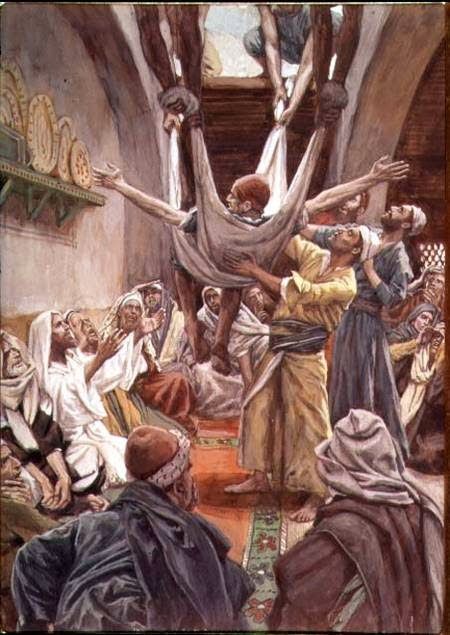
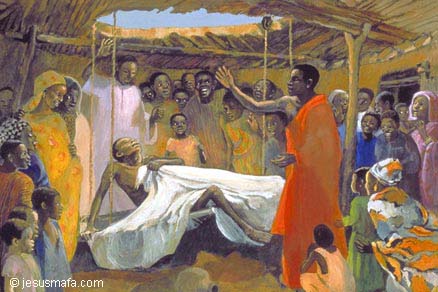
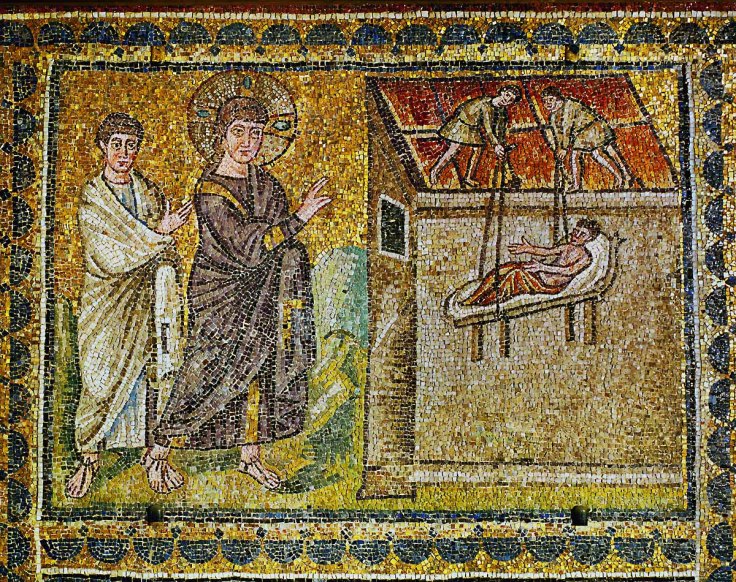
Images of Healing the Paralytic

Below are three separate images depicting the healing of a paralytic man as told in Mark Chapter 2. The images come from different times.  This first one looks like one that I might have seen in school when I was a kid.  I went to Catholic school and they didn’t have child friendly pictures back then. While at first glance the image looks middle eastern, closer examination shows that all the folks in the image have European features regardless of how swarthy their skin is.

paralytic

This second image is from the Jesusmafa images.  My understanding is that these images came out of a partnership between indigenous Mafa Christians and French missionaries in Cameroon. It is a great example of how the stories of the gospel can be inculturated, or put into a localized context, where ever they told.

jesusmafa_healing_paralyzed_man

Finally there is this apparently even older image of the story. I am not sure where it came from but it is in a mosaic style that was fairly prominent in the first 500 years of Christianity.

The paralytic lowered from the roof, Jesus and an apostle. Mosaic (6th)

Website Powered by WordPress.com.

Up ↑