Search

The Hypocritical Christian

Tag

mark 4

The Fear of the Disciples

the-freak-liquid-mountains-of-lake-erie_880

Read Mark 4:35-41

Jesus has just finished a long day of teaching near the shores of the Sea of Galilee. The time has come for them to head to the opposite side of the lake and begin healing and teaching in the communities there.  We are told a couple of pertinent details about the journey.  A significant storm began as they were making there way across the 7 mile span and Jesus was taking a well deserved nap.

I grew up around lakes in Texas and I can tell you that storms on a lake are no small thing.  Apparently, this is particularly true of the Sea of Galilee because of the unique topography around it.  All of Isarel, west to east, is a series of radical changes in elevations in a comparatively short distance.  As a result the Sea of Galilee is in a basin of sorts that channels the wind across the water when a storm rages through the region.  A similar dynamic can be experienced when the wind is channeled through office buildings in a modern city or even apartment complexes in a smaller town.  The point is that the storms on the Sea of Galilee can be nasty and we need to remember that these guys are not in some modern style watercraft, but a homemade boat designed for fishing and not much else.

Have you ever napped on a boat?  It’s glorious! The boat rocks back and forth and if you are sleeping directly on centerline it is the closest thing to being in a cradle that you can experience.  When you consider the crazy compacted schedule that Jesus has been keeping and the incredible amounts of physical and mental energy he has exerted it is no wonder that he is “dead to the world” in the back of the boat.

We are told that when the disciples, all of whom are experienced fishermen, decide to wake Jesus. They are worried about dying because the boat was already taking on water.  I think it is important to pause here and really put yourself in the moment.  The storm is wicked, perhaps there was rain and perhaps there was just wind and waves.  Even without rain the waves alone could be devastating and frightening.  The image above is described as one of the “mountains of water” that form on Lake Erie during a storm.  A fishing boat in those days would have had a very low side to make it easier to haul a net of fish onto the boat.  It wouldn’t take much for a series of significant waves to begin filling the hull up.  Water is coming into the vessel, each wave striking the boat would have begun to feel like invisible fists pounding the side threatening to capsize her or worse break her apart. If the worst happens it is several miles to shore in storm driven waters.  Every one of these men grew up around these waters and every one of them likely has known someone who has drowned there. No wonder they were afraid!

That last point about the deadliness of the sea is pretty crucial for really understanding this story.  In the ancient Jewish tradition, the sea represents evil and chaos.  The sea is unpredictable and kills.  You see this in the very first verses of the scriptures.  God’s spirit hovers over the waters of the void and begins to bring order out of chaos.  The sea is given its limits but is always there as a symbol of the forces that are opposed to God.  You see it in the final pages of scripture when the beast rises up from the sea in Revelation and when the new creation is finalized, we are told that the sea is no more.  So, while the story is about the day that the disciples nearly died on a boat trip across the Sea of Galilee it metaphorically means so much more.

The disciples rouse Jesus from his deep sleep and level an accusation against him, “Do you not care that we are perishing!

Jesus stood and rebuked the wind and commanded the sea, ” Be silent” and the lake became calm.

calm lake

Take a moment and meditate on the two images.

How would you feel?

Try to imagine the feelings of fear and dread of the waves and the storm replaced with the feelings of relief and dread at what just happened.  The fellow next to you in the boat just told the weather to stop and it did.  Not impressed? Try it yourself sometime.  You won’t get very far.   As I write this it is 80 degrees Fahrenheit before 10 AM in Texas.  You don’t think I want to make it cooler with the sheer power of my will?  How many brides would kill to be able to control the weather before their outdoor wedding?  Each of us is powerless against the forces of heat, cold, wind and rain.  Each of us except Jesus.  That is by the way I think Mark’s point in his retelling.  Recall that Mark is a gospel bent on guiding every reader / hearer into making a decision about who Jesus is and in this moment he wants you to realize that Jesus commands the forces of nature and they obey.

In verse 41, the disciples ask “who is this that even the wind and the sea obey him?”  They would have had the benefit of growing up hearing the dozens of references in the psalms, proverbs, Job and prophets that YHWH does this very thing.  They would have grown up being told to remember how YHWH had delivered their people from Egypt by commanding the sea to part and allowing them to cross over on dry land.  This is what they were dealing with and why we are told a great fear (literally a mega phobia) gripped them in the wake of Jesus action.

“Who is this guy?”

That is the question with which we must wrestle.

Now some of you will respond to this with a ho-hum.  Maybe you are a life-long Christian and you settled on the answer “who is this guy?” a long time ago.  You may ask, what about the storms of my life?  My boat is floundering.  Where is the word for me, the reassurance that Jesus will calm my storms?  I have come to this post wanting to know that Jesus can stop the storms in my life.  I have job trouble.  I have debts.  I have addictions.  I have marital strife.  I have cancer.  What about me?  Doesn’t Jesus care that I am perishing?

The very same accusation that the disciples leveled against Jesus is on our own lips many times.

And Jesus said to them, “Why are you so cowardly; do you still have no faith?”

It is not two questions as most translations put it but a single question.  The nature of Jesus question, condemnation really, is to link the fear with the faith.  In other words, if you had faith, you would not fear but rather trust.  I know this because the Greek word used is particular.  It is not, phobos, from which we get the word phobia.  Phobos is the word used in verse 41 to describe the awe-struck fear that has overcome them.  Phobos is the word used throughout the New Testament (Phillipians 2 for example) to render the “fear of the Lord” that is the beginning of wisdom as the Old Testament (proverbs 1) so succinctly summarized the journey of faith in YHWH.  Here though, in verse 40, the word is deilos, a word that used in ancient Greek to describe the cowardice of soldiers who desert in battle and the inaction of the farmer who is paralyzed by fear of the future.  Deilos is always used negatively and connotes a paralyzing fear.  This seems backwards for English speakers because the word phobia was picked up in psychology to describe the rational and irrational fears that affect us.

We are also used to thinking of faith as a matter of the mind alone.  To many of us, having faith is having the correct belief.  In linking faith and cowardice Jesus is linking faith with action.  The person who has faith is the person who trusts.  The person who does not have faith is the person who is paralyzed by fear.  It is not simply understanding (mind) who Jesus is but knowing (heart and mind) who he is and allowing that deeper knowledge to guide our actions and our responses.  Jesus is surprised that after watching him cast out demons and healing people that the disciples are still so timid when the storm comes.

Think back on your life and recall the times that God has provided for you what you needed: the doors that have opened, the healings that have occurred, the resources that were given. The life of faith is not simply understanding who God is but allowing that understanding to put you in a place of trust where you can live in a relationship towards God that is a life marked by the expectation that God will provide.

The accusation was “Do you not care that we are perishing?”  The answer is if you trust me then you know that I care and that you matter.

I do not think that the life of faith means that there is never a reason to fear.  There are scary things out there: violence, war, famine, disease, divorce, unemployment, snakes… it is a long list.  There is nothing wrong with the instinct to fear but faith calls us to get past the fear to trust that the Lord will carry us through all things, even death, when that day comes.

So how do we live it?

Be assured.  Fear not.  The Lord knows your circumstance and your need before you ever vocalize it.  Use the Lord’s prayer as your guide and pray that pattern daily: Praise God, ask for your needs, seek forgiveness and grant forgiveness, ask for deliverance from the evil that is out there, expect and look for the will of God to be done more than your own solutions, and finish reminding yourself that all glory and honor will forever belong to God.  Doing so will train your heart and mind to trust in God’s provision and in God’s timing. When in doubt recall what God has done and know that God will do what is necessary.

Amen.

Questions:

  • What makes you afraid?
  • Are there areas of your life where you are not acting because of fear?
  • When was the last time you prayed the Lord’s prayer?
  • What is one thing you could do today to trust God more?

Are you enjoying the Hypocritical Christian? If you are then share the website with someone else and encourage them to try it out. If you receive it through email and choose to share it with some else let them know where they can find new posts for themselves. Also note that you are welcome to ask questions or even “argue” back through the comments.  Dialogue is always encouraged.  I ask that you suggest the website to others because knowing that people are going to the website encourages me to keep posting.

As always, the above reflection is given freely. If you choose to share it in a group bible study of your own or as a devotional before a small group meeting, etc. please let folks know where you got it.  It is written with fear, foreboding, and prayer by a fellow hypocrite who is just trying to figure out the road ahead.

Be Patient for the Kingdom Comes

Read Mark 4:26-34

Christians are always concerned about the Kingdom of God and how long it seems to be taking to arrive. Do you suppose it has always been this way?  Could it be that Christians in the West have become so conditioned for instant gratification that they more impatient for the Kingdom of God than their predecessors?  The anecdotal evidence is that every generation of Christian from the beginning have been anxious for the ultimate fulfillment of the Kingdom just read Acts 1:6-7.

In North America, denominations are very focused on the Kingdom of God albeit in very separate ways.  The more conservative a Church / Christian the more focused they seem to be on teasing out the signs of the imminent return of Christ. Like “Preppers” storing up for the downfall of civilization, their bug-out-bag is their zippered, handle-covered Bible and instead of a sign indicating they reserve the right to shoot trespassers they warn the trespassers they will be “left behind” that their cars will be driver-less in the event of the rapture through a thoughtfully placed bumper sticker.  Their counterparts in the more liberal arms of the Church have seemed to have forgotten that Jesus promised to return at all, focused instead on doing all this hard kingdom work themselves through political rallies for the justice issue du jour. In case your curious they often decorate their car with bumper stickers encouraging coexisting religious faiths / sects as though the true arrival of the Kingdom of God will look like a joint summit meeting.

These two short parables in Mark suggest where the Kingdom of God is concerned patience is required.

Jesus told them that the Kingdom of God was like a man who cast seed on the ground.  At first, we may naturally think of the parable of the sower we recently looked at but here the emphasis is not on the action of the sower but rather on the seed itself.  Jesus says the Kingdom of God is like the person who casts seed on the ground and while they sleep the seed sprouts and grows “– HOW; he himself does not know“.

Maybe this parable has lost some of its strength in a world where so many people have looked at pictures of a bean sprout plant growing in schoolbooks.  There are even a select few people who really do understand how it all works.  But it seems the point Jesus is trying to make in his pre-scientific method world is that it just happens over time, and it seems almost magical.

Coupled with the Parable of the Sower, we have been given some simple instructions. We are to scatter the Word of God and then let the Word do its thing.   Apparently even while we are sleeping the Word of God is at working sprouting and developing into a great big crop ready for harvest.  When the harvest comes there is more work to be done.

This parable although short works on two levels.  On the one hand it is a reminder to Christians that their efforts do not end with the sharing of the gospel but that they also need to be ready when the harvest is evident.  So, if you have been demonstrating the truth of Christ through words and actions you need to be ready when the one with whom you share is ready for the next step be it accepting Christ, attending worship, or being baptized.  The parable also works on the cosmic level.  Jesus will return when the harvest is ripe some day in the future.  Patience fellow Christ-followers, the Ancient of Days, like a seasoned farmer, will know the right time.

The second parable is another call to patience.  Jesus says that the Kingdom of God is like a Mustard Seed though it is small it grows into a tremendous plant.  There are some critics out there that mock Jesus because as they point out the mustard seed is neither the smallest seed nor is the mature plant the largest on Earth.  C. S. Lewis once commented that it was incumbent upon us to read the scriptures like adults. I suspect this is the sort of ill-conceived criticism he was referencing.

Allow me to update the parable imagery so that anyone can understand Jesus’ point.

Sequoia-Seed-on-Fingertip

Then Jesus said, “How can we picture the Kingdom of God or to what can we compare it to? The Kingdom of God is like this seed on my finger that breaks off from the seed pod on the ground and although it is so tiny and insignificant grows to become an awesome and amazing tree like this: 

sequoia

a tree so large that it can’t be captured on film in its entirety, and it would take more than a classroom of children to encircle its trunk. 

The point of the parable isn’t about the literalness of the seed or the plant, but the fact that the Kingdom is growing all the time, slowly, unseen into something massive and beautiful and only God knows when the harvest will be complete.

The mustard seed, or Sequoia seed, is Jesus.  A poor builder, a crucified criminal, in the furthest reaches of the Roman Empire two millennia ago couldn’t be more small and insignificant; yet, the 2.2 billion Christians alive today all trace their lineage back to this one man and his Resurrection around 34 C.E. (AD).  Not only that, but the estimated 13 billion confessing Christians of the past 2000 years — a Giant Sequoia indeed!

And the Kingdom of God is still growing at its own divinely ordained pace until that promised day when every knee will bow and every tongue confesses that Jesus Christ is the LORD to the glory of God.

What to do between now and then?  Well, one don’t smugly look for signs of THE RETURN and forget to do the work of sowing the gospel.  To do so is to risk a self-righteousness that awaits the judgment of the neighbor without practicing the love of neighbor God requires.  Two, don’t go about trying to rework the whole world into the Kingdom of God as you think it should look because the outcome is guaranteed to be a vision of justice viewed through sinful eyes.  Third, focus on living out Romans 12:9- 13:11  as best you can individually and collectively seeking guidance always first and foremost through scripture, prayer, and confession.

And be patient for the Kingdom is both growing and coming.

Questions:

  • Do you pray regularly for the return of Christ? If so, why? If not, why?
  • When you pray for THE RETURN are you secretly hoping that it come so others will face their comeuppance? 
  • What is the kingdom working balance in your life between prayer and study and good works? 
  • Do you read the Bible regularly? Pray daily? Are you looking for the chance to spread the gospel? 
  • How are you harvesting the growth that is ready until THE RETURN?
  • What are you or your faith community doing to serve God by serving others?

As always the above reflection is given freely. If you choose to share it in a group bible study of your own or as a devotional before a small group meeting, etc. please let folks know where you got it.  It is written with fear, foreboding, and prayer by a fellow hypocrite who is just trying to figure out the road ahead.
Are you enjoying the Hypocritical Christian? If you are please share the website with someone else and encourage them to try it out. If you receive it through email and choose to share it with some else let them know where they can find new posts for themselves. Also note that you are welcome to ask questions or even “argue” back through the comments.  Dialogue is always encouraged.  I ask that you suggest the website to others because knowing that people are going to the website encourages me to keep posting.

The Parable of the Sower

Read Mark 4:1-20

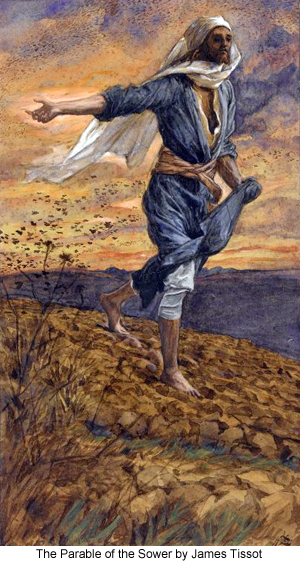
James_Tissot_The_Parable_of_the_Sower_300

“Behold a Sower went out to sow…”  thus begins one of the more famous parables of Jesus and the only one that is given a full explanation by the man himself.  Ironically, this parable is often interpreted by theologians and preachers independently of the explanation Jesus gives when the most complete explanation that we can give someone is read verses 13-20 if you have any questions.

Instead we are given sermons where people are asked “what kind of soil are you?”  We get messages about not worrying about those who are yet to believe because they are just not as fertile a soil as you the faithful listener here this Sunday morning. I almost fell back into that trap myself by very nearly writing a blog post where I intended to ask myself and you how our actions and decisions were impacting the soil of other people’s hearts.

Why are we so quick to try and add to or change the meaning Jesus gives this parable? The cynic in me says that some people want to avoid the fact that Jesus flat out mentions Satan in the explanation.  While I do think that the notion of Satan is disturbing to a great many “modern-minded” Christians, I suspect that the real reason efforts are made to come up with clever extensions of the parable or outright changes in the meaning is because we want the parable to be about us.

The parable is not about us.

The sower sows the word.  The word is the gospel and the gospel is thus: in the person of Jesus, God has initiated the Kingdom of God.  If you are still struggling with that being the fundamental truth of the gospel please reread the first three chapters of Mark, or review this blog post.

In this point in Mark, Jesus is sharing this parable to explain to those who believe in him (presumably the disciples) why some folks, like the pharisees, are so unbelieving that they wish to have him eliminated and other folks, like his immediate family, think that he is bonkers.  “Bonkers” is a technical term in this instance that theologians use so we don’t have to conjure up a confusing word like egotheistical.

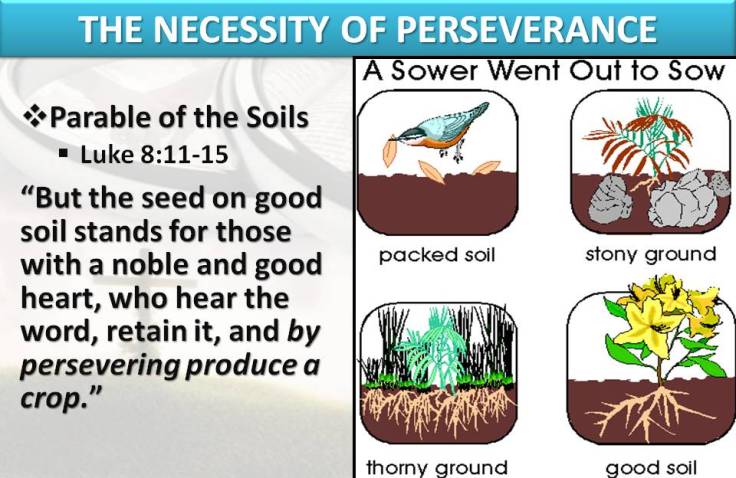
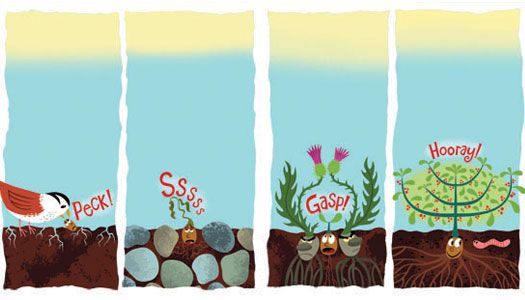
There are a lot of reasons why people fail to believe in Jesus. Some are hard soil and there is no way for the truth to take root before the birds and such eat it. Some are rocky and there is an initial taking hold but the plant doesn’t survive the heat and the wind, like the flowers that I put on my west facing apartment balcony. Others get choked out by the weeds. Finally there are those who are the good soil and the gospel takes root in the heart and grows strong and true and yields fruit.

That’s the meaning plain and simple.

sower images

I am not going to try and change that interpretation, but I am going to try and draw a couple of interpretative lessons out of that explanation.  Personally, I come from a family of farmers although I admit I know more or less nothing about farming.  I only know a little about gardening.  When I was a kid I wanted to help my mother plant a garden so she showed me how. We bought some seeds and we created a pretty good sized garden in the land next to our house. It had several rows that we had created with a tiller that mom borrowed for the purpose.  By the time we were done it was that classic Norman Rockwell style garden with little posts on the end to mark the rows and the seed packet stapled to them so we could remember whether that row was radishes or corn.  What I learned over that weekend was that gardening is hard work.

The first lesson that I would point out to from this sower story is this: the Word is not an annual. This gospel is not a one time yield sort of crop here today and gone tomorrow.  You will note that most of the times that Jesus gets all horticultural on us it is about vineyards or trees.  The Gospel when it takes root is going to be a perennial plant.  This is important because whenever we try to make the parable about us (focusing on the soil rather than the sower /seed) we can become fixated on whether or not we are good soil.  If we are good soil, then the yield can become a way for us to qualify ourselves among the other good soil out there i.e. am I yielding 30 times or 60 times? We can either compare ourselves this way to make ourselves feel like we are better Christians or we can get down on ourselves because we aren’t bearing as much fruit as someone else.

Stop it.

Sometimes the vineyard has a bumper crop.  Some years are lean.  Some years a fruit tree will produce more fruit than you know what to do with and some years there aren’t any fruits at all.  When I lived in Corpus there was a grapefruit tree in the backyard that produced far more grapefruit than I could have ever consumed.  Truth be told, even one grapefruit is generally more than I want to consume. Right across the fence in the neighbors yard, not even 10 feet away there was a grapefruit tree that was a perennial disappointment.  So much so that the neighbor always made sure I knew that he didn’t want me to prune the limbs that stretched over the fence from the superstar tree because he wanted to harvest those grapefruits.

It is like that with Christians.  We have seasons when we produce much fruit in our own lives or in the lives of others and there are seasons when the pickings are slim.  Both are OK.  Both bring glory to the Father because throughout it all we are good soil.   Jesus says, “they are the ones that hear the word and accept it” meaning that the good soil are those who have begun to orient themselves around the truth of Jesus Christ.  What does that mean?  Read Romans 12.  Most people think that the gospel is doing all those things, but those things flow out of understanding the truth about Jesus (Romans 1-11) not the other way around.

In short, if you want to be bear more fruit, then double down on your understanding of who Christ is and the fruit will follow.

Why is that? Because the word is being sown haphazardly all the time.  I mentioned earlier that when it came time to plant the garden my mother and I prepped the plot of land.  We tilled and readied the soil for the seed.  Not this sower named Jesus, this guy is chunking that seed all over the place. I once thought that this was really silly and not the most effective way to plant anything but I recently learned that this was common practice in his day.  A sower would sow the seed and then go back and till the ground turning over the dirt, rocks, weeds, etc whatever with the seed.  They did this for two reasons.  One, they didn’t always have the best soil to work with in the first place.  Let’s face it, Israel ain’t Kansas.  Two, there wasn’t a place down the road to buy potting soil and fertilizer and Weed-B-Gone.  You turned over the dirt and everything in it good and bad to have whatever nutrients you could get in the soil for the plant and you hoped that the Lord would bless you with rain and the right combination of stuff to find out where the good soil was and grow you some produce.

And therein lies the second take away from the parable for the believer: you WILL BE tilled.

Far too many Christians think that the after accepting Christ into their hearts life is going to be a long period of perfect.  When the tough stuff happens they ask themselves “Why is the Lord doing this to me?”  They ask themselves why God is punishing them.

“We rejoice in our suffering because we know that suffering produces perseverance and perseverance produces character and character produces hope and hope does not disappoint because God has poured out His love for us through the Holy Spirit.” (Romans 5:4)   


parable-of-soils

Ignore every preacher you hear (most of them are on TV) that try to sell you this Pollyana notion that the life of the Christian is smooth sailing.  Do your best to ignore your well-meaning Christian friends who try to tell you the same.  As my good buddy Sam used to say “It is hard to be a Christian”.  But when the stuff happens keep in mind that you are being tilled, the Sower is working His soil to make you produce fruit.

I will speak for myself.  Too often I have asked myself what does God want me to learn from this experience.  Too often I have listened to other people ask me that same question to which I have had very little in the way of answer.  What if our question became “God, how do I bear fruit in this moment?”   Don’t hear what I am not saying.  I am not suggesting that there is never a lesson or a pruning of the vine where we need to get ourselves aligned with God more closely.  What I am saying is that always asking the the first questions is putting the focus on us and our experience, pain, and hurt rather than putting the focus on God and asking how we can grow and bloom.

Questions:

  1. Have you found yourself focused more on the soils (you) in the story than on the seed (word)?
  2. Have you ever judged yourself for the amount of fruit your life is yielding for the Lord?
  3. Have you asked yourself recently “Why me Lord?”
  4. How would your walk of faith be different if you asked God to help you bear fruit in times of trial and suffering?
  5. What can you do to focus more on the word during this season of your life?

Are you enjoying the Hypocritical Christian? If you are please share the website with someone else and encourage them to try it out. If you receive it through email and choose to share it with some else let them know where they can find new posts for themselves. Also note that you are welcome to ask questions or even “argue” back through the comments.  Dialogue is always encouraged.  I ask that you suggest the website to others because knowing that people are going to the website encourages me to keep posting.

As always this is given freely and if you choose to use it in a bible study of your own or as a devotional before a small group meeting, etc. please let folks know where you got it.  It is written with fear, foreboding, and prayer by a fellow hypocrite who is just trying to figure out the road ahead.
 

Website Powered by WordPress.com.

Up ↑